Showing posts sorted by relevance for query Holy Thursday fast. Sort by date Show all posts
Thursday, March 30, 2023
The History of the Holy Saturday Fast

Eugene Burnand. Holy Saturday. 1907-1908. Musee des Beaux Arts, La Chaux de Finds, France.

The observance of Lent stretches back as far as Apostolic times. Lent was for centuries observed as forty days of fasting in the Roman Church with Sundays excluded from fasting but not from abstinence. That is, Ash Wednesday (since its institution) through Holy Saturday were days of fasting. I have separately cataloged the history of Lenten fasting in "History of Lenten Fasting: How to Observe the Traditional Lenten Fast."

The Lenten fast began under the Apostles themselves and was practiced in various forms in the Early Church. As time went on, the fast became uniformly observed under the pain of sin. As with all Lenten practices, changes occurred over time regarding the fast, abstinence, and hearing of Holy Mass on Holy Saturday. 

Holy Saturday Fasting Was Practiced in Apostolic Times

In the Early Church, Holy Saturday was part of the apostolic practice of abstaining from all food completely from Holy Thursday evening (or Good Friday morning) until sunset on Holy Saturday (or later). This was known as the "Passion Fast," and in practice, the aim was to fast 40 hours in honor of the 40 hours our Blessed Lord’s body lay in the tomb. Holy Saturday's fast was also practiced like the rest of Holy Week as xerophagiae: “The strictest Christian fast which is observed chiefly in the Eastern churches during Lent or especially Holy Week and in which only bread, salt, water, and vegetables may be eaten” (Webster’s Dictionary). In practice, bread, herbs, raw nuts, or raw vegetables and fruit without oil or dressing may be consumed for those who seek to keep this strict and who are unable to fast from all food whatsoever for two whole days in a row.

Heortology: A History of the Christian Festivals from their Origin to the Present Day by Dr. K.A. Heinrich Kellner states the following regarding the Lenten fast in the ancient Church:

"Among Catholics also abstinence was pushed to great lengths. The canons of Hippolytus prescribe for Holy Week only bread and salt. The Apostolic Constitutions will only permit bread, vegetables, salt and water, in Lent, flesh and wine being forbidden; and, on the last two days of Holy Week, nothing whatsoever is to be eaten. The ascetics, whose acquaintance the Gallic pilgrim made in Jerusalem, never touched bread in Lent, but lived on flour and water. Only a few could keep so strict a fast, and generally speaking people were satisfied with abstaining from flesh and wine. But this lasted throughout the entire Lent, and Chrysostom tells us that in Antioch no flesh was eaten during the whole of Lent. Abstinence from milk and eggs (the so-called lacticinia) was also the general rule."

Regarding Holy Saturday's fast, in particular, Canon 89 of the Council in Trullo in 692 AD provides an account of the piety and devotion of the faithful of that time: 

“The faithful, spending the days of the Salutatory Passion in fasting, praying and compunction of heart, ought to fast until the midnight of the Great Sabbath: since the divine Evangelists, Matthew and Luke, have shewn us how late at night it was [that the resurrection took place].” 

That tradition of fasting on Holy Saturday until midnight would last for centuries. Dom Gueranger writes in the Liturgical Year:

Such, we repeat, was the discipline of the Latin Church for nearly a thousand years: but about the 11th century, an important change began to be introduced with regard to the celebration of Mass on Holy Saturday. The Mass which, hitherto, had been celebrated during the Night preceding Easter Sunday, then began to be anticipated on the Saturday; but it was always considered as the Mass of the hour of our Lord’s Resurrection, and not as the Mass of Holy Saturday. The relaxations that had been introduced with regard to Fasting were the occasion of this change in the Liturgy.

Holy Saturday Was A Holy Day of Obligation in the Middle Ages

Holy Saturday also used to be a Holy Day of Obligation. The first catalog of Holy Days comes from the Decretals of Gregory IX in 1234, which listed 45 Holy Days. In 1642, His Holiness Pope Urban VIII issued the papal bull "Universa Per Orbem" which altered the required Holy Days of Obligation for the Universal Church to consist of 35 such days as well as the principal patrons of one's locality. 

Some of the Holy Days of Obligation removed between 1234 and 1642 included Holy Monday through Holy Saturday in addition to Easter Wednesday through Easter Saturday. Hence by 1642, Holy Saturday was no longer a Holy Day of Obligation.

Holy Saturday Fasting Remained Practiced for Centuries

In my series outlining the changes to fasting and abstinence in the colonies—and through the modern-day United States—I pointed out that Holy Saturday often remained a day of obligatory fasting even when mitigations were issued due to the change in the time of the Vigil that happened back in the 11th century.

For instance, the papal bull "Altitudo Divini Concilii" of Pope Paul III in 1537 reduced the days of penance and those of hearing Mass for the Indians out of pastoral concern due to the physically demanding lifestyle that they lived and also largely due to the fact that they fasted so much already. As a result, the natives were required to only hear Mass on a much smaller number of days: Sundays, Christmas, Circumcision, Epiphany, Candlemas, Annunciation, Sts Peter and Paul, Ascension, Corpus Christi, the Assumption, and the Nativity of the Blessed Virgin. And the only fasting days were the Fridays in Lent, Holy Saturday, and Christmas Eve. Holy Saturday remained.

Centuries later, when Pope Leo XIII issued further changes allowing animal products throughout Lent, he explicitly excluded Holy Saturday from those mitigations:

“In 1886 Leo XIII allowed meat, eggs, and milk products on Sundays of Lent and at the main meal on every weekday [of Lent] except Wednesday and Friday in the [United States]. Holy Saturday was not included in the dispensation. A small piece of bread was permitted in the morning with coffee, tea, chocolate, or a similar beverage.”

By the time of the 1917 Code of Canon Law, the days of obligatory fasting as listed in the 1917 Code of Canon Law were the forty days of Lent, including Ash Wednesday, Good Friday, and Holy Saturday until noon. The Deharbe Catechism in the 1800s refers to the fast ending at Noon, so it does predate the 1917 Code. Why did Holy Saturday fasting only last until noon? It likely dates to when the Vigil Mass for Easter was moved from the night of Holy Saturday into Easter Sunday back to the morning of Holy Saturday. By the High medieval period, the celebration in the morning of the Easter Vigil (and other Triduum services) was almost the universal custom, in large part due to the fasting regulations requiring the fast to last until after Vespers. As a result, sometime after 692 AD, the fast on Holy Saturday was modified to end at noon.

Holy Saturday Fasting Wanes Along With All Other Fasting in the 1900s

Before 1951, Bishops were able to dispense laborers and their family members from the laws of abstinence, if necessary, under the workingmen's privilege that was introduced in 1895. This privilege of eating meat, though, excluded Fridays, Ash Wednesday, Holy Week, and the Vigil of Christmas. In 1951, the abstinence laws in America were again revised as Father Ruff summarizes:

"In 1951 the U.S. bishops standardized regulations calling for complete abstinence from meat on Fridays, Ash Wednesday, the vigils of Assumption and Christmas, and Holy Saturday morning for everyone over age seven. On the vigils of Pentecost and All Saints, meat could be taken at just one meal. Fast days, applying to everyone between 21 and 59, were the weekdays of Lent, Ember days, and the vigils of Pentecost, Assumption, All Saints, and Christmas. On these fast days only one full meal was allowed, with two other meatless meals permitted which together did not make up one full meal. Eating between meals was not permitted, with milk and fruit juice permitted. Health or ability to work exempted one." 

In 1956 under Pope Pius XII, the fast, which previously ended at noon, was extended to the midnight between Holy Saturday and Easter Sunday, on account of the Holy Week changes enacted which made the Vigil Mass obligatory in the evening of Holy Saturday:

"The abstinence and fast prescribed for Lent, which hitherto has ceased on Holy Saturday after noon, according to canon 1252, §4 [1917 Code], will cease in the future at midnight of the same Holy Saturday."

Maxima Redemptionis Nostrae Mysteria (Nov. 16, 1955) AAS 47 (1955)

Fr. Frederick McManus, an American Canon Lawyer, commented on this change:

The Decree on the revised Holy Week changes the law of canon 1252, §4, concerning fast and abstinence on Holy Saturday. According to the canon, the Lenten fast ended after noon on Holy Saturday. This is now abrogated, the obligation is extended until midnight of Holy Saturday, and the entire day becomes one of abstinence and fast. Local Ordinaries at present possess the faculty to dispense all their subjects, including religious (even exempt), from the law of fast and abstinence on Holy Saturday.Thus they may dispense from fast or from abstinence or from both fast and abstinence on this day. 

The Rites of Holy Week (Bruce 1956), pgs 22 and 23.

In 1966, Paul VI's Paenitemini eliminated Holy Saturday and all other days of fasting except for Good Friday and Ash Wednesday in a radical departure from the past. Sadly, those changes were incorporated in the 1983 Code of Canon Law, which largely took Paenitemini while modifying the age of fasting.

A Traditional Holy Saturday Fast (Summary and Application)

  • Early Church: All of Holy Saturday was a strict fast with abstinence
  • 11th Century: The Vigil, which had taken place at night between Holy Saturday and Easter Sunday, is moved to the daytime of Holy Saturday. This change would cause mitigations with the strict fast that had previously always been obligatory on Holy Saturday.
  • 1917 Code: For at least 100+ years before the 1917 Code, the fast, which previously ended at midnight into Sunday, ended at Noon on Holy Saturday. This is largely due to the Vigil Mass taking place in the morning of Holy Saturday.
  • 1956: Pope Pius XII, in changing the Vigil Mass to start only after sunset on Holy Saturday, extends the fast to midnight.

For those seeking more traditional fasting for the final days of Lent - and in preparation for the Lord's Resurrection - a return not to the 1950s or 1917 is in order. Rather, a return to treating all of Holy Saturday as a day of fasting and abstinence in the form of the Passion Fast practiced with the principles of Xerophagiae is the ideal. If we do attend a pre-1955 Easter Vigil Mass in the morning or daytime of Holy Saturday, we can eat after that Mass but I would encourage souls to keep abstinence until after attending Easter Sunday Mass.

While this is not obligatory under penalty of sin, it is a worthwhile end to our fasting as we present to Almighty God the final day of Lenten fasting for His honor and glory and in reparation for our sins. Let us all seek greater perfection and never the minimum of the law.

Want to learn more about the history of fasting and abstinence? Check out the Definitive Guide to Catholic Fasting and Abstinence.

Read more >>
Wednesday, February 22, 2012
Everything Lent

Please bookmark this post and/or share it via email, Facebook, Twitter, etc using the links at the bottom of this post.  This post is a collection of all of my past posts for Lent.  This is meant to be a guide for you to find prayers, devotions, and liturgical information for this holy season.


Q: Why are the forty days called Lent?

A: They are called Lent because that is the Old English word for spring, the season of the year during which they fall. This is something unique to English. In almost all other languages, its name is a derivative of the Latin term, or 'the forty days.' Lent is a time in the Church year lasting forty days (excluding Sundays) from Ash Wednesday to Holy Thursday. It is a period of penance leading up to the joy of Easter.

Words to contemplate throughout Lent: "All things, even humiliation and death, help to save us."

General Lenten Information:

The Origin of Lent
The Purpose of Lent according to Monsignor Massimo Camisasca
Isaiah 53:4-6

Fasting & Abstinence:

Fasting and Abstinence Rules
History of Lenten Fasting: How to Observe the Traditional Lenten Fast
Abstinence from Meat and Animal Products on Sundays in Lent

Prayers:

Fat Tuesday Prayer
Ash Wednesday Prayer
General Lent Prayer
Prayer to Our Lord Jesus Crucified
Stational Churches for Each Day of Lent
Lenten Prayer I
Lenten Prayer II
Prayer before a Crucifix
Stations of the Cross
Prayer for the Grace of the Passion
Prayer in the Steps of the Passion
Lenten Prayer of St. Ephraim
Litany of the Passion

Traditional Mass Propers:

Good Friday

Ash Wednesday:

What is Ash Wednesday, and what are the rules of this day?
Ash Wednesday Prayer
Ash Wednesday Traditional Mass Propers

Holy Week General Information:

Top Ten Suggestions for Holy Week
Palm Sunday
Spy Wednesday - Wednesday before Holy Thursday
Why Do We Celebrate Holy Thursday?
Holy Thursday Plenary Indulgence
Good Friday
Good Friday Indulged Prayer to the Cross
Good Friday Reproaches (Popule Meus) 
The passion of Our Lord Jesus Christ According to St. John (in Gregorian Chant)
Holy Saturday Sermon

Quotations/Letters/Documents:

The Dolorous Passion of Our Lord Jesus Christ
St. Benedict's Words on Lent
St. Leo the Great's Words on Lent
St. Leo the Great's Words on Charity
Advice from the St. Andrew Daily Missal
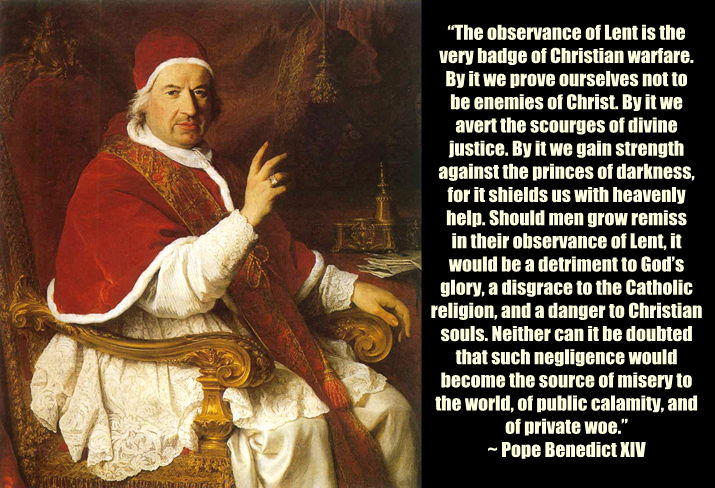
Pope Benedict XIV (1714) on the Strictness of Lent
Homily For Passion Sunday by Bishop Antoine Godeau

Scripture:

Isaiah 53:11b-12
Read more >>
Friday, April 18, 2025
The 40 Hour Passion Fast and the Black Fast


The Strictness of Holy Week

The Passion Fast is a term which refers to the fast which began for some as early as sunset on Holy Thursday and as late as 8 AM on Good Friday. No one was allowed to eat any food during that time until sunset on Holy Saturday, which – since most fasted for Communion – extended until the morning on Easter Sunday. It was often called a “40 Hours Fast” and represents the original Lenten fast. For those who were too weak to follow this fast the minimum fast at this time was that of xerophagiae.

Xerophagiae is a diet of simple, dry, uncooked food, such as raw nuts, bread, fruits, and vegetables. Fish and oil are not part of it and neither are flesh nor animal products. It was a precept to fast on these only during Holy Week by custom and/or decree until approximately the time of Pope St. Gregory the Great (reigned 590 – 604 AD), who mentions nothing of it. It may still have been a custom at that time but no mention of it is made in the Decretals of Gregory IX published in 1234.

The Black Fast

A commonly misunderstood aspect of fasting is the “black fast.” Is the Passion Fast a Black Fast? Is it the only Black Fast? What is the true definition of a black fast? And what is it not? The Catholic Encyclopedia from 1907 answers as follows:

This form of fasting, the most rigorous in the history of church legislation, was marked by austerity regarding the quantity and quality of food permitted on fasting days as well as the time wherein such food might be legitimately taken. 

This is based in practice on the fasting done by the Early Church and the Apostles. In practice, there are three criteria that make a fast a “black fast” as the Encyclopedia identifies:

In the first place more than one meal was strictly prohibited. At this meal flesh meat, eggs, butter, cheese, and milk were interdicted (Gregory I, Decretals IV, cap. vi; Trullan Synod, Canon 56). Besides these restrictions, abstinence from wine, especially during Lent, was enjoined (Thomassin, Traité des jeûnes de l'Église, II, vii). Furthermore, during Holy Week the fare consisted of bread, salt, herbs, and water (Laymann, Theologia Moralis, Tr. VIII; De observatione jejuniorum, i). Finally, this meal was not allowed until sunset. St. Ambrose (De Elia et jejunio, sermo vii, in Psalm CXVIII), St. Chrysostom (Homil. iv in Genesim), St. Basil (Oratio i, De jejunio) furnish unequivocal testimony concerning the three characteristics of the black fast. 

Hence a black fast is one that meets these criteria:

1. Only one meal a day

2. Complete abstinence from all meat and animal products

3. The one meal may only be consumed after sunset.

Consequently, it is not a total abstinence from all food and drink whatsoever that makes a fast a “black fast”. And it also does not mean that one eats only bread. Vegetables are certainly allowed at the meal. And the Passion Fast is one such Black Fast

Want to learn more about the history of fasting and abstinence? Check out the Definitive Guide to Catholic Fasting and Abstinence.

Read more >>
Sunday, April 9, 2006
Top 10 Suggestions for A Catholic Holy Week

"In Holy Week, we participate in the most sublime drama of religious history" (Fr. Pius Parsch)

Today is Palm Sunday, the beginning of Holy Week. This is the week that changed the course of history when Our Lord, Jesus Christ, suffered, died, and rose again for us. This Thursday is Holy Thursday, the commemoration of the Lord's Supper—when He gave us the gift of Himself in the Holy Eucharist.

The Triduum ceased being holy days of obligation a few hundred years ago in the 17th/18th century due to the Reformation and secularism which required people to work these days. But the fact that they are not presently Holy Days of Obligation does not mean we should let these most sacred days pass by. In fact, in previous eras, all commerce and governments would close to allow the faithful all of Holy Week and all of Easter Week off. We need to recover these traditions.

Here are my Top 10 Suggestions for A Catholic Holy Week:
  1. Attend Mass each day, especially on Holy Thursday, Good Friday, and Holy Saturday. Read the Mass propers each day this week, even the traditional readings for Holy Monday, Holy Tuesday, and Holy Wednesday. 
  2. Offer a daily Rosary for the souls that have died this Lent and for the conversion of sinners.
  3. Pray such prayers as the Litany of the Most Precious Blood every day. The Racolta has excellent prayers in honor of the Precious Blood, which is worth saying. There is also the Litany of the Passion.
  4. Take part in visiting Seven Churches Visitation, a traditional devotion where you visit seven churches on the evening of Holy Thursday to pray before the altars of repose at each church.
  5. Go to Confession to ensure that you are in the state of grace for these holy days.
  6. Read the entire Dolorous Passion according to the visions of Blessed Anne Catherine Emerich
  7. It is a requirement to fast on Good Friday, but if your health allows, fast also during the day on Holy Saturday and at night on Holy Thursday. Lent was traditionally 40 days of fasting and 46 days of abstinence. Good Friday also was, in former times, a day of the strictest fasting, and the faithful were encouraged to eat nothing at all on Good Friday, if possible. See: Fasting Rules
  8. Pray for the catechumens who will be received into the Church this week and receive the Sacraments. And pray for any public sinners who are reconciled
  9. Pray the Divine Office more regularly this week. If you do not have a Breviary in your library. Pray it online at Divinum Officium.
  10. Pray the Stations of the Cross on Good Friday and observe strict silence from 12 PM to 3 PM.
Do not let these days of grace go by without participating deeply in the Church's sacred rites. The drama of the Passion is about to unfold.
Read more >>
Wednesday, June 3, 2020
A History of Holy Days of Obligation & Fasting for American Catholics: Part 2

Archbishop John Carroll, the first Bishop in the United States


Holy Days in Early America:

At America's birth, the holy days of obligation, in addition to every Sunday, were as follows: the feasts of Christmas, Circumcision, Epiphany, Annunciation, Easter Monday, Ascension, Whitsun Monday, Corpus Christi, Ss. Peter and Paul, Assumption, and All Saints. The fasting days were the Ember Days of each of the seasons; the forty days Lent; Wednesdays and Fridays in Advent; and the vigils of Christmas, Pentecost, Ss Peter and Paul, and All Saints. Abstinence was required on all fasting days in addition to all Fridays (unless Christmas Day fell on a Friday) and most Saturdays.

A few years later on July 8, 1781, Pope Pius VI "dispensed the English Catholics from the observance, according to their ancient custom, of fasting on all the Fridays in the year, excepting those within the Pascal Season. The Pope excepted from his dispensation the Fridays in Lent, Advent, and the Ember weeks." At this time, the new nation of the United States remained tied to the London District. After the American Revolution, the Catholics in the 13 colonies that constituted the new United States of America were under the jurisdiction of the Apostolic Vicariate of the London District until the Diocese of Baltimore was established on November 6, 1789. This included the area of Maine that previously had been part of Quebec. 

The history of holy days in the lands purchased in 1803 from France in the Louisiana Purchase is also interesting. Owing to the persecution of Catholics in France after the French Revolution, Pope Pius VII on April 5, 1802, reduced the holy days of obligation for Catholics in France to only Christmas, Ascension, Assumption, and the Feast of All Saints.

Spain, which was in possession of the Louisiana territory since 1763, agreed in 1801 to cede it back to Napoleon. Before even getting possession of the territory, he sold it to the United States in 1803. What is particularly interesting is that the Catholics of Louisiana - whose territory includes areas in modern-day Arkansas, Missouri, Iowa, Minnesota, Kansas, and Nebraska - adopted the reduced holy days granted to France in 1802.

A Divergence of Holy Days in the 1800s:

As America expanded, there was a divergence in the days of precept. When Florida was purchased by the United States in 1821, its old holy days were maintained. And the same likewise occurred in the Texas territory when it was acquired by the United States in 1845. And this trend continued as America expanded westward. As the American Catholic Quarterly Review, Volume 11 observes:
"In the Second Plenary Council [of Baltimore] in 1866 the feast of the Immaculate Conception was made of obligation as it had been in Oregon, where the feast of St Peter and St Paul had retained its place with the Monday after Easter and Whit Sunday, St John the Baptist, Candlemas, and St Stephen. Pope Gregory XVI in 1837 dispensed all the dioceses then in the United States from the obligation as to Easter Monday and Whitsun Monday and in 1840 from that of the feast of St Peter and St Paul and the same Sovereign Pontiff relieved the faithful from the fast on Wednesdays in Advent."
Uniformity of American Holy Days Established in 1885:

By the time of the Civil War, considerable changes had occurred to these holy days. It was not until the Third Plenary Council that uniformly was achieved, though at the cost of reducing the holy days observed by many Catholics in the New World. Quoting the same article:
"The effort to induce faithful to a more exact observance of holydays of obligation or least so far as hearing mass was concerned had not been successful. A general indifference prevailed. When zealous priests, to give servants and mechanics every opportunity to fulfil the obligation, had Mass celebrated at an early hour to permit them to attend it proceeding to their usual work, it was found that almost the persons to avail themselves of the opportunity would be a pious old women, while those of the very class for whose the Mass was thus offered were scarcely represented by a straggling individuals.
"The Fathers of the Council renewed their petition to the See and His Holiness Pope Leo XIII on the 31st of December 1885 transferred the solemnization of Corpus Christi to the Sunday following the feast and made the holydays of obligation in all of the United States to be thenceforward: The Immaculate Conception of the Blessed Virgin, Christmas Day, the feast of Circumcision, Ascension Day, the Assumption of the Blessed Virgin, and the feast of All Saints."
The Epiphany and Annunciation were no longer a Holy Day of Obligation in the United States - joining Easter Monday, Pentecost Monday, and St. Peter and Paul as working days.

American Fasting & Abstinence Wanes in the Mid 1800s:

As Holy Days were reduced, so were fasting days. The Third Provincial Council of Baltimore in 1837, with approval of Pope Gregory XVI, dispensed from fast and abstinence the Wednesdays of Advent, except for the Ember Wednesday in Advent.

At this time, complete abstinence was observed on all Saturdays of the year too but over the course of the 19th century, the dispensations from Saturday abstinence became universal. Mara Morrow, author of Sin in the Sixties, illustrates these changes:
"In 1840 the Fourth Provinicial Council of Baltimore asked for a perpetual renewal of an indult dispensing from abstinence on Saturdays, and this indult was renewed for twenty years by Pope Gregory XVI. In 1866, the Second Plenary Council asked that all dispensations granted to the diocese of Baltimore be extended to other American dioceses, but Pope Pius IX preferred individual requests from each bishop in the United States. In 1884, the U.S. bishops who were meeting at the Third Plenary Council decided it would be difficult to pass uniform legislation on the subject of fast and abstinence and hence left it to the authority of provincial councils to determine what was best for their territories. Leo XIII in 1886 granted U.S. bishops the authority to dispense each year from abstinence on Saturdays."
Similarly, Pope Gregory XVI in a rescript from June 28, 1831, granted a dispensation to all Catholics of Scotland from abstinence on Saturdays throughout the year, except on Saturdays that were also days of fasting. Dispensations were granted in many nations, illustrating a weakening in discipline not only in America. On the topic of Saturday abstinence for the United States, an article published in 1966 from the Catholic Northwest paper summarized the American history of Saturday abstinence:

 "In 1833, following the Second Plenary Council of Baltimore, the US bishops in a pastoral letter announced with pleasure that Americans from then on would not have to abstain from meat on Saturdays—except or the Saturdays of Lent, ember weeks, and Saturdays which were vigils of major feasts. They said they had appealed to the Pope for a special dispensation because of “the peculiar circumstances under which our congregations are placed,” and that their request “has been, in great measure complied with.” 

With the growing number of Irish immigrants to America in the early 1800s, special attention was given to dispense from the law of abstinence when St. Patricks' Day fell on a Friday. This was done for the members of the Charitable Irish Society of Boston in 1837 and would become customary in the United States.

Pope Leo XIII Continues the Relaxation of Discipline:

Throughout the centuries covered thus far, Lenten abstinence included not only abstinence from meat but also generally from eggs and dairy products, though exceptions were granted in various localities." Father Weiser in "Christian Feasts and Customs" clarifies: "Abstinence from lacticinia (milk foods), which included milk, butter, cheese, and eggs, was never strictly enforced in Britain, Ireland, and Scandinavia because of the lack of oil and other substitute foods in those countries. The Church using common sense granted many dispensations in this matter in all countries of Europe. People who did eat the milk foods would often, when they could afford it, give alms for the building of churches or other pious endeavors."

The laws of abstinence also required abstinence from fish at the meals where meat was eaten on a fast day as well as on Sundays in Lent, as Pope Benedict XIV decreed. This too began to change. Anthony Ruff relates in his article "Fasting and Abstinence: The Story" the changes made by Pope Leo XIII in the document entitled Indultum quadragesimale:
"In 1886 Leo XIII allowed meat, eggs, and milk products on Sundays of Lent and at the main meal on every weekday [of Lent] except Wednesday and Friday in the [United States]. Holy Saturday was not included in the dispensation. A small piece of bread was permitted in the morning with coffee, tea, chocolate, or a similar beverage."
Fasting days were defined as days of one meal only until 817 AD when the monks of the Benedictine Order were granted permission to take a little drink and bread in the evening on account of the labors they performed. The practice of an evening collation on fasting days for all of the faithful was universal by the 14th century. The practice of an additional morning collation was introduced only in the 19th century as part of the gradual relaxation of discipline. Morrow in Sin in the Sixties expands on the concessions given by Leo XIII:
"It also allowed for the use of eggs and milk products at the evening collation daily during Lent and at the principal meal when meat was not allowed. [It] further allowed a small piece of bread in the morning with a beverage, the possibility of taking the principal meal at noon or in the evening, and the use of lard and meat drippings in the preparation of foods. Those exempt from the law of fasting were permitted to eat meat, eggs, and milk more than once a day." 
Consequently, the Baltimore Manual published by the Third Plenary Council of Baltimore in 1884 states: "Only one full meal is allowed, to be taken about noon or later. Besides this full meal, a collation of eight ounces is allowed. If the full meal is taken about the middle of the day, the collation will naturally be taken in the evening; if the full meal is taken late in the day, the collation may be taken at noon. Besides the full meal and collation, the general custom has made it lawful to take up to two ounces of bread (without butter) and a cup of some warm liquid - as coffee or tea - in the morning. This is important to observe, for by means of this many persons are enabled - and therefore obliged - the keep the fast who could not otherwise do so."

The Catechism of Father Patrick Powers published in Ireland in 1905 mentions that abstinence includes flesh meat and "anything produced from animals, as milk, butter, cheese, eggs." However, Father Patrick notes, "In some countries, however, milk is allowed at collation." The United States was one of those nations whereas Ireland and others were not granted such dispensations. The use of eggs and milk during Lent was to drastically change in a few years with the 1917 Code of Canon Law.

On November 30, 1879, Pope Leo XIII added the Vigil of the Immaculate Conception to the Universal Church's calendar, increasing the number of liturgical vigils from 16 to 17, which not including Holy Saturday, consisted of "the eves of Christmas, the Epiphany, the Ascension, Pentecost, the Immaculate Conception, the Assumption, the eight feasts of the Apostles, St. John the Baptist, St. Laurence, and All Saints." At this time, the Vigil of the Immaculate Conception was not yet a fast day. These 17 vigils mentioned were still in place at the time of the writing of the Catholic Encyclopedia in 1909.

In 1895, the workingmen's privilege gave bishops in the United States the ability to permit meat in some circumstances where there was "difficulty in observing the common law of abstinence, excluding Fridays, Ash Wednesday, Holy Week, and the Vigil of Christmas. This workingmen's privilege (or indult) allowed only for meat once a day during Lent, taken at the principal meal, and never taken in conjunction with fish. This particular indult was extended not only to the laborer but to his family, as well. The motivation of such an indult was no doubt to allow for enough sustenance such that the many Catholic immigrants to the United States who worked as manual laborers could perform their difficult, energy-demanding physical work without danger to their health" (Sin in the Sixties).

The Changes of St. Pius X to Holy Days of Obligation:

In the largest change to Holy Days in centuries, Pope St. Pius X in Supremi disciplinæ in 1911 drastically reduced the number of Holy Days of Obligation in the Universal Church to 8:
  1. Christmas
  2. Circumcision
  3. Epiphany 
  4. Ascension
  5. Immaculate Conception
  6. Assumption of the Blessed Virgin
  7. Sts. Peter and Paul 
  8. All Saints 
In only 269 years, the number of Holy Days on the Universal Calendar had been reduced from 36 under Urban VIII to 8 under Pius X. Shortly thereafter in 1917, Corpus Christi and St. Joseph were added back, bringing the total to 10. The 10 currently observed on the Universal Calendar are the same as from 1917.

As for the Holy Days observed in the United States, the Catholic Encyclopedia in referencing Supremi disciplinæ noted, "Where, however, any of the above feasts has been abolished or transferred, the new legislation is not effective. In the United States consequently the Epiphany and the feast of Sts. Peter and Paul are not days of precept." On a similar note, Corpus Christi when added back as a Holy Day in the Universal Church in 1917 remained transferred to the following Sunday in the United States as a result of Pope Leo XIII's indult from 1885.

James Cardinal Gibbons

The Rapid Decline in Penance from the Early to Mid 1900s:

We see likewise with the fasting days.

The Catholic Encyclopedia from 1909 in describing that fast immediately before the changes to occur under St. Pius X enumerates them as follows: "In the United States of America all the days of Lent; the Fridays of Advent (generally); the Ember Days; the vigils of Christmas and Pentecost, as well as those (14 Aug.) of the Assumption; (31 Oct.) of All Saints, are now fasting days. In Great Britain, Ireland, Australia, and Canada, the days just indicated, together with the Wednesdays of Advent and (28 June) the vigil of Saints Peter and Paul, are fasting days." In 1902, the Holy Father granted a special dispensation for Catholics in England from fasting on the Vigil of Ss. Peter and Paul in honor of the coronation of King Edward VII.

The days of obligatory fasting as listed in the 1917 Code of Canon Law were the forty days of Lent (including Ash Wednesday, Good Friday, and Holy Saturday until noon); the Ember Days; and the Vigils of Pentecost, the Assumption of the Blessed Virgin Mary, All Saints, and Christmas. Partial abstinence, the eating of meat only at the principal meal, was obligatory on all weeks of Lent (Monday through Thursday). And of course, complete abstinence was required on all Fridays, including Fridays of Lent, except when a holy day of obligation fell on a Friday outside of Lent. Saturdays in Lent were likewise days of complete abstinence.

Fasting and abstinence were no longer observed should a vigil fall on a Sunday as stated in the code: "If a vigil that is a fast day falls on a Sunday the fast is not to be anticipated on Saturday, but is dropped altogether that year." Before 1917, the fast of a Vigil that fell on a Sunday was observed instead on the preceding Saturday.

Effective per the 1917 Code of Canon law, the Wednesdays and Fridays of Advent were no longer fast days for the Universal Church. Wednesdays of Advent had previously been abrogated as fast days in America in 1837. Now Fridays in Advent likewise ceased being required days of fast not only in America but universally. The Vigil of St. Peter and Paul also ceased as a fast day on the Universal Calendar, although it had already been abrogated in the United States. And eggs and milk (i.e. lacticinia) became universally permitted. And year-round Saturday abstinence, while generally dispensed from in America since the mid 1800s, ceased universally. 

But additional changes quickly ensued even after the liberalization of the 1917 Code. Mara Morrow, writing on the fasting days around this time, states, "In 1917 Pope Benedict XV granted the faithful of countries in World War I the privilege of transferring Saturday Lenten abstinence to any other day of the week, excepting Friday and Ash Wednesday. In 1919 Cardinal Gibbons was granted his request of transferring Saturday Lenten abstinence to Wednesday for all bishops’ dioceses in the U.S. This permission, as well as the workingmen’s privilege, were frequently renewed, but, after 1931, this permission was only on the basis of personal requests from individual bishops."

Further, in 1931 Cardinal Fumasoni Biondi, the Apostolic Delegate to the United States, addressed the following to the American Bishops: "The Sacred Congregation of the Council, in a letter dated 15 Oct 1931, informs me that, in view of the difficulties experienced by the faithful in observing the laws of fast and abstinence on civil holidays, His Holiness, Pius XI, in the audience of 5 Oct. 1931, granted to all the Ordinaries of the United States, ad quinquennium, the faculty to dispense their subjects from the laws in question whenever any of the civil holidays now observed occurs on a day of fast and abstinence, or of abstinence" (Homiletic and Pastoral Review, 32-416; E.R., 86-65, 190).

Pope Pius XII accelerated the changes to fasting and abstinence as Father Ruff relates: "In 1941 Pope Pius XII allowed bishops worldwide to dispense entirely from fast and abstinence except on Ash Wednesday and Good Friday, provided that there was abstinence from meat every Friday, and fast and abstinence on these two days and the vigil of the Assumption and Christmas. Eggs and milk products were permitted at breakfast and in the evening."

On January 28, 1949, the United States bishops issued modified regulations on abstinence in America again after receiving a ruling from the Sacred Congregation of the Council. Partial abstinence replaced complete abstinence for Ember Wednesdays, Ember Saturdays, and the Vigil of Pentecost.

Samuel Cardinal Stritch

Reductions in Fasting Intensify in the 1950's under Pope Pius XII:

Before 1951, Bishops were able to dispense laborers and their family members from the laws of abstinence, if necessary, under the workingmen's privilege that was introduced in 1895. This privilege of eating meat though excluded Fridays, Ash Wednesday, Holy Week, and the Vigil of Christmas. In 1951, the abstinence laws in America were again revised as Father Ruff summarizes:
"In 1951 the U.S. bishops standardized regulations calling for complete abstinence from meat on Fridays, Ash Wednesday, the vigils of Assumption and Christmas, and Holy Saturday morning for everyone over age seven. On the vigils of Pentecost and All Saints, meat could be taken at just one meal. Fast days, applying to everyone between 21 and 59, were the weekdays of Lent, Ember days, and the vigils of Pentecost, Assumption, All Saints, and Christmas. On these fast days only one full meal was allowed, with two other meatless meals permitted which together did not make up one full meal. Eating between meals was not permitted, with milk and fruit juice permitted. Health or ability to work exempted one." 
As a result, the Vigil of All Saints was reduced to partial abstinence for American Catholics only in 1951.

In 1954, Pope Pius XII issued a special decree granting bishops the permission to dispense from Friday abstinence for the Feast of St. Joseph which that year fell on a Friday. A March 26, 1954 article of the Guardian elaborates: "Bishops throughout the world have been granted the faculty to dispense their faithful from the law of abstinence on the Feast of St. Joseph, Friday, March 19. The power was granted in a decree issued by the Sacred Congregation of the Council, which said it acted at the special mandate of His Holiness Pope Pius XII. The decree was published in L'Osservatore Romano made no mention of a dispensation from the Lenten fast."

1955 saw some of the most significant changes to the Church's liturgy since the Council of Trent. Pope Pius XII in "Cum nostra hac aetate" on March 23, 1955, abolished 15 Octaves in addition to the Octave for the Dedication of a Church, and particular octaves for patrons of various religious orders, countries, dioceses, etc. He also abolished roughly half of all vigils, leading to the removal of the liturgical vigils of the Immaculate Conception, Epiphany, All Saints, and All apostles except Ss. Peter and Paul. The total number of liturgical vigils was now reduced to 7.

Uncertainty existed on whether or not fasting was still required on October 31st, the Vigil of All Saints (commonly called Halloween). The US Bishops requested an official determination from Rome on whether the custom of fasting and abstinence on the suspended Vigil of All Saints had also been terminated. They received a pre-printed notice in a response dated March 15, 1957, stating: "The Decree of the Sacred Congregation of Rites...looks simply to the liturgical part of the day and does not touch the obligation of fast and abstinence that are a penitential preparation for the following feast day." The US Bishop thereafter dispensed both the fast and partial abstinence law for the Vigil of All Saints.

And effective in 1956 per the decree in Maxima Redemptionis Nostrae Mysteria, Holy Saturday's fast and abstinence were extended from noon to midnight. Furthermore, on July 25, 1957, Pope Pius XII commuted the fast in the Universal Church from the Vigil of the Assumption to the Vigil of the Immaculate Conception on December 7, even though he had previously abrogated the Mass for the Vigil of the Immaculate Conception.

On a separate note, in both 1953 and 1957 Pope Pius XII altered the more ancient Eucharistic Fast, and in 1957 introduced the practice of allowing Masses to be offered on Sunday evenings.

On October 9, 1958, Pope Pius XII died. John XXIII was elected and under him, as under his predecessor, changes to Church discipline continued. In 1959, John XXIII permitted the Christmas Eve fast and abstinence to be transferred to 23rd. While the United States, Great Britain, and Ireland kept the penance on December 24, other nations including Canada and the Philippines transferred it to December 23.

The Fasting Requirements of 1962:

By 1962, the laws of fasting and abstinence were as follows as described in "Moral Theology" by Rev. Heribert Jone and adapted by Rev. Urban Adelman for the "laws and customs of the United States of America" copyright 1961: "Complete abstinence is to be observed on all Fridays of the year, Ash Wednesday, the Vigils of Immaculate Conception and Christmas. Partial abstinence is to be observed on Ember Wednesdays and Saturdays and on the Vigil of Pentecost. Days of fast are all the weekdays of Lent, Ember Days, and the Vigil of Pentecost." If a vigil falls on a Sunday, the law of abstinence and fasting is dispensed that year and is not transferred to the preceding day. Father Jone adds additional guidance for the Vigil of the Nativity fast: "General custom allows one who is fasting to take a double portion of food at the collation on Christmas Eve (jejunium gaudiosum)."

He further elaborates on the significance of the changes that had been made under Pope Pius XII:

"There is no longer any question about the interpretation of workingmen since the new formula makes no difference between manual workers, stenographers, white collar workers, students, seminarians, religious, etc. All may make use of the same privileges. The purpose of these new regulations and important modifications is to enable those who are engaged in hard and exhaustive occupations, to keep the fast by enabling them to eat meat once on (partial) abstinence days. Furthermore, Catholics serving in the Armed Forces, while they are in actual service, and their families too, when eating with them, are dispensed from abstinence except on Ash Wednesdays, Good Fridays, Holy Saturday (the entire day) and the Vigil of Christmas. The Ordinaries of the United States may also dispense their subjects from the laws of fast and abstinence on civil holidays, but they are to exhort the faithful to make some offering, especially to the poor, by way of compensation. Bishops may dispense the entire diocese or any part of it (e.g. a town) for the special reason of a great concourse of people or for one of public health."

The Turkey Indult

It must be further clarified that no "turkey indult" exists in the form many believe, even though many Catholics attached to the 1962 Missal claim a dispensation from meat on the Friday after Thanksgiving, citing Pope Pius XII as the source of the dispensation. The dispensation from meat on the day after Thanksgiving was granted in 1957 in the form of quinquennial faculties given to local ordinaries to dispense from abstinence on the Friday after Thanksgiving Day, as stated by Bouscaren in the Canon Law Digest. The quinquennial faculties last 5 years and must be renewed. In 1962 they were renewed but not afterward because there was no need to because of Paenitemini and more importantly because of the November 1966 decree by the National Conference of Catholic Bishops (NCCB), which made abstinence on all Fridays throughout the year "especially recommended" but not obligatory.

Before 1962, the Bishops in the United States did not generally dispense from Friday abstinence on the Friday after Thanksgiving. After the renewal in 1962, more Bishops began to exercise this. In 1963 the Bishop of Little Rock, Arkansas made use of these privileges and dispensed the faithful from meat on the Friday after Thanksgiving:
"By reason of special faculties, His Excellency, the Most Reverend Bishop, grants herewith the following dispensations: from the Law of Fast on the Feast of St. Joseph, Tuesday, March 19; from the Law of Abstinence on Friday, November 29, (day after Thanksgiving) and from the Laws of Fast and Abstinence on Saturday, December 7, Vigil of the Feast of the Immaculate Conception."
Such a dispensation from the law of abstinence was not permanently part of Church law by virtue of it being the Friday after Thanksgiving. While bishops or priests will today dispense from meat on the Friday after Thanksgiving, Pope Pius XII did not permanently dispense meat on that day as many allege. The research of Romanitas Press confirms this.

Nothing is Safe from Change Post-Vatican II:

Shortly after the close of the Second Vatican Council, Paul VI issued an apostolic constitution on fasting and abstaining on February 17, 1966, called Paenitemini, whose principles were later incorporated into the 1983 Code of Canon Law. Paenitemini allowed the commutation of the Friday abstinence to an act of penance at the discretion of the local ordinaries and gave authority to the episcopal conferences on how the universal rules would be applied in their region. Abstinence which previously began at age 7 was modified to begin at age 14. Additionally, the obligation of fasting on the Ember Days and on the remaining Vigils was abolished. Paenitemini maintained the traditional practice that "abstinence is to be observed on every Friday which does not fall on a day of obligation."

The NCCB issued a statement on November 18, 1966. Abstinence was made obligatory on all Fridays of Lent, except Solemnities (i.e. First Class Feasts), on Ash Wednesday, and on Good Friday. Abstinence on all Fridays throughout the year was "especially recommended," and the faithful who did choose to eat meat were directed to perform an alternative penance on those Fridays outside of Lent, even though the US Bishops removed the long-establish precept of requiring Friday penance. The document stated in part: "Even though we hereby terminate the traditional law of abstinence binding under pain of sin, as the sole prescribed means of observing Friday, we ... hope that the Catholic community will ordinarily continue to abstain from meat by free choice as formerly we did in obedience to church law." And finally, fasting on all weekdays of Lent was "strongly recommended" but not made obligatory under penalty of sin.

The 1983 Code of Canon Law largely took Paul VI's apostolic constitution aside from the modification of the age at which fasting binds. Per the 1983 Code of Canon Law, the age of fast was changed to begin at 18 - previously it was 21 - and to still conclude at midnight when an individual completes his 59th birthday. Friday penance is required per these laws on all Fridays of the year except on Solemnities, a dramatic change from the previous exception being only on Holy Days of Obligation.

Per the 1983 Code of Canon Law, fasting and complete abstinence per these rules are required only on Ash Wednesday and Good Friday. The notion of "partial abstinence," introduced under Pope Benedict XIV in 1741, was also removed. By this point, the days of obligatory fast had been reduced to merely two days.

For a chart comparing 1917 v. 1955 v. 1983 fasting and abstinence, please see Catholic Candle.

Holy Days Further Reduced in the 1990's:

Holy Days of Obligation, which had remained the same in the United States since 1917, were further modified in the latter part of the century.  On December 13, 1991, the United States Bishops issued a directive further abrogating New Years Day (the Circumcision), the Assumption, or All Saints in years when the feast falls on a Saturday or a Monday. And on March 23, 1992, in another reduction, the Bishop of Honolulu obtained an indult from the Holy See and approval from the United States episcopal conference to reduce the Holy Days of Obligation to only Christmas and the Immaculate Conception. With so many holy days reduced, and with priests largely not preaching on the necessity of attending Mass and of abstaining from servile works on them, the faithful have lost the sense of the sacred.

What We Have Lost:

Where has the rhythm and rhyme of the Catholic life gone? What have we gained from this slow erosion of the holy days and fasting days? The American Catholic Quarterly Review laments:
"The long line of festivals has been suppressed. Who has gained by it? The French Revolution seized and used all the property of the Church and the nobles. The poor were to be raised from their abject misery. By work and toil they were to acquire competence. After a century of trial the working class in France are desperate anarchists clamoring again for a seizure of property from those who hold it. Spain seized the Church property and has its discontented thousands. Italy did the same and drives her people into exile as immigrants to foreign lands. The gospel of work is now rejected by the poor. They have had too much of it. They clamor for fewer hours of work for more holydays for higher wages. The time and money they extort by combinations have no blessing both are spent in sensual indulgence. Their families do not gain by them but saloon keepers are enriched. These extorted holydays given by the nineteenth century do nothing to elevate or improve the masses. As a mere matter of political economy it may be asked whether the old time Catholic worker who had twenty religious holydays and spent much of them in ennobling and piety inspiring shrines was not happier in himself more prosperous in his home a more valuable element in the body politic than his modern representative."
Practical Considerations:

Consecration of St. Patrick's Cathedral. The day before a consecration used to be a required day of fasting. Father Dominic Prummer in "Moral Theology" published in 1949 states, "On the day previous to the consecration of a church both the Bishop and the people who ask for the church to be consecrated must fast. This is laid down in the Roman Pontifical."

While no authority in the Church may change or alter any established dogmas of the Faith, the discipline of both Holy Days of Obligation and fast days may change. The days of obligation and the days of penance are matters of discipline, not matters of dogma. Lawful authorities in the Church do have the power to change these practices.

In the observance of the two precepts, namely attending Holy Mass on prescribed days and fasting and abstaining on commanded days, we obey them because the Church has the power by Christ to command such things. We do not abstain from meat on Fridays for instance because the meat is unclean or evil. It is the act of disobedience which is evil. As Fr. Michael Müller remarks in his Familiar Explanation of Christian Doctrine from 1874: "It is not the food, but the disobedience that defiles a man." To eat meat on a forbidden day unintentionally, for instance, is no sin. As the Scriptures affirm it is not what goes into one's mouth that defiles a man but that disobedience which comes from the soul (cf. Matthew 15:11).

On a similar note, bishops could lawfully abrogate the precept of hearing Mass on Sundays and other Holy Days of Obligation. While no bishop may dispense the obligation of honoring the Holy Day, which is a matter of Divine Law ingrained in the Ten Commandments, matters of discipline may change. In the Church, there is a clear distinction between doctrine and discipline.

Yet, even with such a distinction, the Church has historically been wise to change disciplines only very slowly and carefully. As Archbishop Fulton J. Sheen once remarked, "It is a long-established principle of the Church never to completely drop from her public worship any ceremony, object or prayer which once occupied a place in that worship." The same may be said for matters concerning either Holy Days of Obligation or fast days. What our forefathers held sacred should remain sacred to us in an effort to preserve our catholicity not only with ourselves but with our ancestors who see God now in Heaven.

Perhaps we need to ask ourselves and our own families what we can do, even if not mandated by Church law, to recover these former holy days of obligation and fasting days. Cultivating a devotion to honor the many former Holy Days of Obligation by additional prayer, leisure, and assisting at the Church's official liturgies is certainly to be commended, even if not strictly required by law. Likewise, fasting and/or abstaining from meat and animal products on the forty days of Lent, the days of Advent, the Vigils of feasts, Ember Days, Rogation Days, and Saturdays year-round would be commendable. In a similar manner, observing the Apostles Fast or the Assumption Fast, which are still kept in the Eastern Churches, would also be praiseworthy for a Roman Catholic.

The Church has over time reduced the requirements required under penalty sin but She still implores the Faithful to do more than the mere minimum. But in reality, are we? St. Francis de Sales remarked, “If you’re able to fast, you will do well to observe some days beyond what are ordered by the Church.”

What days can you add? How can you better observe the feast days of the Apostles or the feasts of our Lord or our Lady? How can we fast better - both in terms of the number of days as well as by limiting the food we consume on fast days?

The 1962 Missal and fasting calendar is not the embodiment of Catholic Tradition. Even the practices in place in 1917 under St. Pius X are shadows of former times. To reclaim Catholic Tradition requires a radical return to the Faith of our ancestors and their observances. May those of forefathers and ancestors of ours who are in Heaven and who see the face of God pray for us and for the entire Church Militant to return to the happy days of eras past when the liturgical year was intricately tied to one's life.


Want to learn more about the history of fasting and abstinence? Check out the Definitive Guide to Catholic Fasting and Abstinence.
Read more >>
Sunday, February 27, 2022
How the Traditional Latin Mass Reinforces Lent as a Fast

It is lamentable that so few Catholics keep the Traditional Lenten fast as practiced by our forefathers in the Faith for centuries. The Traditional Lenten fast - which was greatly watered down since the 1700s - generally constituted the following:

  • Fasting applies for those age 18 or older (but not obligatory for those 60 years of age or older)
  • Ash Wednesday and Good Friday: If possible, no solid food. Only black coffee, tea, or water.
  • Mondays through Saturdays: Only one meal preferably after sunset or at least until not before 3 PM. A morning frustulum and evening collation (i.e. the two "snacks") are permitted but not required. No meat or animal products are allowed for anyone, regardless of age - that included even fish in the Early Church.
  • Sundays: No meat or animal products allowed. Abstinence remained on Sundays even when fasting did not.
  • Holy Week (except Good Friday which is covered above): Only Bread, Salt, and Herbs are permitted for the main meal. Frustulum and collation permitted (of bread, herbs, and salt) but omitted if possible.
  • Holy Saturday: No food until Noon. Abstinence including from all animal products continues until Easter begins.

While we have happily seen an increase in the number of Traditional Latin Masses offered over the past decade, few Catholics have promoted a return to the fasting that our ancestors knew and practiced religiously. In fact, even the rules in place as of 1962 are substantially harder than what the average Catholic observes today. The laws of fasting and abstinence were as follows, as described in Moral Theology (copyright 1961) by Rev. Heribert Jone and adapted by Rev. Urban Adelman, for the “laws and customs of the United States of America”:

“Complete abstinence is to be observed on all Fridays of the year, Ash Wednesday, the Vigils of Immaculate Conception and Christmas. Partial abstinence is to be observed on Ember Wednesdays and Saturdays and on the Vigil of Pentecost. Days of fast are all the weekdays of Lent, Ember Days, and the Vigil of Pentecost.”

One highly interesting liturgical facet particular to the season of Lent is that every Lenten feria has its own propers. That is, each day of Lent has its own Introit, Collect, Epistle reading, Gospel reading, Offertory verse, Communion verse, and Post Communion Prayer. Lent further adds a prayer over the people immediately after the Post Communion. Dom Gueranger notes:

"Each feria of Lent has a proper Mass; whereas, in Advent, the Mass of the preceding Sunday is repeated during the week. This richness of the lenten liturgy is a powerful means for our entering into the Church's spirit, since she hereby brings before us, under so many forms, the sentiments suited to this holy time... All this will provide us with most solid instruction; and as the selections from the Bible, which are each day brought before us, are not only some of the finest of the sacred volume, but are, moreover, singularly appropriate to Lent, their attentive perusal will be productive of a twofold advantage."

Now the actual text of the Lenten Masses underscores the importance of the Lenten fast and repeatedly refers to the fasting done by the Faithful at this time. The Church in Her liturgy assumes and expects the Faithful in attendance at the Traditional Latin Mass to at least be keeping the fasting rules in place as of 1962 - if not the more robust fasting practiced before the mitigations of the preceding centuries.

The Preface for instance not only underscores the ongoing 40-day bodily fast but also mentions some of the benefits of this healing remedy:

It is truly meet and just, right and for our salvation, that we should at all times and in all places give thanks to Thee, holy Lord, Father almighty, eternal God: Who by this bodily fast dost curb our vices, lift our minds, strength and rewards bestow; through Christ our Lord. Through Whom Angels praise Thy Majesty, Dominations worship, Powers stand in awe. The Heavens and the hosts of heaven with blessed Seraphim unite, exult, and celebrate. And we entreat that Thou wouldst bid our voices too be heard with theirs, singing with lowly praise...

The collect for Ash Wednesday also highlights that day as the beginning of the fast of Lent and not a mere one day fast:

Grant, O Lord, to Thy faithful people, that they may undertake with fitting piety this period of fasting, and complete it with steadfast devotion.

The collect for Friday after Ash Wednesday for instance continues the reference to the Lenten fast:

Further with Thy gracious favor, we beseech Thee, O Lord, the fasts which we have begun: that the bodily observance which we keep, we may be able also to practice with sincere intention. 

And likewise with the collect for Saturday after Ash Wednesday:

O Lord, hearken to our supplications: and grant that we may celebrate with devout service this solemn fast, which Thou hast ordained for the healing both of soul and of body.

In the Mass Propers for the First Sunday of Lent, fasting is referenced in the Epistle while the Gospel reading recounts our Lord's forty days of fasting in the desert. And the collect, while not mentioning fasting, does mention abstinence, as our ancestors regularly kept abstinence even the Sundays of Lent up until the 1800s:

O God, Who dost purify Thy Church by the yearly observance of Lent: grant to Thy household, that what we strive to obtain from Thee by abstinence, we may achieve by good works.

Likewise, in the Divine Office, the ordinary of Lent refers to the bodily fast of Lent. It is a known peculiarity to the traditional Breviary that the ordinary of the Lenten season only begins with First Vespers for the First Sunday in Lent. The first four weekdays of Lent use the ordinary for time throughout the year, a holdover from ancient times before Ash Wednesday was established as the beginning of Lent. 

Starting therefore on the First Sunday of Lent, the prayers of the Breviary further underscore the traditional Lenten fast. In the hymn for Matins for this time, the hymn implores us to keep the Lenten fast. This hymn begins as follows:

The fast, as taught by holy lore, We keep in solemn course once more: The fast to all men known, and bound In forty days of yearly round. 

The law and seers that were of old In diverse ways this Lent foretold, Which Christ, all seasons’ King and Guide, In after ages sanctified. 

More sparing therefore let us make The words we speak, the food we take, Our sleep and mirth, —and closer barred Be every sense in holy guard. 

Avoid the evil thoughts that roll Like waters o’er the heedless soul; Nor let the foe occasion find Our souls in slavery to bind.

The little chapter of Terce taken from Joel 2:12-13 refers to fasting as does the antiphon of Sext: "With the armor of justice let us give ourselves to much patience and fasting." And the same can be seen in the hymn of Vespers which begins as follows:

O kind Creator, bow thine ear 

To mark the cry, to know the tear 

Before thy throne of mercy spent 

In this thy holy fast of Lent.

Turning again to the propers for the Mass, the references to fasting continue repeatedly and include the collect of Monday in the First Week of Lent; the Lesson, Collect, and Gospel for Ember Wednesday in Lent; the collect for Monday, Wednesday, Thursday, Friday, and Saturday in the Second Week of Lent; the secret prayer for Thursday in the Second Week of Lent; and more. The collect for Friday in the Second Week of Lent for instance prays:

Grant, we beseech Thee, O Almighty God, that cleansed by this holy fast, we may arrive in the right dispositions at the holy feast which is to come.

By the third week of Lent the references continue to refer to the ongoing fast of Lent as expressed for instance in the collect for Monday in the Third Week of Lent:

Pour forth in Thy mercy, O Lord, we beseech Thee, Thy grace into our hearts: that as we abstain from bodily food, so we may also restrain our senses from hurtful excesses.  

The collect two days later on Wednesday asks pardon from God for those who are undertaking "wholesome fasting" who also "abstain from harmful vices."

Abstinence is explicitly mentioned in the collect for Thursday in the First Week of Lent. And temperance - which is strengthened by both fasting and abstinence - is mentioned by name in the collect on Tuesday of the Third Week of Lent. 

The Gradual on Thursday in the Third Week of Lent, which is the exact middle of the Lenten fast, is taken from Psalm 144 and references God providing "meat in due season," which is certainly a reference to the upcoming celebration of the Lord's Resurrection on Easter Sunday when abstinence ends. Hence, by the time Lent reaches its midpoint, the faithful have heard either exhortations or references to fasting in the collects over a dozen times. And it does not end there as the next day's collect on Friday in the Third Week of Lent asks God to "bless our fasts" with His gracious favor as "in body we abstain from food, so we may fast from sin in mind." Similar words occur in the collect for Saturday in the Third Week of Lent.

This is a mere sampling. References to fasting continue. In one more example, the collect for Wednesday in the Fourth Week of Lent prays:

O God, who through fasting grantest to the just the reward of their merits and to sinners forgiveness: have mercy on Thy clients, that confession of our guilt may enable us to obtain pardon for ours sins.

When Passiontide begins on the Fifth Sunday in Lent, the focus in the Breviary and the Mass shifts from the corporal punishment we bear for our sins to an awareness of the suffering we cause our Lord. But even with this focus change, fasting references do not end as seen in the collect for Monday of Passion Week:

Hallow our fasts, we beseech Thee, O Lord: and mercifully grant us the forgiveness of all our faults.

Consequently, the Church in Her Liturgy through both the propers of the Mass and through the Breviary references and expects the Christian faithful to be observing Lenten fasting and abstinence. These repeated references to the Lenten fast unequivocally illustrate how the Lenten fast should be kept by every one of fasting and/or abstinence age who attends the Tridentine Mass. To attend the Traditional Mass and to keep the watered-down, virtually non-existent fast prescribed in the 1983 Code of Canon Law would be schizophrenic. Keep the Traditional Lenten fast and all traditional fasts. 

And for those looking for ideas on what to make to eat on fasting days, the Lenten Cookbook produced by Sophia Institute Press has a section on vegan recipes that is worth checking out.

Read more >>
Sunday, February 13, 2022
History of Lenten Fasting: How to Observe the Traditional Lenten Fast

The Purpose of Fasting

In principio, in the beginning, the very first Commandment of God  to Adam and Eve was one of fasting from the fruit of the tree of the knowledge of good and evil (cf. Genesis 2:16-17), and their failure to fast brought sin and disorder to all of creation. The second sin of mankind was gluttony. Both are intricately tied to fasting.

Both Elijah and Moses fasted for forty days in the Old Testament before seeing God. Until the Great Flood, man abstained entirely from the flesh meat of animals (cf. Genesis 9:2-3). Likewise, in the New Testament, St. John the Baptist, the greatest prophet (cf. Luke 7:28) fasted and his followers were characterized by their fasting. And our Blessed Lord also fasted for forty days (cf. Matthew 4:1-11) not for His own needs but to serve as an example for us. Our Redeemer said, “Unless you shall do penance, you shall all likewise perish” (Luke 13:3). Fasting and abstinence from certain foods characterized the lives of man since the foundation of the world.

The Church has hallowed the practice of fasting, encourages it, and mandates it at certain times. Why? The Angelic Doctor writes that fasting is practiced for a threefold purpose: 

“First, in order to bridle the lusts of the flesh…Secondly, we have recourse to fasting in order that the mind may arise more freely to the contemplation of heavenly things: hence it is related of Daniel that he received a revelation from God after fasting for three weeks. Thirdly, in order to satisfy for sins: wherefore it is written: ‘Be converted to Me with all your heart, in fasting and in weeping and in mourning.’ The same is declared by Augustine in a sermon: ‘Fasting cleanses the soul, raises the mind, subjects one's flesh to the spirit, renders the heart contrite and humble, scatters the clouds of concupiscence, quenches the fire of lust, kindles the true light of chastity.’”  

St. Basil the Great also affirmed the importance of fasting for protection against demonic forces: “The fast is the weapon of protection against demons. Our Guardian Angels more really stay with those who have cleansed our souls through fasting.”

The Baltimore Catechism echoes these sentiments: “The Church commands us to fast and abstain, in order that we may mortify our passions and satisfy for our sins” (Baltimore Catechism #2 Q. 395). Concerning this rationale, Fr. Thomas Kinkead in “An Explanation Of The Baltimore Catechism of Christian Doctrine” published in 1891 writes, “Remember it is our bodies that generally lead us into sin; if therefore we punish the body by fasting and mortification, we atone for the sin, and thus God wipes out a part of the temporal punishment due to it.” 

Pope St. Leo the Great in 461 wisely counseled that fasting is a means and not an end in itself. For those who could not observe the strictness of fasting, he sensibly said, "What we forego by fasting is to be given as alms to the poor.”  To simply forgo fasting completely, even when for legitimate health reasons, does not excuse a person from the universal command to do penance (cf. Luke 13:3).

The Lenten Fast in the Early Church

The great liturgical Dom Gueranger writes that the fast which precedes Easter originated with the Apostles themselves:

“The forty days' fast, which we call Lent, is the Church's preparation for Easter, and was instituted at the very commencement of Christianity. Our blessed Lord Himself sanctioned it by fasting forty days and forty nights in the desert; and though He would not impose it on the world by an express commandment (which, in that case, could not have been open to the power of dispensation), yet He showed plainly enough, by His own example, that fasting, which God had so frequently ordered in the old Law, was to be also practiced by the children of the new…The apostles, therefore, legislated for our weakness, by instituting, at the very commencement of the Christian Church, that the solemnity of Easter should be preceded by a universal fast...”

The Catechism of the Liturgy by a Religious of the Sacred Heart published by The Paulist Press, New York, 1919 affirms the apostolic origin of the Lenten fast: “The Lenten fast dates back to Apostolic times as is attested by Saint Jerome, Saint Leo the Great, Saint Cyril of Alexandria and others.” In the 2nd century, St. Irenaeus wrote to Pope St. Victor I inquiring on how Easter should be celebrated, while mentioning the practice of fasting leading up to Easter.

Initially, the Lenten fast was practiced by catechumens preparing for their Baptism with a universal fast for all the faithful observed only during Holy Week, in addition to the weekly fasts that were devotionally practiced. But early on, the baptized Christians began to join the catechumens in fasting on the days immediately preceding Easter.  The duration of the fast varied with some churches observing one day, others several days, and yet others observing intensive 40-hour fasting, in honor of the forty hours that the Lord spent in the sepulcher. By the third and fourth centuries, the fast became forty days in most places. St. Athanasius, in 339 AD, referred to the Lenten fast as a forty-day fast that “the whole world” observed. 

Heortology: A History of the Christian Festivals from their Origin to the Present Day by Dr. K.A. Heinrich Kellner states the following regarding the Lenten fast in the ancient Church, noting the strictness that intensified in Holy Week and even more so on Good Friday and Holy Saturday:

"Among Catholics also abstinence was pushed to great lengths. The canons of Hippolytus prescribe for Holy Week only bread and salt. The Apostolic Constitutions will only permit bread, vegetables, salt and water, in Lent, flesh and wine being forbidden; and, on the last two days of Holy Week, nothing whatsoever is to be eaten. The ascetics, whose acquaintance the Gallic pilgrim made in Jerusalem, never touched bread in Lent, but lived on flour and water. Only a few could keep so strict a fast, and generally speaking people were satisfied with abstaining from flesh and wine. But this lasted throughout the entire Lent, and Chrysostom tells us that in Antioch no flesh was eaten during the whole of Lent. Abstinence from milk and eggs (the so-called lacticinia) was also the general rule."

Shortly after the legislation of Christianity in the Roman Empire, the bishops at the Council of Nicea in 325 AD fixed the date of Easter as the first Sunday after the first full moon after the vernal equinox. The canons emerging from that council also referenced a 40-day Lenten season of fasting.

To the Early Christians, fasting was performed until sundown, in imitation of the previous Jewish tradition. Dom Gueranger’s writings affirm, “It was the custom with the Jews, in the Old Law, not to take the one meal, allowed on fasting days, till sun-set. The Christian Church adopted the same custom. It was scrupulously practiced, for many centuries, even in our Western countries. But, about the 9th century, some relaxation began to be introduced in the Latin Church.”

And notably in the early Church, fasting also included abstinence from wine, taking man back to the same diet that mankind practiced before God permitted Noah to eat meat and drink wine. As such, in apostolic times, the main meal was a small one, mainly of bread and vegetables. Fish, but not shellfish, became permitted on days of abstinence around the 6th century. Hence, some Eastern Rite Catholics will abstain from meat, animal products, wine, oil, and fish on fasting days which harkens back to these ancient times.

Remarkably, even water was forbidden during fasting times in the very ancient church. Fr. Alban Butler, in Moveable Feasts and Fasts, provides testimony of this when he writes: "St. Fructuosus, the holy bishop of Tarragon in Spain, in the persecution of Valerian in 259, being led to martyrdom on a Friday at ten o'clock in the morning, refused to drink, because it was not the hour to break the fast of the day, though fatigued with imprisonment, and standing in need of strength to sustain the conflict of his last agony. 'It is a fast,' said he: 'I refuse to drink; it is not yet the ninth hour; death itself shall not oblige me to abridge my fast.'"

The Lenten Fast in the Early Middle Ages

The Lenten fast began under the Apostles themselves and was practiced in various forms in the Early Church. As time went on, the fast became uniformly observed under pain of sin. 

St. Augustine in the fourth century remarked, “Our fast at any other time is voluntary; but during Lent, we sin if we do not fast.” At the time of St. Gregory the Great at the beginning of the 7th century, the fast was universally established to begin on what we know as Ash Wednesday. While the name "Ash Wednesday" was not given to the day until Pope Urban II in 1099, the day was known as the “Beginning of the Fast.” 

In 604, in a letter to St. Augustine of Canterbury, Pope St. Gregory the Great announced the form that abstinence would take on fast days. This form would last for almost a thousand years: "We abstain from flesh meat and from all things that come from flesh, as milk, cheese, and eggs."  When fasting was observed, abstinence was likewise always observed.

Regarding Holy Saturday's fast in particular, Canon 89 of the Council in Trullo in 692 AD provides an account of the piety and devotion of the faithful of that time: “The faithful, spending the days of the Salutatory Passion in fasting, praying and compunction of heart, ought to fast until the midnight of the Great Sabbath: since the divine Evangelists, Matthew and Luke, have shewn us how late at night it was [that the resurrection took place].” That tradition of fasting on Holy Saturday until midnight would last for centuries.

Historical records further indicate that Lent was not a merely regional practice observed only in Rome. It was part of the universality of the Church. Lenten fasting began in England, for instance, sometime during the reign of Earconberht, the king of Kent, who was converted by the missionary work of St. Augustine of Canterbury in England. During the Middle Ages, fasting in England, and many other then-Catholic nations, was required both by Church law and the civil law. Catholic missionaries brought fasting, which is an integral part of the Faith, to every land they visited.

The Lenten fast included fasting from all lacticinia (Latin for milk products) which included butter, cheese, eggs, and animal products. And this abstinence was practiced even on the Sundays of Lent. From this tradition, Easter Eggs were introduced, and therefore the Tuesday before Ash Wednesday is when pancakes are traditionally eaten to use leftover lacticinia. And similarly, Fat Tuesday is known as Carnival, coming from the Latin words carne levare – literally the farewell to meat.


Collations Are Introduced on Fasting Days in the 8th Century

The rules on fasting remained largely the same for hundreds of years. Food was to be taken once a day after sunset. After the meal, the fast resumed and was terminated only after the sun had once again set on the horizon. But relaxations were to soon begin. 

By the eighth century, the time for the daily meal was moved to the time that the monks would pray the Office of None in the Divine Office. This office takes place around 3 o'clock in the afternoon. As a consequence of moving the meal up in the day, the practice of a collation was introduced. The well-researched Father Francis Xavier Weiser summarizes this major change with fasting:

"It was not until the ninth century, however, that less rigid laws of fasting were introduced. It came about in 817 when the monks of the Benedictine order, who did much labor in the fields and on the farms, were allowed to take a little drink with a morsel of bread in the evening...Eventually the Church extended the new laws to the laity as well, and by the end of the medieval times they had become universal practice; everybody ate a little evening meal in addition to the main meal at noon." 

The Lenten Fast in the High Middle Ages

Through the writings of St. Thomas Aquinas, we can learn how Lent was practiced in his own time and attempt to willingly observe such practices in our own lives. The Lenten fast as mentioned by St. Thomas Aquinas constituted of the following: 
  • Monday through Saturday were days of fasting. The meal was taken at 3 PM and a collation was allowed at night.
  • All meat or animal products were prohibited throughout Lent.
  • Abstinence from these foods remained even on Sundays of Lent, though fasting was not practiced on Sundays. 
  • No food was to be eaten at all on either Ash Wednesday or Good Friday, if possible.
  • Holy Week was a more intense fast that consisted only of bread, salt, water, and herbs. 
The Lenten Fast in the Renissance

By the fourteenth century, the meal had begun to move up steadily until it began to take place even at 12 o’clock. The change became so common it became part of the Church’s discipline. In one interesting but often unknown fact, because the monks would pray the liturgical hour of None before they would eat their meal, the custom of called midday by the name “noon” entered into our vocabulary as a result of the fast. With the meal moved up, the evening collation remained.

In the Middle Ages, abstinence from meat on Fridays and during Lent was not only Church law – it was civil law as well. And people gladly obeyed these laws out of respect for the teaching authority of the Church. Yet after the Protestant revolt which began in 1517 and continued through the middle of the 1600s, this was to change.

English Royalty proclamations, even after Henry VIII's illegal separation from the Church, supporting abstinence of meat continued to occur in England in 1563, 1619, 1625, 1627, and 1631. The same likewise occurred in 1687 under King James II. After the Revolution in 1688 and the overthrow of Catholicism by William III and Mary II, the laws were no longer enforced and officially removed from the law books by the Statue Law Revision Act in 1863. Similar changes occurred throughout Europe as Protestants reviled the fast. 

But changes continued even in Catholic nations. St. Epiphanius (367 - 403 AD), the bishop of Salamis at the end of the 4th century, wrote that "Wednesday and Friday are days of fasting up to the ninth hour because, as Wednesday began the Lord was arrested and on Friday he was crucified." Wednesday abstinence persisted for centuries. In Ireland for instance the use of meat on all Wednesdays of the year was prohibited until around the middle of the 17th century. This harkened back to the vestige of those earlier times when Wednesdays were days of weekly fasting as Father Slater notes in “A Short History of Moral Theology” published in 1909:

"The obligation of fasting on all Wednesdays and Fridays ceased almost entirely about the tenth century, but the fixing of those days by ecclesiastical authority for fasting, and the desire to substitute a Christian observance at Rome for certain pagan rites celebrated in connection with the seasons of the year, seem to have given rise to our Ember Days…About the tenth century the obligation of the Friday fast was reduced to one of abstinence from flesh meat, and the Wednesday fast after being similarly mitigated gradually disappeared altogether."

The Lenten Fast Begins Deteriorating in the 1700s

Some of the most significant changes to fasting would occur under the reign of Pope Benedict XIV who reigned from 1740 – 1758. 

On May 31, 1741, Pope Benedict XIV issued Non Ambiginius which granted permission to eat meat on fasting days while explicitly forbidding the consumption of both fish and flesh meat at the same meal on all fasting days during the year in addition to the Sundays during Lent. Beforehand, the forty days of Lent were held as days of complete abstinence from meat. The concept of partial abstinence was born even though the term would not appear until the 1917 Code of Canon Law. Yet even with these changes, Pope Benedict XIV implored the faithful to return to the devotion of earlier eras:

"The observance of Lent is the very badge of the Christian warfare. By it we prove ourselves not to be enemies of the cross of Christ. By it we avert the scourges of divine justice. By it we gain strength against the princes of darkness, for it shields us with heavenly help. Should mankind grow remiss in their observance of Lent, it would be a detriment to God's glory, a disgrace to the Catholic religion, and a danger to Christian souls. Neither can it be doubted that such negligence would become the source of misery to the world, of public calamity, and of private woe." 

Yet changes continued during the 18th and 19th centuries as Antoine Villien's "History of the Commandments" from 1915 documents:

The use of meat on Sundays [of Lent] was at first tolerated, then expressly permitted, for the greater part of Lent. Old people still remember the time when its use was completely forbidden in France from the Friday of Passion week to Easter. Later, new dispensations allowed the gradual extension of the Sunday privilege to Tuesday and Thursday of each week, up to Thursday before Palm Sunday. About the beginning of the pontification of Pius IX [c. 1846], Monday was added to the days on which abstinence need not be observed; a few years later the use of meat on those four days began to be permitted up to Wednesday of Holy Week. Lastly the Saturdays, expect Ember Saturday and Holy Saturday, were included in the dispensations."

Mitigations to fasting also began to accelerate for other periods in the 18th and 19th centuries and this is seen strikingly in the series of changes to occur to fasting in the American Colonies which can be read in detail in the two-part series: A History of Holy Days of Obligation & Fasting for American Catholics.

Father Anthony Ruff relates in his article "Fasting and Abstinence: The Story" the changes made by Pope Leo XIII in the document entitled Indultum quadragesimale:

"In 1886 Leo XIII allowed meat, eggs, and milk products on Sundays of Lent and at the main meal on every weekday [of Lent] except Wednesday and Friday in the [United States]. Holy Saturday was not included in the dispensation. A small piece of bread was permitted in the morning with coffee, tea, chocolate, or a similar beverage."

While the evening collation had been widespread since the 14th century, the practice of an additional morning snack (i.e. a frustulum) was introduced only around the 18th century as part of the gradual relaxation of discipline. Volume 12 of The Jurist, published by the Catholic University of America in 1952, writes, "It is stated that the two-ounce breakfast arose at the time of St. Alphonsus, since which time the usage of the popular two and eight-ounce standards for the breakfast and the collation, respectively, has been extant." 

Mara Morrow in Sin in the Sixties elaborates on the concessions given by Pope Leo XIII which in the late 19th century expanded the practice of the frustulum and further reduced strict abstinence:

"It also allowed for the use of eggs and milk products at the evening collation daily during Lent and at the principal meal when meat was not allowed. [It] further allowed a small piece of bread in the morning with a beverage, the possibility of taking the principal meal at noon or in the evening, and the use of lard and meat drippings in the preparation of foods. Those exempt from the law of fasting were permitted to eat meat, eggs, and milk more than once a day." 

Consequently, the Baltimore Manual published by the Third Plenary Council of Baltimore in 1884 states: "Only one full meal is allowed, to be taken about noon or later. Besides this full meal, a collation of eight ounces is allowed. If the full meal is taken about the middle of the day, the collation will naturally be taken in the evening; if the full meal is taken late in the day, the collation may be taken at noon. Besides the full meal and collation, the general custom has made it lawful to take up to two ounces of bread (without butter) and a cup of some warm liquid - as coffee or tea - in the morning. This is important to observe, for by means of this many persons are enabled - and therefore obliged - the keep the fast who could not otherwise do so."

The Catechism of Father Patrick Powers published in Ireland in 1905 mentions that abstinence includes flesh meat and "anything produced from animals, as milk, butter, cheese, eggs." However, Father Patrick notes, "In some countries, however, milk is allowed at collation." The United States was one of those nations whereas Ireland and others were not granted such dispensations. The use of eggs and milk during Lent was to drastically change in a few years with the 1917 Code of Canon Law.

In 1895, the workingmen's privilege gave bishops in the United States the ability to permit meat in some circumstances. Mara Morrow summarizes that these circumstances occurred when there was "difficulty in observing the common law of abstinence, excluding Fridays, Ash Wednesday, Holy Week, and the Vigil of Christmas. This workingmen's privilege (or indult) allowed only for meat once a day during Lent, taken at the principal meal, and never taken in conjunction with fish. This particular indult was extended not only to the laborer but to his family, as well. The motivation of such an indult was no doubt to allow for enough sustenance such that the many Catholic immigrants to the United States who worked as manual laborers could perform their difficult, energy-demanding physical work without danger to their health" (Sin in the Sixties).


The Remnant of the Lenten Fast Left by the 20th Century

The Catholic Encyclopedia from 1909 in describing that fast immediately before the changes to occur under St. Pius X enumerates them as follows: "In the United States of America all the days of Lent; the Fridays of Advent (generally); the Ember Days; the vigils of Christmas and Pentecost, as well as those (14 Aug.) of the Assumption; (31 Oct.) of All Saints, are now fasting days. In Great Britain, Ireland, Australia, and Canada, the days just indicated, together with the Wednesdays of Advent and (28 June) the vigil of Saints Peter and Paul, are fasting days." 

The days of obligatory fasting as listed in the 1917 Code of Canon Law were the forty days of Lent (including Ash Wednesday, Good Friday, and Holy Saturday until noon); the Ember Days; and the Vigils of Pentecost, the Assumption of the Blessed Virgin Mary, All Saints, and Christmas. Partial abstinence, the eating of meat only at the principal meal, was obligatory on all weeks of Lent (Monday through Thursday). And of course, complete abstinence was required on all Fridays, including Fridays of Lent, except when a holy day of obligation fell on a Friday outside of Lent. Saturdays in Lent were likewise days of complete abstinence. Fasting and abstinence were not observed should a vigil fall on a Sunday as stated in the code: "If a vigil that is a fast day falls on a Sunday the fast is not to be anticipated on Saturday, but is dropped altogether that year." Eggs and milk (i.e. lacticinia) became universally permitted.

But additional changes quickly ensued. Mara Morrow, writing on the fasting days around this time, states, "In 1917 Pope Benedict XV granted the faithful of countries in World War I the privilege of transferring Saturday Lenten abstinence to any other day of the week, excepting Friday and Ash Wednesday. In 1919 Cardinal Gibbons was granted his request of transferring Saturday Lenten abstinence to Wednesday for all bishops’ dioceses in the U.S. This permission, as well as the workingmen’s privilege, were frequently renewed, but, after 1931, this permission was only on the basis of personal requests from individual bishops."

Pope Pius XII accelerated the changes to fasting and abstinence as Father Ruff relates: "In 1941 Pope Pius XII allowed bishops worldwide to dispense entirely from fast and abstinence except on Ash Wednesday and Good Friday, provided that there was abstinence from meat every Friday, and fast and abstinence on these two days and the vigil of the Assumption and Christmas. Eggs and milk products were permitted at breakfast and in the evening." And effective in 1956 per the decree in Maxima Redemptionis Nostrae Mysteria, Holy Saturday's fast and abstinence were extended from noon to midnight.

By 1962, the laws of fasting and abstinence were as follows as described in "Moral Theology" by Rev. Heribert Jone and adapted by Rev. Urban Adelman for the "laws and customs of the United States of America" copyright 1961: 

"Complete abstinence is to be observed on all Fridays of the year, Ash Wednesday, the Vigils of Immaculate Conception and Christmas. Partial abstinence is to be observed on Ember Wednesdays and Saturdays and on the Vigil of Pentecost. Days of fast are all the weekdays of Lent, Ember Days, and the Vigil of Pentecost." If a vigil falls on a Sunday, the law of abstinence and fasting is dispensed that year and is not transferred to the preceding day. 

Thus, even before the Second Vatican Council opened, the fasting customs were drastically reduced within only a few hundred years. 


The Lenten Fast Virtually Eliminated Post Vatican II

Shortly after the close of the Second Vatican Council, Paul VI an apostolic constitution on fasting and abstaining on February 17, 1966, called Paenitemini, whose principles were later incorporated into the 1983 Code of Canon Law. Paenitemini allowed the commutation of the Friday abstinence to an act of penance at the discretion of the local ordinaries and gave authority to the episcopal conferences on how the universal rules would be applied in their region. Abstinence which previously began at age 7 was modified to begin at age 14. Additionally, the obligation of fasting on the Ember Days and on the remaining Vigils was abolished. Paenitemini maintained the traditional practice that "abstinence is to be observed on every Friday which does not fall on a day of obligation."

The NCCB issued a statement on November 18, 1966. Abstinence was made obligatory on all Fridays of Lent, except Solemnities (i.e. First Class Feasts), on Ash Wednesday, and on Good Friday. Abstinence on all Fridays throughout the year was "especially recommended," and the faithful who did choose to eat meat were directed to perform an alternative penance on those Fridays outside of Lent, even though the US Bishops removed the long-establish precept of requiring Friday penance. The document stated in part: "Even though we hereby terminate the traditional law of abstinence binding under pain of sin, as the sole prescribed means of observing Friday, we ... hope that the Catholic community will ordinarily continue to abstain from meat by free choice as formerly we did in obedience to church law." And finally, fasting on all weekdays of Lent was "strongly recommended" but not made obligatory under penalty of sin.

The 1983 Code of Canon Law largely took Paul VI's apostolic constitution aside from the modification of the age at which fasting binds. Per the 1983 Code of Canon Law, the age of fast was changed to begin at 18 - previously it was 21 - and to still conclude at midnight when an individual completes his 59th birthday. Friday penance is required per these laws on all Fridays of the year except on Solemnities, a dramatic change from the previous exception being only on Holy Days of Obligation.

Per the 1983 Code of Canon Law, fasting and complete abstinence per these rules are required only on Ash Wednesday and Good Friday. The notion of "partial abstinence," introduced under Pope Benedict XIV in 1741, was also removed along with nearly all fast days. 

So What Should Traditional Catholics Do To Restore the Lenten Fast?

While no authority in the Church may change or alter any established dogmas of the Faith, the discipline of both Holy Days of Obligation and fast days may change. The days of obligation and the days of penance are matters of discipline, not matters of dogma. Lawful authorities in the Church do have the power to change these practices.

In the observance of the two precepts, namely attending Holy Mass on prescribed days and fasting and abstaining on commanded days, we obey them because the Church has the power by Christ to command such things. We do not abstain from meat on Fridays for instance because the meat is unclean or evil. It is the act of disobedience that is evil. As Fr. Michael Müller remarks in his Familiar Explanation of Christian Doctrine from 1874: "It is not the food, but the disobedience that defiles a man." To eat meat on a forbidden day unintentionally, for instance, is no sin. As the Scriptures affirm it is not what goes into one's mouth that defiles a man but that disobedience which comes from the soul (cf. Matthew 15:11).

Yet, even with such a distinction, the Church has historically been wise to change disciplines only very slowly and carefully. As Archbishop Fulton J. Sheen once remarked, "It is a long-established principle of the Church never to completely drop from her public worship any ceremony, object or prayer which once occupied a place in that worship." The same may be said for matters concerning either Holy Days of Obligation or fast days. What our forefathers held sacred should remain sacred to us in an effort to preserve our catholicity not only with ourselves but with our ancestors who see God now in Heaven.

St. Francis de Sales remarked in the 16th / early 17th century, “If you’re able to fast, you will do well to observe some days beyond what are ordered by the Church.” 

This Lent, I propose for Traditional Catholics the following Lenten fasting plan:
  • Fasting applies for those age 18 or older (but not obligatory for those 60 years of age or older)
  • Ash Wednesday and Good Friday: No solid food. Only black coffee, tea, or water.
  • Mondays through Saturdays: Only one meal preferably after sunset. A morning frustulum and evening collation are permitted but not required. No meat or animal products are allowed for anyone, regardless of age - that includes fish. No olive oil.
  • Sundays: No meat or animal products allowed except on Laetare Sunday. Exceptions for Palm Sunday are mentioned below.
  • Annunciation Day (March 25) and Palm Sunday: Fish and olive oil permitted.
  • Holy Week (except Good Friday): Only Bread, Salt, and Herbs are permitted for the main meal. Frustulum and collation permitted (of bread, herbs, and salt) but omitted if possible
  • Holy Saturday: No food until Noon. Abstinence including from all animal products continues until Easter begins.
And for those looking for ideas on what to make to eat on fasting days, the Lenten Cookbook produced by Sophia Institute Press has a section on vegan recipes that is worth checking out.

Want to learn more about the history of fasting and abstinence? Check out the Definitive Guide to Catholic Fasting and Abstinence.
Read more >>


Copyright Notice: Unless otherwise stated, all items are copyrighted under a Attribution-NonCommercial-NoDerivatives 4.0 International License. If you quote from this blog, cite a link to the post on this blog in your article.

Disclosure of Material Connection: Some of the links on this blog are “affiliate links.” This means if you click on the link and purchase the item, I will receive an affiliate commission. As an Amazon Associate, for instance, I earn a small commission from qualifying purchases made by those who click on the Amazon affiliate links included on this website. I am disclosing this in accordance with the Federal Trade Commission’s 16 CFR, Part 255: “Guides Concerning the Use of Endorsements and Testimonials in Advertising.”