Saturday, November 13, 2010
Diaconate Ordination at Clear Creek Monastery

The New Liturgical Movement blog featured some stunning photographs of a recent (October 3, 2010) diaconate ordination at Clear Creek Monastery.  I wish to share some of these outstanding photos.  Remember - pray for vocations.


Source: NLM
Read more >>
Tuesday, November 9, 2010
Zenit: Pope Points to Liturgy as Education on the Gospel


Benedict XVI is urging a greater appreciation of the liturgy as a source of education about the "good life of the Gospel."

The Pope made these statements in a letter sent to Cardinal Angelo Bagnasco, president of the Italian Episcopal Conference, on the occasion of the Plenary Assembly being held through Thursday in Assisi.

One focus of the assembly is the review of the Italian translation of the newest edition of the Roman Missal.

"The rites speak through their intrinsic rationality," the Pontiff noted, "and educate to a conscious, active and fruitful participation."

He continued, "The correspondence of the prayer of the Church (lex orandi) with the rule of the faith (lex credendi) molds the thought and the feelings of the Christian community, giving shape to the Church, Body of Christ and Temple of the Spirit."

"No human word can do without time, even when, as in the case of the liturgy, it constitutes a window that open beyond time," the Holy Father affirmed. "Hence, to give voice to a perennially valid reality calls for the wise balance of continuity and novelty, of tradition and actualization."

"The Missal itself is placed within this process," he added.

Source: Zenit

Image Source: A Missa Cantata in the Ancient Form of the Roman Liturgy, offered in the parish church of the Assumption of the Blessed Virgin Mary, by Fr. Ervin Kovács
Read more >>
Saturday, November 6, 2010
Rorate Coeli


Rorate caeli desuper, et nubes pluant iustum.
Ne irascaris Domine, ne ultra memineris iniquitatis: ecce civitas Sancti facta est deserta: Sion deserta facta est: Jerusalem desolata est: domus sanctificationis tuae et gloriae tuae, ubi laudaverunt te patres nostri.
Rorate caeli desuper, et nubes pluant iustum.

Peccavimus, et facti sumus tamquam immundus nos, et cecidimus quasi folium universi: et iniquitates nostrae quasi ventus abstulerunt nos: abscondisti faciem tuam a nobis, et allisisti nos in manu iniquitatis nostrae.
Rorate caeli desuper, et nubes pluant iustum.

Vide Domine afflictionem populi tui, et mitte quem missurus es: emitte Agnum dominatorem terrae, de Petra deserti ad montem filiae Sion: ut auferat ipse iugum captivitatis nostrae.
Rorate caeli desuper, et nubes pluant iustum.

Consolamini, consolamini, popule meus: cito veniet salus tua: quare maerore consumeris, quia innovavit te dolor? Salvabo te, noli timere, ego enim sum Dominus Deus tuus, Sanctus Israel, Redemptor tuus.
Rorate caeli desuper, et nubes pluant iustum.

Note: Rorate Coeli is an Advent Hymn
Read more >>
Posts for November: Devotions for the Dead

Read more >>
Monday, November 1, 2010
400th Anniversary of the Canonization of St. Charles Borromeo

Today is the 400th Anniversary of the Canonization of St. Charles Borromeo. Four hundred years ago he was canonized by Pope Paul V. Read my prior post on St. Charles Borromeo, patron saint of seminarians. Let us pray for his intercession this day.

As We have already mentioned,[10] We are of the opinion that the shining example of Christ's soldiers has far greater value in the winning and sanctifying of souls than the words of profound treatises. We therefore gladly take this present opportunity to teach some very useful lessons from the consideration of the life of another holy pastor whom God raised up in more recent times and in the midst of trials very similar to those We are experiencing today. We refer to Saint Charles Borromeo, Cardinal of the Holy Roman Church and Archbishop of Milan, whom Paul V, of holy memory, raised to the altar of the saints less than thirty years after his death. The words of Our Predecessor are to the point: "The Lord alone performs great wonders and in recent times He has accomplished marvelous things among Us. In His wonderful dispensation He has set a great light on the Apostolic rock when He singled Charles out of the heart of the Roman Church as the faithful priest and good servant to be a model for the pastors and their flock. He enlightened the whole Church from the light diffused by his holy works.

Encyclical of Pope Pius X promulgated on May 26, 1910.
Prayer:

Ever keep Thy Church, O Lord, we beseech Thee, under the abiding protection of St. Charles, Thy Confessor and Bishop: that as his watchful care over his flock won him glory, so his intercession may always make us fervent in Thy love. Through our Lord.

Prayer Source: 1962 Roman Catholic Daily Missal
Read more >>
Thursday, October 21, 2010
Pope Benedict XVI Names 24 New Cardinals, including 4 Americans

After this consistory, the total number of cardinals will be 203, of which 121 are electors (less than 80 years old).

The new cardinals who qualify as electors are:

-- Archbishop Angelo Amato, prefect of the Congregation for Saints' Causes


-- Patriarch Antonios Naguib of Alexandria of the Copts, Egypt


-- Archbishop Robert Sarah, president of the Pontifical Council Cor Unum (on the right)


-- Archbishop Francesco Monterisi, archpriest of the Papal Basilica of St. Paul Outside the Walls

-- Archbishop Fortunato Baldelli, major penitentiary of the Apostolic Penitentiary

-- Archbishop Raymond Leo Burke, prefect of the Supreme Tribunal of the Apostolic Signature


-- Archbishop Kurt Koch, president of the Pontifical Council for Promoting Christian Unity

-- Archbishop Paolo Sardi, vice chamberlain of Apostolic Chamber

-- Archbishop Mauro Piacenza, prefect of the Congregation for Clergy

-- Archbishop Velasio De Paolis, president of the Prefecture for the Economic Affairs of the Holy See

-- Archbishop Gianfranco Ravasi, president of the Pontifical Council for Culture

-- Archbishop Medardo Joseph Mazombwe, retired archbishop of Lusaka, Zambia

-- Archbishop Raúl Eduardo Vela Chiriboga, retired archbishop of Quito, Ecuador

-- Archbishop Laurent Monsengwo Pasinya of Kinshasa, Democratic Republic of Congo

-- Archbishop Paolo Romeo of Palermo, Italy

-- Archbishop Donald Wuerl of Washington

-- Archbishop Raymundo Damasceno Assis of Aparecida, Brazil

-- Archbishop Kazimierz Nycz of Warsaw, Poland

-- Archbishop Albert Malcolm Ranjith Patabendige Don of Colombo, Sri Lanka

-- Archbishop Reinhard Marx of Munich and Freising, Germany

As well, the Pontiff elevated to the dignity of cardinal two prelates and two priests, who are over the age of 80 and are thus non-electors, for their "generosity and dedication in the service of the Church." These include:

-- Archbishop José Manuel Estepa Llaurens, retired archbishop of Spain's military

-- Bishop Elio Sgreccia, former president of the Pontifical Academy for Life

-- Monsignor Walter Brandmuller, former president of the Pontifical Committee for Historical Sciences

-- Monsignor Domenico Bartolucci, former director of the Pontifical Choir
Read more >>
Tuesday, October 19, 2010
Feast of Our Lady of the Rosary 2010 Video


Slideshow of photos taken during the Solemn High Mass to celebrate the Feast of Our Lady of the Rosary, the Titular Feast of the parish church in Blackfen.
Read more >>
Rev. John Berg celebrates Mass at Church of St. William of York

The Very Rev John Berg, Superior General of the Fraternity of St Peter, was in Reading today to celebrate Mass at the church of St William of York, and bless the house occupied by the two Fraternity priests based there. This has recently been given canonical status as a FSSP residence by the local ordinary, Bishop Crispian Hollis of Portsmouth.

2010 10 03_7606

2010 10 03_7595

2010 10 03_7652

2010 10 03_7681

Images are from the Flickr Photostream of Joseph Shaw.
Read more >>
Friday, October 15, 2010
Upcoming Canonization of Br. Andre

Zenit Reports:
A celebration of Catholicism in Canada is perhaps the best way to describe the events leading up to the canonization of Blessed Brother André Bessett on Sunday at St. Peter's in Rome.

As many as 5,000 Canadian Catholics are making the pilgrimage to Rome to attend the proclamation of Brother André as Canada's first native-born male saint, according to Eric Durocher, coordinator for English Pastoral Services for the Archdiocese of Montreal.

Additionally, the Archdiocese of Montreal has organized several events for the pilgrims that have chosen to celebrate the canonization of Brother André in the city where he served for most of his ministry.

St. Joseph's Oratory of Mount Royal, which was founded by Brother André in 1904, will be the central focus for activities before and during the canonization ceremonies. An all night prayer vigil will be held at the Oratory; uniting pilgrims in Rome and in Canada in prayerful reflection and celebration of Brother André’s spiritual life and heritage.

Throughout the overnight vigil, activities are planned in conjunction with the Congregation of the Holy Cross Fathers, the community to which St. André belonged, and the Archdiocese of Montreal. The events of the vigil will begin with a Lucenarium (candlelight prayer) followed with presentations of lectures on the life of Brother André by groups with which he was closely associated.

Night prayer in the style of the Monastery of Taizé is followed with exposition of the Blessed Sacrament, the celebration of lauds (morning prayer), and finally a procession from the tomb of Brother André to the Basilica of St. Joseph.
Read more >>
Wednesday, October 13, 2010
Pontifical Mass said by Bishop Perry on Pontifical Mass the Feast of Our Lady of the Rosary in New York City

Here are some photos from that Mass via Traditional + Catholicism Pictures.


Read more >>
Pope Benedict XVI Adds Tiara Back to Papal Coat of Arms


Rome Reports states:

The papal crest that hangs from Benedict XVI window is sporting a new design this week. That was before and this is now. We still don't know if the changes are definitive or if it's just one version of the papal coat of arms.

The exterior is inspired by Pope Barberini's crest, which is found on the canopy or baldacchino of Saint Peter's main altar.

The main difference compared to the prior is the comeback of the papal triple crown, which highlights governmental function of the Pope.

A symbol present in all the papal crests of the last century, including that of Pope John Paul the second.
Read more >>
Saturday, October 9, 2010
Why Our Lord Gave the Evangelical Counsels


FromThe Three Ages of the Interior Lifeby Rev Fr Garrigou-Lagrange, O.P.

Christ and the Rich Young Man

Christ said to the rich young man mentioned in St Matthew’s Gospel: “If thou wilt be perfect, go sell what thou hast and give to the poor, and thou shalt have treasure in heaven. And come, follow Me.” The Evangelist adds: “When the young man had heard this word, he went away sad, for he had great possessions.” (St Matthew 19:21)

The effective practice of the three evangelical counsels (i.e. the vow of poverty, chastity and obedience) is not obligatory nor is it indispensable to reach the perfection toward which we must all tend, but it is a most suitable means more surely and rapidly to reach the end and not run the danger of stopping halfway.

We have said that a soul cannot reach perfection without having the spirit of the counsels, or the spirit of detachment. Now, it is difficult truly to have this spirit without the effective practice of this detachment, which seemed too hard to the rich young man. Sanctity can be attained in the married state, as we see from the lives of St Clotilde, St Louis, and Blessed Anna Maria Taigi, but it is more difficult and more rare to reach it by this common road.

It is not easy to have the spirit of detachment in regard to worldly goods, permitted pleasures, and our own will, if, in reality, we do not effectively detach ourselves from them. The Christian who lives in the world is often exposed to excessive absorption and preoccupation about a situation to be acquired or maintained for himself and his family. He is also in danger of forgetting to some extent that he must advance toward another life, another fatherland, and that to reach it, something is needed quite different from the understanding of worldly affairs: in other words, the help of God, which should be sought through prayer, and the fruit of grace, which is merit.

In family life he is also inclined to dwell on affections in which he finds a legitimate satisfaction for his need of loving. He is also led to forget that he must above all things love God with his whole heart, with his whole soul, with all his strength, and with his whole mind. Frequently charity is not in him a living flame which rises toward God while vivifying all other affections; instead, it is like a burning coal which slowly dies out under the ashes. This explains the ease with which a number of these Christians sin, scarcely reflecting that their sin is an infidelity to the divine friendship, which should be the most profound sentiment in their hearts.

Lastly, the Christian living in the world is often exposed to doing his own will, side by side, so to speak, with the will of God. After giving a few moments to prayer on Sundays and weekdays, he may organize his life from the simple, natural point of view in accordance with his reason which is more or less deformed by self-love and the prejudices or conventions of his environment. Then faith seems at times reduced to a number of sacred truths that have been memorized, but have not become truths of life. The understanding is then too much preoccupied with earthly interests, sometimes with diversions; should difficulties demanding great moral energy arise, the spirit of faith is often found wanting. The great truths about the future life, about the helps that come to us from Christ, remain practically inefficacious, like distant truths that have never been assimilated and are lost in the depths of the heavens. Practical faith is lacking then, a faith that would cause the light of the mysteries of salvation to descend into the midst of the difficulties of daily life.

Such are evidently the dangers which the Christian encounters when he does not seek to practice effectively the evangelical counsels in the measure possible to him. If he fails in this matter, he will go astray and fall progressively into three moral maladies radically opposed to the three counsels.

St John speaks of these evils when he says: “For all that is in the world (or according to its spirit) is the concupiscence of the flesh and the concupiscence of the eyes and the pride of life, which is not of the Father, but is of the world.” They are three purulent wounds which ravage souls and bring death to them by turning them away from God.

Banishment of our First Parents from Eden

These three moral wounds appeared in the world after the sin of the first man and our repeated personal sins. To understand their gravity, we should recall the fact that they replace in many souls the triple harmony that existed in the state of original justice. It is this triple harmony that Christ wishes precisely to re-establish by the three evangelical counsels. Originally, on the first day of creation there was perfect harmony between God and the soul, between the soul and the body, between the body of man and exterior goods. Harmony existed between God and the soul, since it is created to know God, to love Him, to serve Him, and by this means to obtain eternal life.

The first man, who was created in “the state of sanctity and original justice,” was a contemplative who conversed familiarly with God, as we read in the first chapters of Genesis. His soul found its principal nourishment in divine things, “a little less than the angels.” (Psalms 8:6). In the light of God, he considered all things, and he obeyed the Lord.

From this superior harmony came that which existed between the soul and the body, which was made to serve the soul. Since the soul was perfectly subordinated to God, it had dominion over its body. The passions or movements of the sensible appetites followed with docility the direction of right reason enlightened by faith and the impelling force of the will vivified by charity.

Finally, there was harmony between the body and exterior goods. The earth produced its fruits spontaneously without the necessity of being worked painfully; the animals were docile, or at least did no harm to man, who had received dominion over them.

Sin disturbed this triple harmony by destroying the highest of the three; it introduced the triple disorder, called by St. John “the concupiscence of the flesh, and the concupiscence of the eyes, and the pride of life.”

Lucifer: "I will not serve."

Man revolted against the law of God; and the human soul, thenceforth inclined to pride, has often repeated: “I will not serve.” The soul has ceased to nourish itself with divine truth, and instead conceives its own narrow, false, ever-changing, little ideas. It wished to make for itself its own truths and principles, and to direct itself alone, limiting as far as possible the authority of God, instead of receiving from Him the salutary direction which alone leads to true life. Refusing to submit to the dominion of God, the soul has lost control over its body and its passions, which were made to obey the reason and will. What is more, the soul has often made itself the slave of the body, of its lower instincts: this is the concupiscence of the flesh. Many people so far forget their divine destiny as to be occupied from morning to night with their bodies, which become their idols. Their passions reign as masters; the soul becomes their slave, for passions that are antithetic, love, jealousy, anger, hatred, follow each other in the soul in spite of it. Instead of directing these passions, the soul is carried away by them as by wild horses which no longer know the bit.

Finally, the body, instead of making use of exterior goods, becomes their slave; it overtaxes itself at times to obtain an abundance of these exterior goods. It surrounds itself with useless luxury, to the detriment of the poor who are hungry. It must have all that glitters and makes a man seem important: this is the concupiscence of the eyes. After accumulating a fortune, many men are wholly absorbed in the care of maintaining and increasing it. Slaves to their business, they never find time to pray, to read a page of the Gospel, to feed their souls. They settle down here on earth as if they were going to stay here always, with hardly any concern for their salvation.

This triple slavery, which replaces the original triple harmony, is order overthrown. Christ came to restore the order that had been destroyed; with this end in view, He gave us the three evangelical counsels.

The three virtues of poverty, chastity, and obedience are called religious or holy virtues because they are subordinated to the virtue of religion, which renders to God the worship that is due Him. By reason of its object, the worship due to the Lord, the virtue of religion is the first of the moral virtues; it takes its place immediately after the three theological virtues and infused prudence which directs it. It offers to God the acts of the three religious virtues of poverty, chastity, and obedience. To make certain of not turning back, the religious binds himself by the three corresponding vows, a triple engagement or promise to practice these three virtues, first for a time, then until death, following the example of Christ, who was obedient “unto death, even to the death of the cross.”

As the Savior offered Himself, the religious offers himself also in union with Him, giving his entire life as an oblation or sacrifice. Since the religious ought to offer everything, – exterior goods, body, heart, will, personal judgment – this sacrifice, if well made and not revoked as time goes on, truly deserves the title of holocaust. It ought to be lived daily in an ever more intimate manner; then it obtains the hundredfold promised by the Savior, who declared: “Amen, I say to you, there is no man who hath left house or brethren or sisters or father or mother or children or lands for My sake and for the gospel, who shall not receive a hundred times as much, now in this time, houses and brethren and sisters and mothers and children and lands, with persecutions; and in the world to come, life everlasting.” (St Mark 10:29)
Read more >>
Thursday, October 7, 2010
Sixteenth Sunday after Pentecost

Some beautiful images from Mass in Toronto.
Editor Note: These images are no longer available.
Read more >>
Friday, October 1, 2010
Find the Perfect Christmas Cards and Invitations


Summer flew by and it sure feels like the Fall is doing the same, which means the most wonderful time of the year will be here before you know it.  One of my favorite parts of the Holiday Season (and there sure are a lot of favorites) are all the wonderful Christmas cards from friends and family coming in the mail.  It makes going out to the mailbox so much more exciting!  Receiving special holiday wishes from friends and family close and far just seems to put the holiday spirit in the air.  And I love lining the mantle above the fireplace with all the Season’s Greetings, watching them grow in number as it gets closer and closer to Christmas.

I was introduced to Storkie.com last year, and am excited to share with you information about their unique holiday cards.  Storkie is committed to providing high quality, affordable stationery with a customer experience that is quite simply fantastic. Their website allows you to make all sorts of customizations to your cards, and they make it easy!  From classic to contemporary, Storkie has it all.  Most orders ship out in just 1-2 days, so even if you are a procrastinator, you can still get your Christmas cards in the mail on time.  And their professional typesetters review every order to make sure everything is perfect.  If you’d like to see a proof before they print your order, no problem – that option is free!

One of the coolest things about Storkie’s Christmas photo cards is that you can personalize graphics in addition to all of the text, fonts, colors.  Their innovative Dynamic Designs let you choose from different design and color combinations.  So creating something unique that matches your style is easy and fun! Below is their fun snow globe Christmas cards personalized in 3 totally different ways: from snowmen to polar bears to penguins, and blue to green to red.
If you prefer classic Christmas greeting cards for your holiday sentiments, Storkie has a wonderful selection of cards that feature gorgeous embossing and raised lettering printing, all still at affordable prices (all under $2).

Go check out Storkie’s wonderful selection of unique Christmas cards and find the perfect Season’s Greetings to send to your friends, family, and colleagues.  Also keep them in mind for your other Christian stationery needs, including Christening invitations, First Communion invitations, and Confirmation invitations.

Get excited, it may be October, but it’s starting to look a lot like Christmas!!!
Read more >>
Tuesday, September 28, 2010
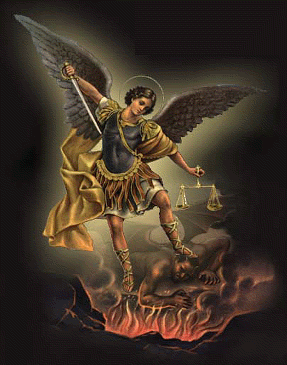
Feast of Archangles of Michael, Gabriel, and Raphael.

Saint Michael, ora pro nobis!

Feast (1969 Calendar): September 29

Angels are an essential part of the Christian faith. They are a "truth of the faith" and are mentioned over a hundred times in the Bible. We must believe in angels and fallen angels, devils, to be Christian. In honor of today's feast of the archangels, please say the full-length St. Michael prayer.

The information below is from Catholic Culture:
The liturgy celebrates the feast of these three archangels who are venerated in the tradition of the Church. Michael (Who is like God?) was the archangel who fought against Satan and all his evil angels, defending all the friends of God. He is the protector of all humanity from the snares of the devil. Gabriel (Strength of God) announced to Zachariah the forthcoming birth of John the Baptist, and to Mary, the birth of Jesus. His greeting to the Virgin, "Hail, full of grace," is one of the most familiar and frequent prayers of the Christian people. Raphael (Medicine of God) is the archangel who took care of Tobias on his journey. 
Before the reform of the General Roman Calendar today was only the feast of St. Michael. St. Gabriel was observed on March 24 and St. Raphael on October 24.
The Catechism of the Catholic Church teaches us that "[T]he existence of the spiritual, non-corporeal beings that Sacred Scripture usually calls 'angels' is a truth of faith. The witness of Scripture is as clear as the unanimity of Tradition." 
Angels are pure, created spirits. The name angel means servant or messenger of God. They are celestial or heavenly beings, on a higher order than human beings. An angel has no body and does not depend on matter for his existence or activity. They are distinct from saints, which men can become. Angels have intellect and will, and are immortal. They are a vast mulitude, but each is an individual person. Archangels are one of the nine choirs of angels listed in the Bible. In ascending order, the choirs or classes are 1) Angels, 2) Archangels, 3) Principalities, 4) Powers, 5) Virtues, 6) Dominations, 7) Thrones, 8) Cherubim and 9) Seraphim.

Read more >>
Sunday, September 26, 2010
300th Anniversary of the Canonization of St. Bernard of Calvo

Today is the 300th Anniversary of the Canonization of St. Bernard of Calvo, who was a a Cistercian Bishop of Vich educated in Spain. St. Bernard of Calvo is remembered as the first abbot of the Santes Creus monastery. In 1223 he was made Bishop of Vich and remained in that position until his death 20 years later.
Read more >>
Friday, September 24, 2010
Brief History of the Gloria in Excelsis Deo

 
The hymn – Great Doxology – begins with the words that the angels sang when the birth of Christ was announced to shepherds in Luke 2:14. Other verses were added very early, forming a doxology, which in the fourth century became part of morning prayer, and is still recited in the Byzantine Rite Orthros service.

The Latin translation is traditionally attributed to St. Hilary of Poitiers (c. 300-368), who may have learned it while in the East (359-360). The Vulgate Latin translation of the Bible was commissioned only in 382. The Latin hymn thus uses the word excelsis to translate the Greek word ὑψίστοις (the highest) in Luke 2:14, not the word altissimis, which St. Jerome preferred for his translation. In the Roman Rite, it is recited during Mass. 

In the Tridentine Mass, the priest is instructed, when saying the opening phrase "Gloria in excelsis Deo", to extend his hands and raise them to shoulder height and, at the word "Deo", to join them and bow his head. He is then to continue the recitation standing erect with hands joined and bowing his head to the cross at the words "Adoramus te", "Gratias agimus tibi", "Iesu Christe" (twice), and "Suscipe deprecationem nostram", and at the concluding phrase (as also at the concluding phrase of the Nicene Creed and the Sanctus), to make a large sign of the cross on himself. At High Mass  the priest intones the opening phrase, while the deacon and subdeacon stand behind him; then they join him at the altar and together with him quietly recite the rest of the hymn, after which they sit down and wait for the choir to finish its singing of the same text.

Read more >>
Thursday, September 23, 2010
Feast of St. Padre Pio

Read more >>
Wednesday, September 22, 2010
THE GENERAL PRINCIPLES OF CEREMONIES OF THE ROMAN RITE

Romanitas Press has another great item in its inventory, this one concerning the General Principles of Ceremonies of the Roman Rite for inferior ministers.
This 92-page softcover book covers the general principles of the Roman Rite, the foundation of all rubrics. This abridged edition treats specifically of the principles that affect the inferior ministers (altar servers) when fulfilled by laymen. Though the serving of the ceremonies by laymen is done virtually the same as by clerics, there are some minor exceptions (e.g., wearing the biretta or receiving and giving the Pax) which were omitted from this edition.

To facilitate the explanations on the general principles, 18 pictures, 2 expository tables and 11 diagrams have been included, while 183 footnotes provide valuable sources of authority, further explanations and various tips. Other features include a table of contents and two glossaries of terms (sanctuary-related and rubrically-related) used within the book.
Printed in easy-to-read text, this 5½" x 8½" booklet is packed with essential knowledge for any Catholic interested in better understanding the ceremonial intricacies of the ancient Roman Rite, but especially for master of ceremonies, adult servers (ages 12 and up) and clerics (even priests).

This booklet is a prelude to an upcoming comprehensive edition that will include even more information regarding incensations, matters that affect clerics who fulfill the various offices of inferior ministers, general principles for sacred ministers and some general items about pontifical ceremonies.
Read more >>
Tuesday, September 21, 2010
Ember Days

Although Ember Days are no longer considered required in mainstream Roman Catholicism following Vatican II, they can - and should - still be observed by the Faithful. In fact, many Traditional priests encourage the Faithful to observe the days. Ember Days are set aside to pray and/or offer thanksgiving for a good harvest and God's blessings. If you are in good health, please at least fast during these three days and pray the additional prayers. Remember the words from the Gospel: "Unless you do penance, you shall likewise perish" (Luke 13:5)

Ember Days: September 22, 24, and 25

From New Advent:

Ember days (corruption from Lat. Quatuor Tempora, four times) are the days at the beginning of the seasons ordered by the Church as days of fast and abstinence. They were definitely arranged and prescribed for the entire Church by Pope Gregory VII (1073-1085) for the Wednesday, Friday, and Saturday after 13 December (S. Lucia), after Ash Wednesday, after Whitsunday, and after 14 September (Exaltation of the Cross). The purpose of their introduction, besides the general one intended by all prayer and fasting, was to thank God for the gifts of nature, to teach men to make use of them in moderation, and to assist the needy. The immediate occasion was the practice of the heathens of Rome. The Romans were originally given to agriculture, and their native gods belonged to the same class.

At the beginning of the time for seeding and harvesting religious ceremonies were performed to implore the help of their deities: in June for a bountiful harvest, in September for a rich vintage, and in December for the seeding; hence their feriae sementivae, feriae messis, and feri vindimiales. The Church, when converting heathen nations, has always tried to sanctify any practices which could be utilized for a good purpose. At first the Church in Rome had fasts in June, September, and December; the exact days were not fixed but were announced by the priests. The "Liber Pontificalis" ascribes to Pope Callistus (217-222) a law ordering: the fast, but probably it is older. Leo the Great (440-461) considers it an Apostolic institution. When the fourth season was added cannot be ascertained, but Gelasius (492-496) speaks of all four. This pope also permitted the conferring of priesthood and deaconship on the Saturdays of ember week--these were formerly given only at Easter.

Before Gelasius the ember days were known only in Rome, but after his time their observance spread. They were brought into England by St. Augustine; into Gaul and Germany by the Carlovingians. Spain adopted them with the Roman Liturgy in the eleventh century. They were introduced by St. Charles Borromeo into Milan. The Eastern Church does not know them. The present Roman Missal, in the formulary for the Ember days, retains in part the old practice of lessons from Scripture in addition to the ordinary two: for the Wednesdays three, for the Saturdays six, and seven for the Saturday in December. Some of these lessons contain promises of a bountiful harvest for those that serve God.

From Catholic Culture:

Since man is both a spiritual and physical being, the Church provides for the needs of man in his everyday life. The Church's liturgy and feasts in many areas reflect the four seasons of the year (spring, summer, fall and winter). The months of August, September, October and November are part of the harvest season, and as Christians we recall God's constant protection over his people and give thanksgiving for the year's harvest.

The September Ember Days were particularly focused on the end of the harvest season and thanksgiving to God for the season. Ember Days were three days (Wednesday, Friday and Saturday) set aside by the Church for prayer, fasting and almsgiving at the beginning of each of the four seasons of the year. The ember days fell after December 13, the feast of St. Lucy (winter), after the First Sunday of Lent (spring), after Pentecost Sunday (summer), and after September 14 , the feast of the Exaltation of the Holy Cross (fall). These weeks are known as the quattor tempora, the "four seasons."

Since the late 5th century, the Ember Days were also the preferred dates for ordination of priests. So during these times the Church had a threefold focus: (1) sanctifying each new season by turning to God through prayer, fasting and almsgiving; (2) giving thanks to God for the various harvests of each season; and (3) praying for the newly ordained and for future vocations to the priesthood and religious life.
Read more >>
Sunday, September 19, 2010
Three Days that Changed the World by Fr. Hector R. G. Perez

At this time I wanted to make readers aware that I have a CD of "Three Days that Changed the World" by Fr. Hector R. G. Perez for sale. Fr. Perez brings us alongside Jesus in the final hours of His public ministry as He brings to fulfillment the very purpose His Incarnation, the salvation of all mankind. Fr. Perez's detailed insights of those last three days offer a moving look into the loving heart of the Messiah and detailed descriptions of his intense emotional and physical sufferings as they really were. With this knowledge, our hearts can only love him more.

The CD is in new, unopened packaging. The cost is $3.00 for the CD as well as a $2.50 charge per order for shipping and handling. Payment will be accepted through Paypal (using a credit, debit, et cetera) below. Upon payment, I will gladly send you this CD.


As long as this post is still up, there are copies remaining for sale.

No future obligations are required.

Please direct all questions and inquiries to my email, which is available via my blogger profile.
Read more >>
17th Sunday After Pentecost Propers

INTROIT
Psalms 118: 137, 124
Thou art just, O Lord, and Thy judgment is right; deal with Thy servant according to Thy mercy. -- (Ps. 118. 1). Blessed are the undefiled in the way: who walk in the law of the Lord. V.: Glory be to the Father . . .

COLLECT - Grant, we beseech Thee, O Lord, that Thy people may shun all the wiles of the devil: and with pure mind follow Thee, the only God. Through our Lord Jesus Christ, Thy Son, who liveth and reigneth . . .

EPISTLE
Ephesians 4: 1-6
Brethren: I, a prisoner of the Lord, beseech you that you walk worthy of the vocation in which you are called. With all humility and mildness, with patience, supporting one another in charity, careful to keep the unity of the Spirit in the bond of peace. One body and one spirit, as you are called in one hope of your calling. One Lord, one faith, one baptism. One God and Father of all, who is above all, and through all, and in us all, who is blessed for ever and ever. Amen.

GRADUAL
Psalms 32: 12, 6
Blessed is the nation whose God is the Lord: the people whom He hath chosen for His inheritance. V.: By the word of the Lord the heavens were established; and all the power of them by the spirit of His mouth.

Alleluia, alleluia. V.(Ps. 101. 2). O Lord, hear my prayer; and let my cry come to Thee. Alleluia.

Missa Cantata: Gospel

Source: Flickr

GOSPEL
Matthew 22: 34 - 46
At that time the Pharisees came to Jesus, and one of them, a doctor of the law, asked Him, tempting Him: Master, which is the great commandment of the law? Jesus said to him: Thou shalt love the Lord thy God with thy whole heart, and with thy whole soul and with thy whole mind. This is the greatest and the first commandment. And the second is like to this: Thou shalt love Thy neighbor as thyself. One these two commandments dependeth the whole law and the prophets. And the Pharisees being gathered together, Jesus asked them, saying: What think you of Christ, whose son is He? They say to Him: David's. He saith to them: How then doth David , in spirit, call Him Lord, saying: The Lord saith to My Lord: Sit on my right hand until I make Thine enemies Thy footstool? If David then call Him Lord, how is He his son? And no man was able to answer Him a word; neither durst any man, from that day forth, ask Him any more questions.

OFFERTORY
Daniel 9: 9, 17, 18, 19
I, Daniel, prayed to my God, saying: Hear, O Lord, the prayers of Thy servant; show Thy face upon Thy sanctuary, and favorably look down upon this people upon whom Thy Name is invoked, O God.

SECRET - We humbly entreat Thy Majesty, O Lord; that these holy Mysteries which we celebrate may set us free both from past and future sins. Through our Lord Jesus Christ, Thy Son, who liveth and reigneth with Thee in the unity of the Holy Ghost . . .

PREFACE (Preface of the Most Holy Trinity) - It it truly meet and just, right and for our salvation, that we should at all times, and in all places, give thanks unto Thee, O holy Lord, Father almighty, everlasting God; Who, together with Thine only-begotten Son, and the Holy Ghost, art one God, one Lord: not in the oneness of a single Person, but in the Trinity of one substance. For what we believe by Thy revelation of Thy glory, the same do we believe of Thy Son, the same of the Holy Ghost, without difference or separation. So that in confessing the true and everlasting Godhead, distinction in persons, unity in essence, and equality in majesty may be adored. Which the Angels and Archangels, the Cherubim also and Seraphim do praise: who cease not daily to cry out, with one voice saying:

COMMUNION
Psalm 75: 12, 13
Vow ye, and pray to the Lord your God, all you that round about Him bring presents: to Him that is terrible, even to Him ho taketh away the spirit of princes: to the terrible with all the kings of the earth.


POST COMMUNION -By Thy sanctifying gifts, O almighty God, may our vices be healed, and may eternal remedies be available unto us. Through our Lord Jesus Christ, Thy Son, who liveth and reigneth with Thee in the unity of the Holy Ghost . . .
Read more >>
Saturday, September 18, 2010
Feast of St. Joseph of Cupertino


Double (1955 Calendar): September 18

Today is the Feastday of St. Joseph of Cupertino.  The following is taken from the St. Benedict Center:
Saint Joseph of Cupertino was a Franciscan, a man of simple and innocent mind, who was first admitted and then dismissed by the Capuchins and later accepted by the Conventuals. Through sheer childlike simplicity he managed to learn enough theology to be ordained a priest. His love for God was so great that the mere mention of the name of Jesus would put him into an ecstasy. At Mass he was seen dozens of times floating in mid-air, in rapture. After a life of great humiliations, he finally departed from this world at the age of sixty.
I have written a highly-visited post on him previously regarding his Prayer for Success in Final Exams.  Please see that post and pray for his intercession, especially if you are taking any upcoming examinations or classwork this year.

Traditional Matins Reading:

Joseph was born of pious parents at Cupertino, a town of the Salentines in the diocese of Nardo, in the year of salvation one thousand six hundred and three. Prevented with the love of God, he spent his boyhood and youth in the greatest simplicity and innocence. The Virgin Mother of God delivered him from a long and painful malady, which he had borne with the greatest patience; whereupon he devoted himself entirely to works of piety and the practice of virtue. But God called him to something higher; and in order to attain to closer union with him, Joseph determined to enter the Seraphic Order. After several trials he obtained his desire, and was admitted among the Minor Conventuals in the convent called Grotella, first as a lay-brother, on account of his lack of learning; but afterwards, God so disposing, ho was raised to the rank of a cleric. After making his solemn vows he was ordained priest, and began a new life of greater perfection. Utterly renouncing all earthly affections and everything of this world almost to the very necessaries of life, he afflicted his body with hairshirts, chains, disciplines, and every kind of austerity and penance; while he assiduously nourished his spirit with the sweetness of holy prayer, and the highest contemplation. By this means, the love of God, which had been poured out in his heart from his childhood, daily increased in a most wonderful manner.

His burning charity shone forth most remarkably in the sweet ecstasies which raised his soul to God, and the wonderful raptures he frequently experienced. Yet, marvellous to tell, however rapt he was in God, obedience would immediately recall him to the use of his senses. He was exceedingly zealous in the practice of obedience; and used to say that he was led by it like a blind man, and that he would rather die than disobey. He emulated the poverty of the seraphic patriarch to such a degree, that on his deathbed he could truthfully tell his superior he had nothing which, according to custom, he could relinquish. Thus dead to the world and to himself Joseph showed forth in his flesh the life of Jesus. While in others he perceived the vice of impurity by an evil odour, his own body exhaled a most sweet fragrance, a sign of the spotless purity which he preserved unsullied in spite of long and violent temptations from the devil. This victory he gained by strict custody of his senses, by continual mortification of the body, and especially by the protection of the most pure Virgin Mary, whom he called his Mother, and whom he venerated with tenderest affection as the sweetest of mothers, desiring to see her venerated by others, that they might, said he, together with her patronage gain all good things.

Blessed Joseph’s solicitude in this respect sprang from his love for his neighbour, for he was consumed with zeal for souls, urging him to seek the salvation of all. His love embraced the poor, the sick, and all in affliction, whom he comforted as far as lay in his power, not excluding those who pursued him with reproaches and insults, and every kind of injury. He bore all this with the same patience, sweetness, and cheerfulness of countenance as were remarked in him when he was obliged frequently to change his residence, by the command of the superiors of his Order, or of the holy Inquisition. People and princes admired his wonderful holiness and heavenly gifts; yet, such was his humility, that, thinking himself a great sinner, he earnestly besought God to remove from him his admirable gifts: while he begged men to cast his body after death in a place where his memory might utterly perish. But God, who exalts the humble, and who had richly adorned his servant during life with heavenly wisdom, prophecy, the reading of hearts, the grace of healing, and other gifts, also rendered his death precious and his sepulchre glorious. Joseph died at the place and time he had foretold, namely, at Osimo in Picenum, in the sixty-first year of his age. He was famous for miracles after his death; and was enrolled among the blessed by Benedict XIV and among the saints by Clement XIII. Clement XIV, who was of the same Order, extended his Office and Mass to the universal Church.

Collect:

O God, at Your command Your only-begotten Son was lifted up above the earth that He might draw all things to Himself. May the merits and example of Your seraphic confessor Joseph help to raise us above all earthly desires so that we may come to Jesus, who lives and rules with You . . .
Read more >>
Thursday, September 16, 2010
Birthday

http://www.galescreekcamp.org/Assets/birthday+cake.png
Today I am celebrating my birthday so additional postings today and in the next few days will not be very likely.

However, at this time, I do wish to thank everyone who regularly reads this blog. I am thankful for the 5.5 years of blogging on A Catholic Life, and I hope for many additional years!
Read more >>
Wednesday, September 15, 2010
Server's Mass Response Card: A Guide for the Proper Pronunciation of the Latin Responses

In the past I have mentioned Romanitas Press, and I wish to again mention their products.  The company offers a highly practical SERVERS' MASS RESPONSE CARD which is explained below 

AN EASY-TO-USE training guide for teaching the proper liturgical pronunciation of the Latin responses made by the altar server at Mass.

The card's exterior partitions contain the Latin responses with their corresponding English phonetic renderings per the more romano (like the Romans) liturgical pronunciation as endorsed by Popes St. Pius X, Benedict XV, and Pius XI.

Also included are expanded rubrical instructions for the liturgical gestures and reverences made in connection with the responses, and the responses made when serving for a bishop. The layout of the exterior partitions was carefully arranged to allow card’s use at the altar if necessary.

The card’s inside partitions contain helpful explanations and basic rules about making the responses, more romano pronunciation, a list of common pronunciation mistakes made by English-speakers, and even several informative and authoritative footnotes.
Red and black text was printed on heavy matte paper stock (to keep the card stiff when being held), then coated with a matte varnish to increase the anti-glare property and protect the card from moisture and frequent use.

Measures folded at 11 14/16" x 4¼" (folds out completely to 17” wide).
Read more >>
Tuesday, September 14, 2010
Exaltation of the Holy Cross; Anniversary of Summorum Pontificum

Today we commemorate the great Feast of the Exaltation of the Holy Cross.  Today is also the 3rd Anniversary of the implementation of Pope Benedict XVI's Summorum Pontificum.  For this day I wish to highlight some of my past posts.

Exaltation of the Holy Cross


Today is the Feast of the Exaltation of the Holy Cross, where we recall the triumph of the Cross against sin, satan, and death as well as fact that when we are baptized each one of us becomes part of Christ on His Cross so that through our daily crosses we may be brought to the Resurrection (Luke 9:23, 24).

"The Cross is more than something to be looked at. It’s something to join. The Cross is an invitation to the Christian to join Jesus on the Cross. Oftentimes, this is a part of the mystery of the cross we just don’t understand. There are many references in Sacred Scripture that tell us that we are invited to participate in the cross. Jesus said, "What I have done, so must you do also." He said that on Holy Thursday after He washed feet, but what He meant was, "If I have been a servant, then you too must be a servant. If I have washed feet, you must wash feet. And if I have suffered, so you must suffer." It says elsewhere in the scriptures, "Where I have gone, you must follow." In 1st Peter it is so clear – "Christ suffered for you, and left you an example to have you follow in His footsteps."

Continue Reading...

The Anniversary of Summorum Pontificum


It is at this time that I wish to especially remember Archbishop Marcel Lefebvre, who resisted the Second Vatican Council's false propositions of ecumenism, religious liberty, and the altering of the Mass of All Times. It is through his witness and the formation of the Priestly Fraternity of St. Pius X (SSPX) that the Mass of All Times has spread. And, I will venture to say that without Archbishop Marcel Lefebvre's role, the Traditional Latin Mass would have been at last forgotten and no organized resistance to the change would have existed.It is Archbishop Lefebvre who has been slandered in recent years. The cause of canonization of his saintly mother has long been forgotten. Instead, in the words of Bishop Bernard Fellay during a sermon in Paris following Archbishop Lefebvre's death said, "Archbishop Lefebvre has gone, but the Mass is saved, the Catholic priesthood is saved..." Because of his resistance to all of changes affecting all of the Sacraments, the Society of St. Pius X is largely responsible for Pope Benedict XVI's issuance of the motu proprio and then the clear declaration that the Bishops of the Society of St. Pius X consecrated by Archbishop Marcel Lefebvre are not excommunicated.

In the words of Father Franz Schmidberger at the Requiem Mass of Archbishop Lefebvre, "The work of the Archbishop on this earth is accomplished. Now begins his ministry as intercessor in eternity. He has given everything he could give...the miracle of a new generation of priests."

...

Our Holy Father has shown us that through his pontificate, the Sacred Traditions of our Holy Faith are being rightfully restored to their former glory. Let's look at some examples of restoration by Pope Benedict XVI.

In August 2006, Pope Benedict XVI abolished the Christmas concert featuring "pop" music established by Pope John Paul II. In January 2007, he called on the Vatican Courts to tighten up the annulment criteria, as annulments have exponentially increased following Vatican II. Pope Benedict XVI has further restored the use of the Pascal Mozetta in the Octave of Easter 2008.

Continue Reading...
Read more >>
Monday, September 13, 2010
High Mass at Queen of Peace, Patton, PA on September 14, 2010

On Tuesday (Sept 14), a HIGH Mass will be celebrated at Queen of Peace at 7 PM in honor of the 3-year anniversary of the institution of Summorum Pontificum, the Apostolic Letter of Pope Benedict XVI granting greater freedom to priests who wish to celebrate the Traditional Latin Mass and the Faithful who wish access to it. Let us remember to thank Our Blessed Lord on this anniversary for the tremendous gift of the ancient Mass and ask him to bless Our Holy Father Benedict XVI with holiness and good health for many years to come.

Queen of Peace is located in Patton, PA. The full address is 907 Sixth Ave, Patton, PA 16668

Celebrated in accordance with the expressed wishes of Pope Benedict XVI, with the official support of Bishop Joseph Adamec and Archabbot Douglas Nowicki, OSB.


"What earlier generations held as sacred remains sacred and great for us, too.... It behooves all of us to preserve the riches which have developed in the Church's faith and prayer and to give them their proper place.” -- Pope Benedict XVI, Summorum Pontificum
Read more >>
Sunday, September 12, 2010
Cardinal Newman: Recommended Texts

With the upcoming beatification of John Henry Cardinal Newman, I wish to highlight some of his best works that I would recommend to those seeking to learn from this holy man. Formerly a priest in the Church of England, Newman was received into the Roman Catholic Church on 9 October 1845.

In his early life, he was a major figure in the Oxford Movement to bring the Church of England back to its Catholic roots. Eventually his studies in history persuaded him to become a Catholic. Both before and after becoming a Catholic, he wrote influential books, including Via Media, Essay on the Development of Christian Doctrine (1845), Apologia Pro Vita Sua (1865–66) and the Grammar of Assent (1870).

One of his most powerful statements which I have mentioned in prior posts is his words: "To know history is to cease to be protestant."

1. An Essay on the Development of Christian Doctrine (A classic and a must read for anyone that reads Newman)

2. The Apologia Pro Vita Sua (Now a Classic in Western literature)

3. 3ed of the preface of the Via Media (very good also, talks about the roles of the Church as priest, prophet and king)

4. An Essay in Aid of a Grammar of Assent (A more philosophical work; very good also)

5. Many of the sermons (very powerful and critical of 19th century culture and reflections on the human condition. Furthermore it concerns itself with hell and the afterlife)
Read more >>


Copyright Notice: Unless otherwise stated, all items are copyrighted under a Attribution-NonCommercial-NoDerivatives 4.0 International License. If you quote from this blog, cite a link to the post on this blog in your article.

Disclosure of Material Connection: Some of the links on this blog are “affiliate links.” This means if you click on the link and purchase the item, I will receive an affiliate commission. As an Amazon Associate, for instance, I earn a small commission from qualifying purchases made by those who click on the Amazon affiliate links included on this website. I am disclosing this in accordance with the Federal Trade Commission’s 16 CFR, Part 255: “Guides Concerning the Use of Endorsements and Testimonials in Advertising.”