Showing posts sorted by relevance for query Septuagesima. Sort by date Show all posts
Sunday, February 5, 2012
Liturgical Changes for Septuagesima


Starting with First Vespers of Septuagesima Sunday on Saturday evening, the Alleluia now ceases to be said until we proclaim our Lord's resurrection! At first Vespers of Septuagesima Sunday, two alleluias are added to the closing verse of Benedicamus Domino and its response, Deo gratias, as during the Easter Octave. Starting with Compline, the word Alleluia is no longer said until the Easter Vigil and the proclamation of the Lord's Resurrection!
 
Likewise, violet vestments are worn, except on feasts, from Septuagesima Sunday until Holy Thursday. As during Advent and Lent, the Gloria and Te Deum are no longer said on Sundays. The readings at Matins for this week are the first few chapters of Genesis, telling of the creation of the world, of Adam and Eve, the fall of man and resulting expulsion from the Garden of Eden, and the story of Cain and Abel.

In the following weeks before and during Lent, the readings continue to Noah, Abraham, Isaac, Jacob, and Moses. The Gospel reading for Septuagesima week is the parable of the Workers in the Vineyard (Matthew 20:1-16)

Click here for Septuagesima Sunday's Mass Propers.
Read more >>
Tuesday, January 23, 2024
The Value of Fasting in Septuagesima

Septuagesima is both the name of the third Sunday before Lent as well as the season itself that runs from this day up until Ash Wednesday. The other Sundays in the Season of Septuagesima are Sexagesima Sunday and Quinquagesima Sunday. In some places, a custom of observing a fast of devotion, in anticipation of and in preparation for the Great Lenten fast, was observed as Father Weiser mentions in his “Handbook of Christian Feasts and Customs”:

“This preparatory time of pre-Lent in the Latin Church was suggested by the practice of the Byzantine Church, which started its great fast earlier, because their ‘forty days’ did not include Saturdays. Saint Maximum (465 AD), Bishop of Turin, mentioned the practice in one of his sermons. It is a pious custom, he said, to keep a fast of devotion (not of obligation) before the start of Lent.” 

Dom Guéranger mentions where and how the fast of Septuagesima began, noting that the law of custom governed this fast in certain places but not universally:

“The first Council of Orleans, held in the early part of the 6th century, enjoins the Faithful [of Gaul] to observe, before Easter, Quadragesima, (as the Latins call Lent,) and not Quinquagesima, in order, says the Council, that unity of custom may be maintained. Towards the close of the same century, the fourth Council held in the same City repeals the same prohibition, and explains the intentions of making such an enactment, by ordering that the Saturdays during Lent should be observed as days of fasting. Previously to this, that is, in the years 511 and 541, the first and second Councils of Orange had combated the same abuse, by also forbidding the imposing on the Faithful the obligation of commencing the Fast at Quinquagesima. The introduction of the Roman Liturgy into France; which was brought about by the zeal of Pepin and Charlemagne, finally established, in that country, the custom of keeping the Saturday as a day of penance; and, as we have just seen, the beginning Lent on Quinquagesima was not observed excepting by the Clergy. In the 13th century, the only Church in the Patriarchate of the West, which began Lent earlier than the Church of Rome, was that of Poland its Lent opened on the Monday of Septuagesima, which was owing to the rites of the Greek Church being much used in Poland. The custom was abolished, even in that country, by Pope Innocent the fourth, in the year 1248.” 

Eastern Catholic Rites still do this to an extent. For instance, Cheesefare Week is the week preceding the Great Lent in Eastern Christianity. It is the last week during which dairy products and eggs are permitted before the strict fasting period of Lent begins. Meatfare Week is the week immediately preceding Cheesefare Week. During this week, Eastern Christians traditionally consume meat for the last time before the Lenten fast.

Septuagesima is an appropriate time for us to begin preparing our bodies for the upcoming Lenten fast by incorporating some fasting into our routine. Fasting on Wednesdays, Fridays, and even Saturdays at this time will help make the transition to a true Lenten fast easier on the body. 

Want to learn more about the history of fasting and abstinence? Check out the Definitive Guide to Catholic Fasting and Abstinence.

Read more >>
Sunday, May 18, 2014
Latin Names for Sundays in the Roman Rite

Unfortunately in the past fifty years Catholics have all but forgotten that each Sunday of the Liturgical Year has a special name, taken from the first words of the Introit from the Proper Prayers for the Mass that day.

For your edification, I present the Latin names for these Sundays.  Some of these names (e.g. Laetare Sunday) are more common than others.  You may find the proper prayers on my separate page dedicated to the Traditional Mass Propers by clicking here.

Note: The Class distinction listed below is from the 1962 Rubrics.


Advent
First Sunday of Advent
1 Cl. Purple Missa 'Ad Te Levave'
Second Sunday of Advent
1 Cl. Purple Missa 'Populus Sion'
Third Sunday of Advent (Gaudete Sunday)
1 Cl. Rose Missa 'Gaudete'
Wednesday/Friday/Saturday of Advent Embertide (Wednesday, Friday and Saturday after the Third Sunday -- Gaudete Sunday -- of Advent)
2 Cl. Purple Missa 'Rorate Coeli'/Missa 'Prope es Tu'/Missa 'Veni'
Fourth Sunday of Advent
1 Cl. Purple Missa 'Rorate Coeli'
Christmastide
Vigil of Christmas
1 Cl. Purple Missa 'Hodie Scietis'
Nativity of Our Lord Jesus Christ (Christmas)
1 Cl. with Octave White First Mass at Midnight: Missa 'Dominus Dixit'
Second Mass at Dawn: Missa 'Lux Fulgebit'
Third Mass During the Daytime: Missa 'Puer Natus Est'
Sunday within the Octave of the Nativity of Our Lord
1 Cl. White Missa 'Dum Medium'
Feast of the Holy Name of Jesus (the Sunday after Jan. 1, or Sunday after the Octave Day of the Nativity, or Jan. 2, or the Sunday between the Octave Day of the Nativity and the Epiphany)
2 Cl. White Missa 'In Nomine Jesu'
The Epiphany of Our Lord Jesus Christ
1 Cl. White Missa 'Ecce Advenit'
First Sunday after Epiphany (Feast of the Holy Family)
2 Cl. White Missa 'Exsultat Gaudio'
Time after Epiphany
Second Sunday after Epiphany
2 Cl.. Green Missa 'Omnis Terra'
Third Sunday after Epiphany
2 Cl. Green Missa 'Adorate Deum'
Fourth Sunday after Epiphany
2 Cl. Green Missa 'Adorate Deum'
Fifth Sunday after Epiphany
2 Cl. Green Missa 'Adorate Deum'
Sixth Sunday after Epiphany
2 Cl. Green Missa 'Adorate Deum'
Septuagesima
First Sunday of Septuagesima (Septuagesima Sunday)
2 Cl. Purple Missa 'Circumdederunt Me'
Second Sunday of Septuagesima (Sexagesima Sunday)
2 Cl. Purple Missa 'Exsurge'
Third Sunday of Septuagesima (Quinquagesima Sunday)
2 Cl. Purple Missa 'Esto Mihi'
Lent
Ash Wednesday
1 Cl. Purple Missa 'Misereris Omnium'
First Sunday of Lent (Quadragesima Sunday)
1 Cl. Purple Missa 'Invocabit Me'
Wednesday/Friday/Saturday of Lenten Embertide (Wednesday, Friday, and Saturday after the First Sunday of Lent)
2 Cl. Purple Missa 'Reminiscere Miserationum Tuarum'/Missa 'De Necessitatibus'/Missa 'Intret Oratio'
Second Sunday of Lent
1 Cl. Purple Missa 'Reminiscere Miserationum'
Third Sunday of Lent
1 Cl. Purple Missa 'Oculi Mei'
Fourth Sunday of Lent ("Laetare Sunday" or "Rose Sunday")
1 Cl. Rose Missa 'Laetare'
Fifth Sunday of Lent (Passion Sunday, which begins the two weeks of Passiontide)
1 Cl. Purple Missa 'Judica Me Deus'
Friday after Passion Sunday (Feast of the Seven Sorrows)
Com. White Missa 'Sabant Juxta'
Sixth Sunday of Lent and Second Sunday of Passiontide (Palm Sunday, which begins Holy Week)
1 Cl. Red Missa 'Domine Ne Longe'
Spy Wednesday (the Wednesday of Holy Week)

Purple Missa 'In Nomine Jesu'
Maundy Thursday (the Thursday of Holy Week. The three days called the "Sacred Triduum" begin now)
1 Cl. White Missa 'Nos Autem'
Good Friday (the Friday of Holy Week)
1 Cl. Black Mass of the Presanctified (not a true Mass, but a Communion Service using pre-sanctified Hosts)
Paschaltide
Holy Saturday (Eastertide begins with the Vigil Mass)
1 Cl. Purple No Mass, but an Easter Vigil Service which begins the Easter Season
Easter Sunday
1 Cl. with Octave White Missa 'Resurrexi'
Monday in Easter Week
1 Cl. White Missa 'Introduxit'
Tuesday in Easter Week
1 Cl. White Missa 'Aqua Sapientiae'
Wednesday in Easter Week
1 Cl. White Missa 'Venite'
Thursday in Easter Week
1 Cl. White Missa 'Victricem Manum Tuum'
Friday in Easter Week
1 Cl. White Missa 'Eduxit Eos Dominus'
Saturday in Easter Week
1 Cl. White Missa 'Eduxit Dominus'
First Sunday after Easter ("Low Sunday" or "Quasimodo Sunday" or "Divine Mercy Sunday")
1 Cl. White Missa 'Quasi Modo'
Second Sunday after Easter

White Missa 'Misericordia Domini'
Third Sunday after Easter

White Missa 'Jubilate Deo'
Fourth Sunday after Easter

White Missa 'Cantate Domino'
Fifth Sunday after Easter

White Missa 'Vocem Jucunditatis'
Outside of Eastertide: Missa "Protexisti'
Ascension Thursday
1 Cl. White Missa 'Viri Galilaei'
Vigil of the Pentecost
1 Cl. Red Missa 'Cum Sanctificatus'
Pentecost Sunday (Whitsunday)
1 Cl. with Octave Red Missa 'Spiritus Domini'
Wednesday/Friday/Saturday of Whit Embertide (Wednesday, Friday and Saturday after Pentecost)
1 Cl./1 Cl./1 Cl. Red/Red/Red Missa 'Deus Dum Egredereris'/Missa 'Repleatur Os Meum'/Missa 'Caritas Dei'
Time after Pentecost
First Sunday after Pentecost (Trinity Sunday)
1 Cl. Green Missa 'Benedicta Sit'
Thursday after Trinity Sunday (Feast of Corpus Christi)
1 Cl. White Missa 'Cibavit Eos' and Procession
Second Sunday after Pentecost
2 Cl. White Missa 'Factus Est Dominus'
Friday after the Second Sunday after Pentecost (Feast of the Sacred Heart)
1 Cl. White Missa 'Cogitationes Cordis'
Third Sunday after Pentecost
2 Cl. White Missa 'Respice In Me'
Fourth Sunday after Pentecost
2 Cl. Green Missa 'Dominus Illuminatio Mea'
Fifth Sunday after Pentecost
2 Cl. Green Missa 'Exaudi Domine'
Sixth Sunday after Pentecost
2 Cl. Green Missa 'Dominus Fortitudo'
Seventh Sunday after Pentecost
2 Cl. Green Missa 'Omnes Gentes'
Eighth Sunday after Pentecost
2 Cl. Green Missa 'Suscepimus Deus'
Ninth Sunday after Pentecost
2 Cl. Green Missa 'Ecce Deus Adjuvat'
Tenth Sunday after Pentecost
2 Cl. Green Missa 'Cum Clamarem'
Eleventh Sunday after Pentecost
2 Cl. Green Missa 'Deus In Loco'
Twelfth Sunday after Pentecost
2 Cl. Green Missa 'Deus in Adjutorum'
Thirteenth Sunday after Pentecost
2 Cl. Green Missa 'Respice Domine'
Fourteenth Sunday after Pentecost
2 Cl. Green Missa 'Protector Noster'
Fifteenth Sunday after Pentecost
2 Cl. Green Missa 'Inclina Domine'
Sixteenth Sunday after Pentecost
2 Cl. Green Missa 'Miserere Mihi Domine'
Seventeenth Sunday after Pentecost
2 Cl. Green Missa 'Justus Es Domine'
Wednesday/Friday/Saturday of Michaelmas Embertide (Wednesday, Friday and Saturday after September 14)
2 Cl. Purple Missa 'Exsultate Deo'/Missa 'Laetetur Cor'/Missa 'Venite Adoremus Deum'
Eighteenth Sunday after Pentecost
2 Cl. Green Missa 'Da Pacem Domine'
Nineteenth Sunday after Pentecost
2 Cl. Green Missa 'Salus Populi'
Twentieth Sunday after Pentecost
2 Cl. Green Missa 'Omnia Quae Fecisti'
Twenty-first Sunday after Pentecost
2 Cl. Green Missa 'In Voluntate Tua'
Twenty-second Sunday after Pentecost
2 Cl. Green Missa 'Si Iniquitates Observaveris'
Twenty-third Sunday after Pentecost
2 Cl. Green Missa 'Dicit Dominus'
Twenty-fourth Sunday after Pentecost
2 Cl. Green Missa 'Dicit Dominus'
Twenty-fifth Sunday after Pentecost
2 Cl. Green Missa 'Dicit Dominus'
Twenty-sixth Sunday after Pentecost
2 Cl. Green Missa 'Dicit Dominus'
Twenty-seventh Sunday after Pentecost
2 Cl. Green Missa 'Dicit Dominus'
Last Sunday of Pentecost (no matter how many Sundays in Pentecost there are)
2 Cl. Green Missa 'Dicit Dominus'
Read more >>
Sunday, January 27, 2013
Septuagesima Sunday

Image Source: Traditio Guam

Starting with First Vespers of Septuagesima Sunday on Saturday evening, the Alleluia now ceases to be said until we proclaim our Lord's resurrection! At first Vespers of Septuagesima Sunday, two alleluias are added to the closing verse of Benedicamus Domino and its response, Deo gratias, as during the Easter Octave. Starting with Compline, the word Alleluia is no longer said until the Easter Vigil and the proclamation of the Lord's Resurrection!

Likewise, violet vestments are worn, except on feasts, from Septuagesima Sunday until Holy Thursday. As during Advent and Lent, the Gloria and Te Deum are no longer said on Sundays. The readings at Matins for this week are the first few chapters of Genesis, telling of the creation of the world, of Adam and Eve, the fall of man and resulting expulsion from the Garden of Eden, and the story of Cain and Abel.

In the following weeks before and during Lent, the readings continue to Noah, Abraham, Isaac, Jacob, and Moses. The Gospel reading for Septuagesima week is the parable of the Workers in the Vineyard (Matthew 20:1-16)
Read more >>
Wednesday, February 4, 2015
Catholic Study Lessons on Septuagesima

In this period of Pre-Lent, we focus on the need for a Savior and recall the sin of Adam and Eve. 

This past Sunday, the Church began the season of Septuagesima.  Septuagesima is traditionally observed 2 and a half weeks before the start of Lent.  This time, informally called "Pre-Lent," is a time for us to focus on the need for a Savior.  It is a time to prepare a Lenten prayer schedule so that we can determine which extra devotions and Masses we will go to in Lent.  It is a time to begin weaning ourselves from food so that we may more readily fast during Lent.

As we prepare to begin the discipline of Lent, which are traditionally 40 days of fasting and penance, I would like to recommend the series of lessons on Lent which CatechismClass.com is currently offering.

The course on Lent includes a lesson for all days during the week of Ash Wednesday and a weekly lesson for all weeks of the season.  This course also includes lessons on all of the Sundays of Septuagesima. I'm very happy to recommend this great, traditional program.

Importance of Lent

With regard to prayer, St. Paul tells us to "Pray without ceasing." (1 Thess. 5:17). And Our dear Lord advises us, "Amen, amen I say to you: if you ask the Father anything in my name, he will give it you." (John 16:23). Also He said, "If you abide in me [i.e., "live in Me," or "stay in the state of grace"], and my words abide ["live"] in you, you shall ask whatever you will, and it shall be done unto you." (John 15:7). Further, Our Lord has said, "Watch ye, therefore, praying at all times, that you may be accounted worthy to escape all these things that are to come, and to stand before the Son of man." (Luke 21:36). And in the Book of Judith we read, "Know ye that the Lord will hear your prayers, if you continue with perseverance in fastings and prayers in the sight of the Lord." (Judith 4:11).

Our obligation to do apostolic work, no matter who we are, is seen in the general admonition of St. John the Baptist, ". . .make straight the way of the Lord . . ." (In. 1:23; Is. 40:3). The Church has used this counsel in her Advent liturgy, so we know it applies to all—at least to the extent that all must pray and do penance for the success of the Church's missionary activity, help support it financially—and wherever possible take an active part in the conversion or reconversion of those we know.

The primary purpose of Lent, of course, is to help us become truly holy—and we should work toward this goal during Lent by extra prayer, penance, good works, almsgiving, attendance at Mass and reception of the Sacraments (the chief sources of grace).
Read more >>
Sunday, January 28, 2024
A Catholic Life Podcast: Episode 50

In today’s episode, on Septuagesima Sunday, I address the following: 

  1. The Liturgical Changes for Septuagesima 
  2. The Value of Fasting in Septuagesima
  3. The Feast of the Prayer of Christ 
  4. Upcoming Feastdays this Week

This episode is sponsored by PrayLatin.comPrayLatin.com offers Latin prayer cards to learn and share prayers in the sacred language. Learn your basic prayers in Latin conveniently on the go. Practice your pronunciation with easy-to-follow English phonetic renderings of Latin words. PrayLatin.com offers prayer cards in various formats, including Latin-English rosary pamphlets with the traditional 15 mysteries. Shop for additional Latin resources like missal booklets, server response cards, and more. Visit PrayLatin.com today.

Subscribe to the podcast on Buzzsprout, Apple Podcasts, Spotify, I-tunes, and many other platforms!

Read more >>
Thursday, January 12, 2012
Understading Epiphanytide: The Octave of Epiphany through Septuagesima

Of all the seasons that the Modern Novus Ordo Catholic Calendar has neglected to properly retain and celebrate, Epiphanytide has, like Ascensiontide, unfortunately fallen by the wayside.  But, for those Catholics committed to the Sacred Traditions of the past, Epiphanytide holds a special length of time.  Instead of having Christmastide turn into some oddly name "Ordinary Time" (after all did anyone even really understand its purpose or its oddly split up parts through the year), traditional Catholics will celebrate Christmastide, Epiphanytide, Septuagesima, and then finally begin the penance of Lent.

So what exactly is Epiphanytide and what customs do traditional Catholics observe during this time?


Octave of the Epiphany

While the Novus Ordo calendar unfortunately only has 2 octaves, traditional Catholics will be familiar with the idea of multiple overlapping Octaves.  The practice of celebrating an Octave, while not only traced to the time spent by the Apostles and the Blessed Virgin Mary awaiting the Paraclete, also has its origins in the Old Testament eight-day celebration of the Feast of Tabernacles (Leviticus 23:36) and the Dedication of the Temple (2 Chronicles 7:9). Very truly, Christ did not come to abolish the Old Law but to fulfill it.

By the 8th century, Rome had developed liturgical octaves not only for Easter, Pentecost, and Christmas, but also for the Epiphany and the feast of the dedication of a church.

After 1568, when Pope Pius V reduced the number of octaves (since by then they had grown considerably), the number of Octaves was still plentiful.  Octaves were classified into several types. Easter and Pentecost had "specially privileged" octaves, during which no other feast whatsoever could be celebrated. Christmas, Epiphany, and Corpus Christi had "privileged" octaves, during which certain highly ranked feasts might be celebrated. The octaves of other feasts allowed even more feasts to be celebrated.

To reduce the repetition of the same liturgy for several days, Pope Leo XIII and Pope St. Pius X made further distinctions, classifying octaves into three primary types: privileged octaves, common octaves, and simple octaves. Privileged octaves were arranged in a hierarchy of first, second, and third orders. For the first half of the 20th century, octaves were ranked in the following manner, which affected holding other celebrations within their time frames:
  • Privileged Octaves
    • Privileged Octaves of the First Order
      • Octave of Easter
      • Octave of Pentecost
    • Privileged Octaves of the Second Order
      • Octave of Epiphany
      • Octave of Corpus Christi
    • Privileged Octaves of the Third Order
      • Octave of Christmas
      • Octave of the Ascension
      • Octave of the Sacred Heart
  • Common Octaves
    • Octave of the Immaculate Conception of the BVM
    • Octave of the Solemnity of St. Joseph
    • Octave of the Nativity of St. John the Baptist
    • Octave of Saints Peter and Paul
    • Octave of All Saints
    • Octave of the Assumption of the BVM
  • Simple Octaves
    • Octave of St. Stephen
    • Octave of St. John the Apostle
    • Octave of the Holy Innocents
As one can notice, the Octave of the Epiphany ranked even higher than the Octave of Christmas!

Complexity of Octaves

With the overlapping Octaves of Christmas, St. Stephen, St John, and the Holy Innocents, things could be complicated for those praying the Divine Office.  Let's assume the anniversary of the dedication of the cathedral falls on December 27.  What happens?  In the 1962 rubrics, the feast is translated after the octave, but what happens for those following the pre-1955 calendar?  Here is what the days would look like from a liturgical point of view

27 December: Dedication, Comm. of the Octave of the Nativity; Vespers of the preceding with Psalms from the Nativity, Comm. of the following, of the Octave of the Nativity and the Dedication

28 December: Holy Innocents,  Comm. of the Octave of the Nativity and the Dedication; at Vespers, Psalms from the Nativity,  from the Chapter of the following, Comm. of the preceding, St Thomas, the Octave of the Nativity and the Dedication

29 December: St. John, Comm. of St Thomas Becket, the Octave of the Nativity, and the Dedication; Vespers of the preceding with Psalms from the Nativity, Comm. of the following, St Thomas, and the Octave of the Nativity and Dedication.

30 December: Sunday in the Octave of the Nativity, Comm. of the Octave of the Nativity, and the Dedication; Vespers of the preceding with Psalms from the Nativity, Comm. of the following and the Octave of the Nativity and Dedication.

31 December: St. Sylvester I, Comm. of the Octave of the Nativity, and the Dedication; Vespers of the following without any Commemorations.

1 January: Circumcision, no Commemorations; Vespers of the preceding without any Commemorations.

2 January: Holy Name, Comm. of the Octave of St. Stephen; Vespers of the preceding, Comm. of the Octave Day of the Dedication

3 January: Octave Day of the Dedication, Comm. of the Octave of St. John; Vespers of the preceding, Comm. of the following Octave day of the Holy Innocents.

Season of Epiphanytide

The Sunday within that octave was up until the reforms of 1955, the feast of the Holy Family, and Christmastide was reckoned as the twelve days ending on 5 January, followed by Epiphany time, 6-13 January. The following Sundays, until Septuagesima, were named as the "First (etc.) Sunday after Epiphany".

The 1969 "destruction" in the General Roman Calendar defined Christmastide instead as extending from the Vigil Mass of Christmas on the evening of 24 December to the Feast of the Baptism of the Lord (generally the Sunday after 6 January).

While sometimes performed (but often neglected in the Novus Ordo), the Feast of the Epiphany is a time for the blessing of one's home using blessed Chalk and holy water.  This traditional has a beautiful ritual in the Rituale Romanum and is described in my post: Blessing of Epiphany Chalk.

Because the date of Easter changes each year, two seasons of the Calendar have variable lengths in order to balance (after all there can not be more than 52 weeks in the year). The Season of Time After Pentecost can have as few as 23 Sundays or as many as 28 Sundays depending on the date of Easter. This season of Epiphanytide can have anywhere from 4 to 38 days, depending on the date of Easter. If this season is short, then Time after Pentecost will be longer; and if this Season is long, Time after Pentecost will be shorter.  Makes sense, right?

But the spiritual focus of the season up through Candlemas is essentially a continuation of Christmas and contemplation of the Divine Childhood. After Candlemas (February 2nd), the celebration of events of His young life gives way to a focus on His adult life.

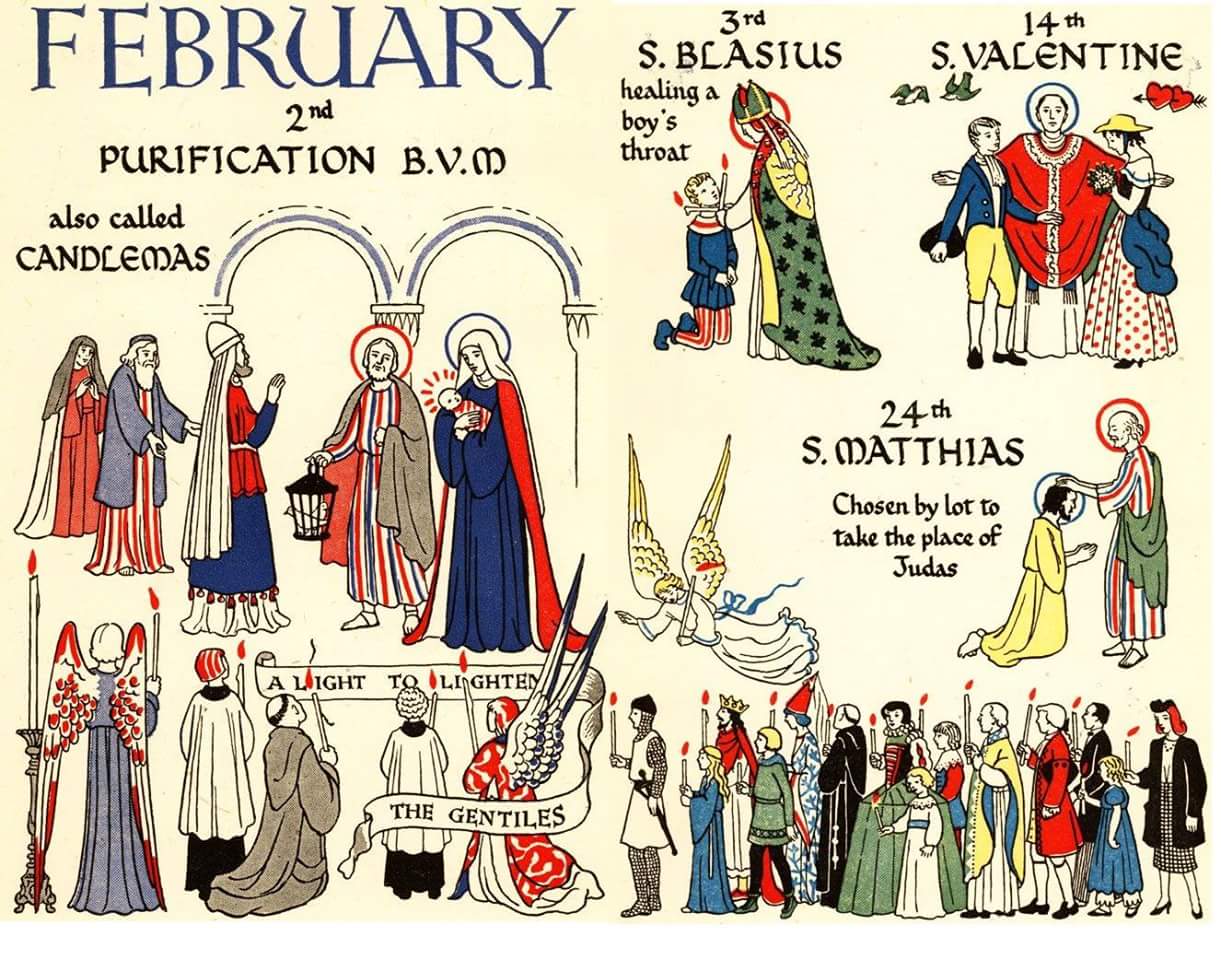
Candlemas (The Feast of the Purification of our Lady) is another day in which the Novus Ordo calendar greatly overlooks in importance.  The Feast of Candlmas, exactly 40 days after Christmas, commemorates Mary's obedience to the Mosaic law by submitting herself to the Temple for the ritual purification, as commanded in Leviticus.

The Feast of the Purification, is called Candlemas for the traditional blessing and distribution of candles on that day.  It is customary to bring candles from home to be blessed -- at least 51% beeswax candles that one uses for devotional purposes (candles for the family altar, Advent candles, etc.) -- so they can be lit after dusk on All Saints' Day (1 November), during the Sacrament of Unction, and during storms and times of trouble.  Nowadays, though, for those few parishes continuing this ancient observance, the parish will provide the candles.

Mass on Candlemas is typically preceded by a procession with the lighted candles and the singing of anthems. The lighted candles are held during the reading of the Gospel and from the beginning of the Canon of the Mass to Communion.

And this Season of Epiphanytide is also the time (typically depending on the length of the season), the Feast of St. Brigid, St. Agnes, and St. Blaise (on which day the Faithful's throats are blessed).

Let's remember not to neglect this season and give it our due observance.  After all, those of us praying the Older Breviary will find much beauty in the hymns and antiphons during this time.  More on those hymns and devotions associated with them will follow in subsequent posts.
Read more >>
Thursday, January 10, 2013
Traditional Roman Catholic Sunday Mass Propers


1962 vs. Pre-1955 Mass Propers

To those Catholics looking for the Traditional (pre-Vatican II) Sunday propers, look no further than the below list.  Do note: these are from the 1945 Missal and represent the Mass as it was said up until the changes made in 1955 by Pope Pius XII. The changes in the cycle of Sunday readings, outside of Holy Week, only really affected Sundays that previously had commemorations of Octaves. So you will notice commemorations of the Octave of the Sacred Heart, Corpus Christi, and the Ascension which are not retained in the 1962 Missal. We can in a greater way help preserve Catholic Tradition by keeping and praying these traditional Octaves and keeping the older readings that were part of the Faith for centuries. 

The most significant changes to the Missal in 1955 concern Holy Week but most of the readings remained the same except for the Easter Vigil, although the rubrics changed significantly. Notes on the differences between the Pre-1955 Readings and the Post-1955 readings are noted on each post.

Temporal vs. Sanctoral Cycle

The Proper of Seasons, called the Temporal Cycle, traces the earthly life of Our Lord Jesus Christ. It consists mainly of Sundays related to the various liturgical seasons. This maps onto the 7 liturgical seasons contained in the two cycles we previously discussed: the Christmas Cycle and the Easter Cycle. It starts with Advent then goes through Christmas, Epiphany, Septuagesima, Lent, Easter, and Time after Pentecost.

There is also the Proper of Saints, called the Sanctoral Cycle, which is the annual cycle of feasts not necessarily connected with the seasons. We commemorate and ask the intercession of those holy men and women who set a marvelous example that we should all strive to imitate. We also commemorate various events and mysteries of the faith in the Sanctoral Cycle.

The following are the traditional proper for the temporal cycle of readings in the Traditional Latin Mass for Sundays and select other holy days. 

ADVENT 


CHRISTMAS 

EPIPHANY
LENT 

HOLY WEEK [Notes on 1962 vs 1954 Readings are included]

ASCENSION 

PENTECOST

Read more >>
Sunday, February 16, 2025
A Catholic Life Podcast: Episode 105

In today’s episode, on the Septuagesima Sunday, I address the following:

  1. A Catholic Life Podcast 50 on Septuagesima
  2. The 7 Traditional Categories of Saints

This episode is sponsored by PrayLatin.comPrayLatin.com offers Latin prayer cards to learn and share prayers in the sacred language. Learn your basic prayers in Latin conveniently on the go. Practice your pronunciation with easy-to-follow English phonetic renderings of Latin words. PrayLatin.com offers prayer cards in various formats, including Latin-English rosary pamphlets with the traditional 15 mysteries. Shop for additional Latin resources like missal booklets, server response cards, and more. Visit PrayLatin.com today.

Subscribe to the podcast on Buzzsprout, Apple Podcasts, Spotify, I-tunes, and many other platforms!


Read more >>
Tuesday, February 14, 2017
Feast of The Prayer of Christ (Masses in Some Places)

Each year on the Tuesday after Septuagesima there was celebrated a "Mass in Some Places," according to the 1955 Missal. This special Mass is for The Prayer of Christ and has been around for several hundred years.  The Catholic Encyclopedia summarizes this special feastday that is worthy of our meditation:
This feast occurs on the Tuesday after Septuagesima (double major). Its object is to commemorate the prolonged prayer which Christ offered in Gethsemane in our behalf in preparation for His Sacred Passion. 
The Office insists on the great importance of prayer. The feast is placed at the beginning of Lent to remind us that the penitential season is above all a time of prayer. The Office probably was composed by Bishop Struzzieri of Todi, at the suggestion of St. Paul of the Cross (d. 1775), and, together with the other six offices by which the mysteries of Christ's Passion are celebrated (see Moveable Feasts in Some Places), was approved by Pius VI. 
The hymns were composed by Fatati (Schulte, "Hymnen des röm. Brev."). Outside the Congregation of St. Paul this feast was adopted later than any of the other feasts of the Passion. It is not found in the proprium of Salerno (1793) nor in that of Livorno (1809). Other dioceses took it up only after the city of Rome had adopted it (1831). It has not yet been inserted in the Baltimore Ordo.
Collect:

O Lord Jesus Christ, who in the garden, with words and example, taught us to pray to overcome the dangers of temptations, grant us, that, always intent on prayer, we deserve to obtain copious fruit: You who are God and live and reign with God the Father in the unity of the Holy Spirit for ever and ever. Amen.
Read more >>
Wednesday, September 7, 2005
Catholic Feast Days


Introduction:

Catholic Feastdays are days set aside to remember important people and events through the course of the Faith from the time of Mary's birth all the way through today honoring the saints. The calendar of saints has been changed throughout Church history to remove some saints in order that others may be celebrated too. One of these changes occurred in 1969, which greatly altered (arguably in a very bad way), the calendar.

Today, some Traditional Catholics like to follow the pre-1955 Calendar, some prefer the 1955 Calendar, and some prefer the 1962 Calendar.  These three calendars are very similar. The exceptions are noted below

The following calendar lists the General Roman Catholic Calendar.  Many saints are not on the General Calendar and some are only on specific calendars of specific orders or for specific areas of the world.  Yet, all saints have a feast day in the year, even if it is not universally celebrated on the General Calendar.

Temporal vs. Sanctoral Cycle:

This page concerns the Proper of Saints, called the Sanctoral Cycle, which is the annual cycle of feasts not necessarily connected with the seasons. We commemorate and ask the intercession of those holy men and women who set a marvelous example that we should all strive to imitate. We also commemorate various events and mysteries of the faith in the Sanctoral Cycle.

There is also the Proper of Seasons, called the Temporal Cycle, traces the earthly life of Our Lord Jesus Christ. It consists mainly of Sundays related to the various liturgical seasons. This maps onto the 7 liturgical seasons contained in the two cycles we previously discussed: the Christmas Cycle and the Easter Cycle. It starts with Advent then goes through Christmas, Epiphany, Septuagesima, Lent, Easter, and Time after Pentecost. For that reason, when you go to Mass on Sundays you likely will not hear the readings for the saints mentioned here. You should refer to the Traditional Sunday Propers for the Sunday readings since in most cases, the temporal cycle takes precedence over the Sanctoral Cycle.

Recommended Volumes of Meditation on the Catholic Liturgical Year:

The Liturgical Year (15 Volume Set) by Father Dom Gueranger (A MUST READ!)

Pre-1954 vs 1962 Calendar:

The following list by month indicates the Liturgical Year according to the General Roman Catholic Calendar as of 1954.  In 1954, Pope Pius XII instituted the feast of the Blessed Virgin Mary, Queen on May 31, and to make room for it, he moved the feast of St. Angela Merici to June 1. That was the final change before significant changes occurred in 1955. Besides the drastic changes and alterations to the Holy Week Liturgies in 1955 as part of the temporal cycle, there were a few other noteworthy changes. With the advent of the 1955 Calendar, Pope Pius XII instituted the feast of "St. Joseph the Worker" on May 1 (moving the feast of "Saints Philip and James" from May 1, where it had been since the sixth century, to May 11th, and suppressing the Patronage of St. Joseph that, since Pope Pius IX's decree of September 10, 1847, had been celebrated on the second Wednesday after the Octave of Easter).  

Additional changes that occurred in 1960 under John XXIII include the removal of most saints who were on the calendar twice. For instance, the Feast of the Finding of the Holy Cross, the 2nd feast of St. Agnes commemorating her apparition to her parents, and the Feast of St. John before the Latin Gate were all removed. These changes were incorporated in the 1962 Missal, however, a priest may still choose to offer a votive Mass for those saints on those traditional feastdays.

Some of the Movable Feasts (Some are part of the Temporal Cycle but included here for easy reference):
Movable Masses in Some Places (Relating more to the temporal cycle but included here for easy reference):
Traditional Calendar (1954)

Differences related to different calendars are noted in italicsSome Masses that were only celebrated in certain places at this time and were not on the Universal Calendar are noted as "Mass in Some Places". In the Month of November, various locations or orders keep special feasts of their own saints. Those are noted as well.

 January:
** Feast of the Holy Name: Sunday between the Circumcision and Epiphany [or January 2, when no such Sunday occurs]

February
Note: In a leap year, the Vigil of St. Matthias is kept on February 24, and any Feasts usually occurring from February 24 through 28 are kept one day later.


March

April
Wednesday after the II Sunday after Easter: Solemnity of St. Joseph, C - Double of the I Class
Wednesday after the III Sunday after Easter: Octave Day of St. Joseph, C - Greater Double


May


June


July


August


September

October


November


December
Read more >>


Copyright Notice: Unless otherwise stated, all items are copyrighted under a Attribution-NonCommercial-NoDerivatives 4.0 International License. If you quote from this blog, cite a link to the post on this blog in your article.

Disclosure of Material Connection: Some of the links on this blog are “affiliate links.” This means if you click on the link and purchase the item, I will receive an affiliate commission. As an Amazon Associate, for instance, I earn a small commission from qualifying purchases made by those who click on the Amazon affiliate links included on this website. I am disclosing this in accordance with the Federal Trade Commission’s 16 CFR, Part 255: “Guides Concerning the Use of Endorsements and Testimonials in Advertising.”