Saturday, November 5, 2005
A Catholic Wikipedia

November 2006 Update: The Catholic Wikipedia mentioned below, for a reason unknown to me, no longer exists. All work on there has been deleted. There is, however, a new Catholic Wikipedia project going on that is connected with the real Wikipedia. Help out if you can!


Update: I've added a few posts and see there is still a lot of work left to do. So much of our faith needs to be covered there for the encyclopedia to become close to ready to help others. I encourage everyone to add some pages. Just click on a link for a page and if you think it should be edited then edit it. Don't be afraid about not understanding the software there. After a few posts I understand completely how to edit posts and put in links.

Original Post: I'm the kind of person that loves using Wikipedia.com because it is the editable, online encyclopedia. Anyone can edit and create pages so it constantly is updated with the latest information. I especially like going to the Catholic articles and others to spread the faith. For example, I added information to the In vitro fertilization article to point out that the Catholic faith is opposed to it.

But now there is another encyclopedia online that can be edited by anyone and this is an entirely Catholic Wikipedia. Anyone can edit and I know many of my readers here could really help out the editing. Some of you are great on saint and others on pro-life issues. I know Paul from In Veritate Ambulare knows a lot about sacred vessels. So, I wanted to let everyone know that this project is now open in English because so many of you could help so much.
Read more >>
Friday, November 4, 2005
Common Questions on the Eucharist

Frequently Asked Questions on the Eucharist (FAQ)


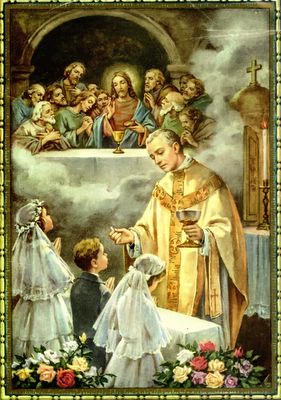
First Holy Communion at a Parish in France (March 1952)


Q: What is Holy Communion?

A: Also known as the Eucharist, Holy Communion is the center of the Catholic faith because it is truly the Body, Blood, Soul, and Divinity of Our Lord Jesus Christ. It is not in any way a symbol but literally Christ’s most Holy body. The bread and wine at the Mass become the holiest of holies through the priest’s words by the power of God. The moment when the Bread and Wine become Jesus Christ is called transubstantiation. The entire Gospel of John Chapter Six even wrote specifically on the Eucharist and how Christ’s body is truly present.

Some people that don't believe in the Eucharist say that Jesus meant for it to be symbolic. Well, then we look to the Gospel of John Chapter 6. That chapter is entirely on the Eucharist, and we see that when Our Lord tells them "Unless you eat my Body and Drink my Blood you will have no life within you" the people do one thing: they leave Him. If Jesus was speaking symbolically He would have said "No, you misunderstand" like He did before in the Gospels, but this time He just let them walk away. Thousands left Him, but He let them because what He spoke was literally true and they couldn't accept it. “Since Christ Himself has said, ‘This is My Body’ who shall dare to doubt that it is His Body? (Saint Cyril of Jerusalem)

For more information see: The Eucharist.

Q: Does the Sacred Host also contain Christ's Blood?


A: Yes, the Consecrated Host also contains the Blood, Soul, and Divinity of Our Lord. The wine also becomes at the Consecration not just Christ s Blood but His Body, Soul, and Divinity also. After the Consecration, the presence of Christ only remain. The consecrated bread may look like bread but no part of its substance is bread. Only the accidents (the mere appearance, taste, smell, etc) of bread remains the same applies to the Consecrated wine - it is not wine.

The breaking of the Body of Christ or the separation of the Blood does not divide Christ, so receiving only a piece of a full Communion Host is still receiving Jesus Christ completely (as affirmed at the Council of Trent: Thirteenth Session: Canon III)

Q: Do the People Also Need to Receive Holy Communion From the Chalice?

For centuries, only the priest alone received the Consecrated Wine from the chalice. The notion in the past few decades that the faithful need to also receive from the chalice is a grave error. The fullness of Christ is received under either species. Traditionally, as is still done of course in the Tridentine Mass, the faithful will only receive the Consecrated Host.

The Baltimore Catechism in Q. 900 advised, "The Church does not give Holy Communion to the people as it does to the priest under the appearance of wine also, to avoid the danger of spilling the Precious Blood; to prevent the irreverence some might show if compelled to drink out of a chalice used by all, and lastly, to refute those who denied that Our Lord's blood is present under the appearance of bread also."

For more information, please see Holy Communion Under One or Both Species?

Q: What are Eucharistic Miracles?

A: These are outward signs of the majesty of Our Lord’s true presence in the Holy Eucharist. I recognize this mirroring the Transfiguration when Our Lord on Mt. Tabor appeared dazzlingly white with Elijah and Moses. This was an outward manifestation of Our Lord’s immense greatness. The Transfiguration wasn’t in and of itself the greatest part of this mystery, but what is even greater is that Christ humbled Himself and kept in His immense glory while on earth.

Eucharistic miracles are the same where the Lord’s greatness reveals itself and scientific testing has proven it to be true blood and tissue. These miracles are not required beliefs of the Catholic faith, and the Eucharist from these Mass is no less amazing then the Eucharist at other Masses because the Eucharist is always the same true presence of Jesus Christ. Read about these beautiful miracles.

Q: If I suspect someone is taking the Eucharist from Mass without the intentions of giving it to the sick what should I do?

A: If someone takes Communion back to the pew and doesn’t consume it PLEASE report it to the priest or someone in an authority position at the parish. Sometimes people will take Our Lord’s Body to desecrate it and this destruction of Our Lord in the Eucharist is a grave sacrilege. We can help prevent this by working to stop Communion in the hand.

Q: Can Holy Communion ever be denied? 


A: It can be denied to individuals in a public act of scandal. For example, if one regularly known non-Catholic is at a Mass and wishes to receive Holy Communion it is to be denied. Holy Communion may - and should - be denied to those Catholics who promote intrinsic evils such as abortion, gay marriage, and artificial contraception. Also, if one suspects a person is going to desecrate the Eucharist it can be denied.

Q. Should the Faithful be Forced to Receive Communion in the Hand?

No. Even during health crises, Holy Communion may never be denied on the tongue. No one may force Holy Communion in the Hand. The Vatican has affirmed this.


Q: Are there special conditions on receiving the Eucharist?

A: Yes. One must be a Catholic in good standing with the Church. You must also obey the Eucharistic fast and not be in a state of mortal sin (Ecclesia de Eucharistia, 37). Those who have committed a mortal sin must first receive absolution in Confession. Those who fail to do so commit the most grievous sin of sacrilege.

The Catechism of the Council of Trent states, “As of all the sacred mysteries bequeathed to us by our Lord and Savior as most infallible instruments of divine grace, there is none comparable to the most holy Sacrament of the Eucharist; so, for no crime is there a heavier punishment to be feared from God than for the unholy or irreligious use by the faithful of that which contains the author and source of holiness.”

St. Cyril of Alexandria explains further the gravity when he says, “They who make a sacrilegious Communion receive Satan and Jesus Christ into their heart.  Satan, that they may let him rule, and Jesus Christ that they may offer Him in sacrifice to Satan.”

That’s a sacrilegious Communion.  That’s why it is so grave and evil and truly few sins offend the Lord’s heart as much as this.  Indeed, our Lord told St. Bridget in a vision, “There does not exist on earth a punishment great enough to punish it sufficiently.”

Q: How many times a day can we receive communion?

A: In the old 1917 Code of Cannon Law, reception of Holy Communion more than once a day was prohibited. Unfortunately, in another novelty after Vatican II, the 1983 Code was revised to state that Holy Communion can be received twice a day, noting though that the second time must be in a Mass. Traditionally, we receive our Lord only once a day (that is once each calendar day and not necessarily once every 24 hours). Traditional Catholics will still maintain this practice.

As an exception to both the 1917 and the 1983 Canon Law, a person may receive Holy Communion again the same day in the form of the Viaticum, which is the name of the Eucharist when given to one who is extremely ill and seemly near death. Holy Communion is often given to souls during Last Rites, and it would be called Viaticum.

"Christ held Himself in His hands when He gave His Body to His disciples saying: 'This is My Body.' No one partakes of this Flesh before he has adored It" (Saint Augustine).

Q: What act of reverence should we show before receiving Holy Communion?

A: An act of reverence must be made before receiving Holy Communion because it is showing reverence to Our Lord truly present before us. People are also still allowed to receive the Holy Eucharist while kneeling, and as is the traditional practice, Holy Communion should be received while kneeling.

Q: What is Intinction?

A: Intinction is only allowed to be performed by the ordinary minister of Holy Communion (i.e. the priest). No "lay minister" may do so. Intinction is where the Sacred Host is dipped in the Sacred Blood of Christ. In the Byzantine Rite one receives the Lord without saying “Amen” but the priest puts the Host dipped in the Sacred Blood in the person’s mouth. Those receiving this way always have their head tipped backwards.

This form of receiving Holy Communion is rarely observed in the Roman Catholic Rite because of the risk of dripping the Lord's body and blood on the ground. When observed, the priest has a minister standing at his side holding the consecrated wine and he takes a particle of the consecrated bread and dips it. He then says "The body and blood of Jesus". A paten must be held under the Body and Blood to prevent any from falling to the ground. While uncommon, this form of receiving is permitted in the Roman Catholic Church (i.e. the Latin Rite).

Q: What is the Eucharistic fast and how long is it?

A: The Eucharistic fast is a fast before receiving Holy Communion to observe a period of reflecting and spiritual hunger for Our Lord. Currently, only medicine and water are allowed before hand, but if one needs to eat for serious medical reason this can be circumvented. Note that a priest who celebrates the Eucharist two or three times a day can take something before the second and third Mass even if it is less than one hour before receiving the Blessed Sacrament again. Also, the elderly, ill, and those that care for them may receive the Eucharist if they have eaten something in the previous hour (Canon 919).

 Many Traditional Catholics will take part in the traditional fast, which was three hours long. Other Traditional Catholics will take part in an older form of the fast which mandated fasting from midnight until receiving Communion.

For more thorough information see: What is the Eucharistic Fast?

Q: How often is one required to receive the Eucharist?

A: A Catholic is only required to receive the Eucharist once a year and that is to be done during the Easter season (Canon 920). However, one should receive our Lord more often - even daily - if they are in the state of grace and have the right dispositions so they do not receive our Lord out of mere habit.

When is the Easter Season for the purpose of observing our "Easter Duty"? In the United States it is from the first Sunday of Lent to Trinity Sunday inclusive; in other countries, the season may begin on Ash Wednesday and close on Low Sunday or Ascension Thursday.
Read more >>
In Vitro Fertilization and the Catholic Faith


In vitro fertilization is not permitted in the Catholic faith for any reason; instead, adoption is encouraged and there are morally acceptable options for infertile couples. Currently, according to a July 4th issue of Newsweek, IVF costs $9,000 and 25% of all cycles now involve a live birth. It should also be noted that there is a serious though rare side effect, Ovarian Hyperstimulation Syndrome (OHSS), that has killed patients using IVF. (An example of a woman in the UK) And, 6 million embryos, human beings like us, have died because of this procedure. That is roughly 80-90% of all embryos created in IVF. In the US, 170,000 embryos die each year.

UpdateRead Why Catholics Must Reject IVF, published in May 2024

Speech of Pope Pius XII to Catholic Doctors in Rome for their 4th International Congress (Sept. 29, 1949), Acta Apostolicae Sedis 49:

"Artificial fertilization, outside of marriage, is to be condemned outright as immoral. Such is indeed the natural law and the positive divine law, that the procreation of a new life can only be the fruit of marriage. Marriage alone safeguards the dignity of the spouses (mainly the woman in this case), their personal property. By itself, only it provides for the good and education of the child. Consequently, on the condemnation of artificial fertilization outside the conjugal union, no difference of opinion is possible between Catholics. A child conceived under these conditions would, by the very fact, be illegitimate.

"Artificial fertilization in marriage, but produced by the active element of a third party, is also immoral and, as such, to be condemned without appeal. Only the spouses have a reciprocal right over their body to engender a new life, an exclusive, non-transferable, inalienable right. And that must also be taken into consideration of the child. To anyone who gives life to a small being, nature imposes, by virtue of this bond, the burden of its conservation and education. But between the legitimate husband and the child, the fruit of the active element of a third party (the spouse was he consenting), there is no bond of origin, no moral and legal bond of conjugal procreation.

"As for the lawfulness of artificial fertilization in marriage, it suffices for us, for the moment, to recall these principles of natural law: the simple fact that the result to which we aim is achieved by this route, does not justify the use of the medium itself; nor the desire, in itself very legitimate among spouses, to have a child, is not enough to prove the legitimacy of the recourse to artificial fertilization, which would fulfill this desire.

"Let it not be forgotten: only the procreation of a new life according to the will and the plan of the Creator carries with it, to an astonishing degree of perfection, the achievement of the aims pursued. It is, at the same time, in conformity with the bodily and spiritual nature and with the dignity of the spouses, with the normal and happy development of the child."
Read more >>
St. Martin de Porres


Optional Memorial (1969 Calendar): November 3

St. Martin de Porres (1579 - 1639) showed commendable love, especially for the Holy Eucharist, and he worked tirelessly for the good of others. He set up an orphanage for poor children and a shelter for stray dogs and cats to be nursed back to health. He always helped others and was even called St. Martin of Charity.

St. Martin de Porres was born into poverty and spent time as a surgeon-barber, where he learned medicine. At age 11, he became a servant in the Holy Rosary Dominican priory in Lima, Peru. He begged for money from the rich and collected more than $2,000 a week to care for the poor and sick of Lima. In 1603, he took vows as a Dominican brother. He also fasted regularly, never ate meat, and spent much time in prayer and meditation. St. Martin had many gifts, including levitation and bilocation. He died of a fever in 1639.

Pope Gregory XVI beatified Martin de Porres on October 8, 1837. Pope John XXIII canonized him in Rome on May 6, 1962. He was the first canonized black saint from the Americas. 

Prayers to Saint Martin de Porres:

O GOD, Who has given us In Your humble Son, Our Lord Jesus Christ, The model of all virtue And perfection, Grant to us The virtue of humility. We think so little of You Because we are So full of ourselves. We cannot love You more Until humility shows us Our own nothingness And makes us rejoice In our complete Dependence upon You. You have given to the world a glorious apostle of humility: 

ST. MARTIN DE PORRES. Guide us by his example And strengthen Us through his intercession In our efforts To conform our hearts To the humble Heart Of Your crucified Son. May the glory of sainthood Which you have Deigned to bestow Upon Brother Martin Draw the world closer And closer to You. Renew, O Lord, in these days When pride and forgetfulness Of You are so widespread, The wonders which You performed Through Your humble servant During his lifetime. Through the same Christ Our Lord. Amen. Our Father, Hail Mary, Glory Be (3 times each.)
Read more >>
Wednesday, November 2, 2005
All Soul's Day

Solemnity (1969 Calendar): November 2
Double (1955 Calendar): November 2

Today is the day after the Solemnity of All Saints and is the Commemoration of All the Faithful Departed (All Souls). This feast, dating back to the 11th Century, is a time to remember all of the faithfully depart and pray that they are now in the grace of God. God certainly is Love and He is mercy. The only thing we can do is trust in Him and pray for our loved ones.

In the middle of the 11th century, St. Odilo, the abbot of Cluny (France), said that all Cluniac monasteries were to offer special prayers and sing the Office for the Dead on November 2, the day after the feast of All Saints. The custom spread from Cluny and was adopted throughout the entire Roman Catholic Church. Now the entire Church celebrates November 2nd as All Soul's Day.

Indulgence:
To gain a Plenary Indulgence form noon Nov. 1 until midnight Nov. 2, visit the church, pray for the Holy Souls and also for the intentions of the Holy Father. On All Soul's Day and for a week afterward, a Plenary Indulgence for the Holy Souls is granted for a visit to the cemetery with devotion and prayer for the dead. All through November, you can gain partial indulgence every day you visit the cemetery and pray for the dead.

Also a Mass said for a person during life or death is worth immense value because the Mass is the memorial of Jesus Christ's sacrifice of the Cross. Mary, in one apparition, once told someone that Our Lord would die for us again as many times as we have heard Mass. The Mass is extremely important.

Today let's remember to pray for the souls in purgatory and those faithfully departed. Please pray with your whole heart and mind this following prayer, which Our Lord promised St. Gertrude would free 1,000 souls from purgatory.
Eternal Father, I offer Thee the Most Precious Blood of Thy Divine Son, Jesus, in union with the Masses said throughout the world today, for all the Holy Souls in Purgatory, for sinners everywhere, for sinners in the Universal Church, those in my own home and within my family.Amen.

Prayer:

O God, the Creator and Redeemer of all the faithful: grant to the souls of Thy servants and handmaidens the remission of all their sins: that through pious supplications, they may obtain the pardon which they have always desired: Who livest and reignest.

Prayer Source: 1962 Roman Catholic Daily Missal
Read more >>
Tuesday, November 1, 2005
The Feast of All Saints

"The Landauer Altarpiece, All Saints Day" by Albrecht Durer (1471 - 1528) , 1511, oil on panel, Kunsthistorisches Museum, Vienna, Austria, 123 x 135 cms

Solemnity (1969 Calendar): November 1
Double of the I Class (1955 Calendar): November 1

Today is a great day in the Church year because it is All Saints Day - a Day of Holy Obligation for most countries, meaning all Catholics must attend Mass today. 

For today's traditional Mass Propers, please click here. Today, we remember all of those saints now in Heaven, both known and unknown, and reflect on their lives. Saints are great role models. Go read some of my posts on the Saints and read about a few of them - see that Heaven isn't easy. All Saints Day is preceded by the Vigil of All Saints (i.e. Halloween) which is traditionally a day of fasting and abstinence in preparation for today's great holy day.

The Catholic Encyclopedia provides a short account of the history of All Saints Day:

In the early days the Christians were accustomed to solemnize the anniversary of a martyr's death for Christ at the place of martyrdom. In the fourth century, neighbouring dioceses began to interchange feasts, to transfer relics, to divide them, and to join in a common feast; as is shown by the invitation of St. Basil of Caesarea (379) to the bishops of the province of Pontus. Frequently groups of martyrs suffered on the same day, which naturally led to a joint commemoration. In the persecution of Diocletian the number of martyrs became so great that a separate day could not be assigned to each. But the Church, feeling that every martyr should be venerated, appointed a common day for all. The first trace of this we find in Antioch on the Sunday after Pentecost. We also find mention of a common day in a sermon of St. Ephrem the Syrian (373), and in the 74th homily of St. John Chrysostom (407). At first only martyrs and St. John the Baptist were honoured by a special day. Other saints were added gradually, and increased in number when a regular process of canonization was established; still, as early as 411 there is in the Chaldean Calendar a "Commemoratio Confessorum" for the Friday after Easter. In the West Boniface IV, 13 May, 609, or 610, consecrated the Pantheon in Rome to the Blessed Virgin and all the martyrs, ordering an anniversary. Gregory III (731-741) consecrated a chapel in the Basilica of St. Peter to all the saints and fixed the anniversary for 1 November. A basilica of the Apostles already existed in Rome, and its dedication was annually remembered on 1 May. Gregory IV (827-844) extended the celebration on 1 November to the entire Church. The vigil seems to have been held as early as the feast itself. The octave was added by Sixtus IV (1471-84).

Indulgences for This Time of Year (Each Paragraph is a separate one):
The faithful who recite prayers or perform other devout exercises in supplication for the faithful departed during the month of November, may gain a plenary indulgence on the usual conditions, if they perform these devotions daily for the entire month. 
Those, who during the aforesaid month, take part in public services held in a church or public oratory in intercession for the faithful departed may gain a plenary indulgence, if they attend these exercises on at least fifteen days and, in addition, go to confession, receive Holy Communion and pray for the intentions of the Sovereign Pontiff (Jan. 17, 1888)

The faithful, as often as they visit a church or public oratory, or even a semi-public oratory (if they may lawfully use the same), in order to pray for the dead on the day on which the Commemoration of All the Faithful Departed is celebrated (November 2nd) or on the Sunday immediately following, may gain a plenary indulgence applicable only to the souls detained in Purgatory, on condition of confession and Communion, and the recitation six times during each visit of Our Father, Hail Mary, and Glory Be for the intentions of the Sovereign Pontiff (June 25, 1914)

The faithful who during the period of eight days from the Commemoration of All Souls inclusive, visit a cemetery in a spirit of piety and devotion, and pray, even mentally, for the dead may gain a plenary indulgence on the usual conditions, on each day of the Octave, applicable only to the dead.

Raccolta Source
The Toties Quoties Indulgence

Additionally, from noon on All Saints Day through midnight of All Souls Day, the Catholic faithful, as often as they visit a church to pray for the dead, reciting six times during each visit the Our Father, Hail Mary and Glory Be for the intentions of Holy Mother Church may gain a plenary indulgence applicable only to the souls in Purgatory, under the usual conditions of making a good Confession within a week before or after, worthily receiving Holy Communion within the week and having the right intention of heart. 

Besides assisting at Holy Mass today, consider praying the Rosary at night in anticipation of All Souls Day tomorrow. And keep in mind, prior to 1955, there was an Octave Associated with All Saints!  In the midst of that Octave was the Feast of the Sacred Relics.  Let's keep the memory of these past traditions alive.

Prayer:

Almighty and everlasting God, Who hast enabled us to honor in one solemn feast the merits of all Thy Saints: we beseech Thee, that, with so many praying for us, Thou wouldst pour forth on us the abundance of Thy mercy for which we long. Through our Lord.

Prayer Source: 1962 Roman Catholic Daily Missal
Read more >>
Monday, October 31, 2005
Why call yourself "Moneybags"?

I have been asked a lot why I call myself "Moneybags" for a screenname. First off, I don't do this for greed as some would think. The idea for my screenname was a result of Monopoly. I love the boardgame, so I planned on calling myself "Pennybags". However, since I like to be original, I changed it to "Moneybags".

Also, when I was very young I enjoyed playing the video game Spyro. And one of the characters on the game was named Moneybags. That was what caused me to take my original idea of Pennybags and turn it into Moneybags.

I hope I cleared up any questions, and I hope you enjoy the blog!

Note: This was my original username on the blog.
Read more >>
Pro-life Alito nominated to Supreme Court

Well, it's official that in the US, Samuel A. Alito Jr., has been nominated to the US Supreme Court and is enthusiastically supported by pro-life groups. To read the press release by the National Pro-life Action Center, visit this Washington Post article.

Let's remember to thank God for giving us a pro-life nominee that will not only stand up for the unborn but all peoples that are unfortunate.

Also, as Catholic Fire pointed out, if Alito is confirmed then five Catholics would be on the bench and represent a majority (Roberts, Scalia, Thomas, Kennedy, & Alito). And, if each one of them stood up for the Catholic beliefs on abortion, stem cells, euthanasia, etc our society would be so much closer to living by God's standards as He commanded us not to sin.

Alito is known for his decision in our particular case as noted by Wikipedia:

"He is known for his conservative judicial views. In one of his most cited decisions, he was the sole dissenter in Planned Parenthood v. Casey in 1991. In that case, he voted to uphold a Pennsylvania law that required women to tell their husbands before having an abortion, noting that the law allowed certain exceptions such as an abusive spouse. The Supreme Court struck down the law in 1992." (SOURCE)

Again, the issue here isn't at all like some think - taking away womens' rights. The issue lies in protecting the rights of the unborn child that it may have the ability for "life, liberty, and the pursuit of happiness". Let's pray Alito is nominated and stands up for the rights of all citizens so that no one is left behind to die but all are treated equally.

Image Source: In the Public Domain (same Wikipedia article)
Read more >>
Sunday, October 30, 2005
November: A Month to Pray for the Souls in Purgatory


I wanted to post today on November, which is the traditional month to especially pray for the souls in purgatory. I have outlined here a few past posts of mine that I'd like to share that could answer questions on purgatory. The recent Synod of Bishops in Rome spoke on many recommendations and one of which is to make homilies more apologetic (defending the Catholic faith). So, I would like to pass on these links to defend the faith and teach it and I hope others at their blogs will mention this month. These poor souls need our prayers since they can't pray for themselves in purgatory; let us pass on the word to pray, pray, and pray for them.
"The holy souls are eager for the prayers of the faithful which can gain indulgences for them. Their intercession is powerful. Pray unceasingly. We must empty Purgatory!" -- St. Padre Pio.
From Catholic Education:
One pain that is likely in store for most of us is the frustration that will come from the awareness that the living have the ability to grant tremendous relief by offering fasts, alms, prayers, i.e., The Rosary, The Act of Reparation, The Acts of Faith, Hope, and Charity, The Stations of the Cross, and The Sacrifice of the Mass, etc., in suffrage for us, but are not doing so because they don’t realize they have this power to help us, nor that there is a spiritual treasury of the Church available for them to relieve us, nor that we even need their help, because we did not pass on to them these enduring truths of the faith.
Indulgence:
To gain a Plenary Indulgence form noon Nov. 1 until midnight Nov. 2, visit the church, pray for the Holy Souls and also for the intentions of the Holy Father. On All Soul's Day and for a week afterward, a Plenary Indulgence for the Holy Souls is granted for a visit to the cemetery with devotion and prayer for the dead. All through November, you can gain partial indulgence every day you visit the cemetery and pray for the dead.

Source
Ideas for this November:
Other Recommended Posts:
Read more >>
Begin Prayer for Souls in Purgatory

Today I am beginning a special 7-day long prayer for the poor souls in purgatory especially with All Saints Day and All Souls Day approaching. St. Padre Pio repeatedly called for prayers and prayed for the souls in purgatory as did many of our holy Pontiffs and saints of centuries past. Purgatory is a Catholic Dogma and a required belief of the faith.

Our Lord once appeared to St. Gertrude and gave her a prayer for the souls in purgatory, and He promised that every time it was said that 1,000 souls would escape from purgatory.

Prayers for Each Day

Preparatory Prayer

My Jesus, by the sorrows You suffered in Your agony in the Garden, in Your scourging and crowning with thorns, in Your journey to Calvary, and in Your crucifixion and death, have mercy on the souls in Purgatory, and especially on those that are most forsaken; deliver them from the torments they endure; call them and admit them to Your most sweet embrace in Paradise, where You live with the Father and the Holy Spirit, one God, forever and ever. Amen. (FROM THE RACCOLTA)

(Here say the prayer for the day)

0ur Father

Our Father in Heaven, Your Kingdom come; Your will be done on earth, as it is in Heaven. Give us this day our daily bread; and forgive us our sins, as we forgive those who sin against us; and lead us not into temptation, but deliver us from evil. Amen.

Hail Mary

Hail Mary, full of grace, the Lord is with you; blessed are you among women; and blessed is the fruit of your womb, Jesus. Holy Mary, Mother of God, pray for us, sinners, now and at the hour of our death. Amen.

Eternal Rest

Eternal rest, grant unto them, O Lord; and let perpetual light shine upon them. May they rest in peace. Amen.

Concluding Prayer

Merciful Father, hear our prayers and console us. As we renew our faith in Your Son, Whom You raised from the dead, strengthen our hope that all our departed brothers and sisters will share in His resurrection, who lives and reigns with Thee and the Holy Spirit, one God, forever and ever. Amen.

Sunday

O Lord God Almighty, I beseech You, by the Precious Blood which Your Divine Son Jesus shed in the Garden, deliver the souls in Purgatory, and especially that one which is the most forsaken of all, and bring him into Your glory, where he may praise and bless You forever. Amen.
Our Father. Hail Mary. Eternal rest, etc.

Monday

O Lord God Almighty, I beseech You, by the Precious Blood which Your Divine Son Jesus shed in His cruel scourging, deliver the souls in Purgatory, and, among them all, especially that soul who is nearest to his entrance into Your glory, that he may soon begin to praise You and bless You forever. Amen.

Tuesday

O Lord God Almighty, I beseech You, by the Precious Blood of Your Divine Son Jesus that was shed in His bitter crowning with thorns, deliver the souls in Purgatory, and, among them all, particularly that soul who is in greatest need of our prayers, in order that he may no longer be delayed in praising You in Your glory and blessing You forever. Amen.

Wednesday

O Lord God Almighty, I beseech You, by the Precious Blood of Your Divine Son Jesus that was shed on the streets of Jerusalem, while He carried on His sacred shoulders the heavy burden of the Cross, deliver the souls in Purgatory, and especially the one who is richest in merits in Your sight, so that, having soon attained the high place in glory to which he is destined, he may praise You triumphantly and bless You forever. Amen.

Thursday

O Lord God Almighty, I beseech You, by the Precious Body and Blood of Your Divine Son Jesus, which He Himself, on the night before His Passion, gave as meat and drink to His Beloved Apostles and bequeathed to His Holy Church to be the Perpetual Sacrifice and life-giving nourishment of His faithful people, deliver the souls in Purgatory, and, most of all, that soul who was most devoted to this Mystery of infinite love, in order that he may praise You therefore, together with Your Divine Son and the Holy Spirit in Your glory forever. Amen.

Friday

O Lord God Almighty, I beseech You, by the Precious Blood which Jesus Your Divine Son did shed this day upon the tree of the Cross, especially from His sacred hands and feet, deliver the souls in Purgatory, and particularly that soul for whom I am most bound to pray, in order that I may not be the cause which hinders You from admitting him quickly to the possession of Your glory, where he may praise You and bless You forevermore. Amen.

Saturday

O Lord God Almighty, I beseech You, by the Precious Blood which gushed forth from the sacred side of Your Divine Son Jesus in the presence and to the great sorrow of His Most Holy Mother, deliver the souls in Purgatory, and, among them all, especially that soul who has been the most devout to this noble Lady, that he may come quickly into Your glory, there to praise You in her, and her in You, through all the ages. Amen.

The St. Gertrude Prayer:

Eternal Father, I offer Thee the Most Precious Blood of Thy Divine Son, Jesus, in union with the Masses said throughout the world today, for all the Holy Souls in Purgatory, for sinners everywhere, for sinners in the Universal Church, those in my own home and within my family. Amen.

Image Source: Believed to be in the Public Domain
Read more >>
What Does it Mean to Be a Saint?

I heard this story once from my parish's pastor, and it is a true story.

One time in a religious education class the instructor asked her students, "What does it mean to be a saint?" One girl raised her hand and said, "I know the answer; I learned this from the stained glass windows in church - to be a saint means to let the light shine through."

Image Source: Believed to be in the Public Domain
Read more >>
Friday, October 28, 2005
Miers Was Not Catholic

According to an article found via the Roman Catholic blog, Harriet Miers was never even Catholic when we all read that she was indeed a Catholic. I'm glad that after past evidence of her possibly being pro-choice and now this news, that another person will be nominated.
Read more >>
Christ-Haunted Blog

It seems that the blog, Christ-Haunted is down in readers. It's a very good blog and one of my favorites to browse through.
Read more >>
Thursday, October 27, 2005
What book of the Bible are you?

You are Leviticus


You are Leviticus.


Which book of the Bible are you?
brought to you by Quizilla
Read more >>
Wednesday, October 26, 2005
Blog Maintenance

I wanted to clean out my blog and was looking for suggestions on making it more user friendly. For example, do you think I have too many links in the sidebar? Which ones would you cut out?

Thanks in advance for any suggestions
Read more >>
Pro-life Victory!

In response to a past post of mine on a Missouri pro-life law, I wanted to update everyone. Recently a bill became law in Missouri stating that abortion facilities have admitting privileges at a local hospital 30 miles from the center in case of a botched abortion. Planned Parenthood filed a lawsuit, but they have now withdrawn the lawsuit and the abortion clinic in Springfield, Missouri is closed!

(Read More)
Read more >>
Mary As Co-Redemptrix


Co-Redemptrix in Scripture

Regarding the specific use of the title of “Co-Redemptrix,” theologians have asserted this unique role of our Blessed Mother for centuries even though it has not been dogmatically defined as the Assumption or the Immaculate Conception were infallibly defined by the Vicar of Christ.

As recorded in the Gospel, the Archangel Gabriel spoke to the Blessed Virgin Mary:

“And the angel answering, said to her: The Holy Ghost shall come upon thee, and the power of the most High shall overshadow thee. And therefore also the Holy which shall be born of thee shall be called the Son of God. And behold thy cousin Elizabeth, she also hath conceived a son in her old age; and this is the sixth month with her that is called barren: Because no word shall be impossible with God” (Luke 1:35-37).

By this address to the Virgin Mary, the Archangel showed Her the sign that nothing is impossible with God as has been shown through St. Elizabeth’s conception of St. John the Baptist. And our Blessed Mother replied with insurmountable humility and wisdom in such a way that deserves repeating both now and forever: “Behold the handmaid of the Lord; be it done to me according to thy word. And the angel departed from her” (Luke 1:38) 

This radical humility is essentially the cornerstone of the Gospel. Without humility, there would be no Savior. He chose to dwell among us and humble Himself to suffer hunger, thirst, work, and the Cross. Mary also humbled herself in such a radical way by allowing Christ to take her body and turn it into the Ark of the New Covenant, where the greatest of all treasures would be kept. This is preciously one reason Mary is given the title Co-Redemptrix because she consented to be the Mother of God, but it is also because Mary plays a pivotal role in Christ’s sufferings and death.

In no way, however, does the title of Co-Redemptrix mean that Mary was equal to God as she also needed a Savior. As expressed with certainty and clarity in the Collect Prayer for the Feast of the Immaculate Conception, Christ saved His mother from sin before her conception:

O God, Who, by the Immaculate Conception of the virgin, didst prepare for Thy Son a worthy habitation, we beseech Thee, that as Thou didst preserve her from every stain by the foreseen death of this Thy Son, so Thou wouldst grant that we also being cleansed from guilt by her intercession, may come to Thee. Through the same our Lord.

St. Maximilian Kolbe, addressing this important point, affirms the Blessed Virgin Mary as Co-Redemptrix while asserting, contrary to the false claims of Protestants, her inferiority in comparison with God Himself:

“The title of Co-redemptrix applied to Mary never places her on a level of equality of with Jesus Christ, the divine Lord of all, in the saving process of humanity’s redemption. Rather, it denotes Mary’s regular and unique sharing (although subordinate and dependent) with her Son in the saving work of redemption for the human family. 

“The Mother of Jesus participates in the redemptive work of her Son, who alone could reconcile humanity with the Father in His glorious divinity and humanity. Because of her intimate and unparalleled sharing in the mysterious work with the divine Redeemer, both at the Incarnation (cf Lk 1:28) and at the work of redemption at Calvary (cf Jn19:26), Mary has merited the Church title, ‘Co-redemptrix’ which literally means, ‘with the Redeemer.’”

The Popes on Mary as Co-Redemptrix

While the title "Coredemptrix" first received Papal sanction under Pope St. Pius X, by his approval of its use in a decree of the Congregation of Rites concerning the feast of the Seven Dolors (A.A.S., Vol. 41, 1908, p. 409), centuries of tradition affirm the Blessed Virgin Mary’s role as Co-Redemptrix (i.e., working with the Redeemer) to bring about the world’s salvation.

Pope St. Pius X explains, "from this common sharing of sufferings and will, She merited to become most worthily the reparatrix of the lost world, and so the dispensatrix of all the gifts which were gained for us by the death and blood of Jesus. ... since She was ahead of all in holiness and union with Christ, and was taken up by Christ into the work of human salvation, She merited congruously, as they say, what Christ merited condignly, and is the chief minister of the dispensation of graces (Ad diem illum, Feb. 2, 1904).

His successor, Pope Benedict XV, teaches, "With Her suffering and dying Son She suffered and almost died, so did She surrender Her mother's rights over Her Son for the salvation of human beings, and to appease the justice of God, so far as pertained to Her, She immolated Her Son, so that it can be rightly said, that She together with Christ has redeemed the human race" (Admodum probatur, June 20, 1917).

The Sources of Catholic Dogma, Denzinger, plainly states: “In the decree of the Sacred Congregation of the Holy Office (section on indulgences), Sunt quos amor, June 26, 1913 (AAS 5 (1913) 363), he [Pope Benedict XV] praises the custom of adding to the name of Jesus the name of ‘His Mother, our coredemptor, the blessed Mary’; cf. also the prayer enriched by the Holy Office with an indulgence, in which the Blessed Virgin Mary is called ‘coredemptress of the human race’ (Jan. 22, 1914; AAS 6 [1914] 108).”

And after the death of St. Pius X, Pope Pius XI continued to affirm Mary as Co-Redemptrix throughout the years:

“The Virgin participated with Jesus Christ in the very painful act of the redemption” (Explorata res, 1923).

“And now lastly may the most benign Virgin Mother of God smile on this purpose and on these desires of ours; for since she brought forth for us Jesus our Redeemer, and nourished Him, and offered Him as a victim by the Cross, by her mystic union with Christ and His very special grace she likewise became and is piously called a reparatress [Co-Redemptrix]” (Miserentissimus Redemptor, 1928)

“[Mary became the Mother of Jesus] in order that she might become a partner in the redemption of the human race” (Auspicatus profecto, 1933)


The Theological Certainty of Mary as Co-Redemptrix:

Fathers Iesu Solano and J.A. de Aldama in Sacrae Thologiae Summa IVa "On the Incarnate Word; On the Blessed Virgin Mary" affirm, after considering the Scripture and Tradition surrounding our Lady the certainty of this title:

“That Mary cooperated with the work of the Redemption, at least mediately, is a matter of faith.

“That she also cooperated immediately is a doctrine more in conformity with the quoted texts of the Holy Pontiffs. Indeed these texts, taken together as a whole, signify the constant teaching for a century of the Roman Pontiffs proposed to the whole Church more clearly with the passage of time for they are not unaware of the disputes of theologians over this matter.

“That the title of Co-redemptrix is used rightly is certain; and it is not licit to doubt about its suitability.”

Simply put, those who claim that Mary should not be given the title of Co-Redemptrix gravely error and cause scandal to the entire Church. For such errors, I suggest offering a prayer of reparation
Read more >>
Newly Canonized Saints

Note: For an updated list of the recent canonizations, please click here.

Józef Bilczewski
Gaetano Catanoso
Zygmunt Gorazdowski
Alberto Hurtado Cruchaga
Felix of Nicosia

These people are, like all other saints, true role models showing us that belief in Christ and following his Church is essential to Heaven. Follow the Church's teachings on all Dogmas and matters of faith including birth control, stem cell research, euthanasia, salvation, grace, the Sacraments, and all other issues.

"Wrong is wrong, even if everyone else is doing it. Right is right, even if no one else is doing it."- St. Augustine

Image Source: Photo believed to be in the Public Domain
Read more >>
Monday, October 24, 2005
Summary on the Synod Final Update

I haven't followed the Synod too closely, but I wanted to post a summary of some Synod news for readers. This Synod is a three week assembly on the Eucharist and the first synod under Pope Benedict XVI during what better time than during the end of the Year of the Eucharist.

Note: Links below are to the National Catholic Reporter. I do not endorse all - even most - of the content.

1. Priest shortage is first concern (10/3)
2. Topic of Divorced/Remarried Catholics takes center stage (10/5)
3. The environment and social justice emerge as topics (10/6)
4. Outreach to Latin Mass Catholics (10/15)
5. How is Jesus present in the Eucharist? (10/17)
6. Day of Reflection and Adoration (10/17)
7. Draft on 50 propositions presented (10/18) (287 propositions originally submitted)
8. No changes on Church discipline recommended (10/18)
9. 50 Propositions released (10/22)
10. End of the Synod (10/23)

Year of the Eucharist ends (10/23)

This Sunday the Year of the Eucharist formally ended, but I pray that love for Christ truly present (Body, blood, soul, and divinity) in the Holy Eucharist might not end. For continued information on the Eucharist visit the Year of the Eucharist Website. Also, at the closing Mass for the Year of the Eucharist, Pope Benedict XVI officially declared five individuals as saints. Read Our Holy Father's homily

"For I have received of the Lord that which also I delivered unto you, that the Lord Jesus, the same night in which he was betrayed, took bread. And giving thanks, broke, and said: Take ye, and eat: this is my body, which shall be delivered for you: this do for the commemoration of me. In like manner also the chalice, after he had supped, saying: This chalice is the new testament in my blood: this do ye, as often as you shall drink, for the commemoration of me. For as often as you shall eat this bread, and drink the chalice, you shall shew the death of the Lord, until he come. Therefore whosoever shall eat this bread, or drink the chalice of the Lord unworthily, shall be guilty of the body and of the blood of the Lord. But let a man prove himself: and so let him eat of that bread, and drink of the chalice. For he that eateth and drinketh unworthily, eateth and drinketh judgment to himself, not discerning the body of the Lord. Therefore are there many infirm and weak among you, and many sleep" (1 Cor. 11:23-30).
Read more >>
World Catholic Population: 2003

 
With statistics now out for 2003, the Catholic population grew by 15 million and on all continents but Europe where it fell be slightly over 200,000. I pray the Church grows and all Christians become united in the One, Holy, Catholic, and Apostolic Church one day. Only through prayer and example can we make Christ's prayer in the Garden true: "...That they might be one."
Read more >>


Copyright Notice: Unless otherwise stated, all items are copyrighted under a Attribution-NonCommercial-NoDerivatives 4.0 International License. If you quote from this blog, cite a link to the post on this blog in your article.

Disclosure of Material Connection: Some of the links on this blog are “affiliate links.” This means if you click on the link and purchase the item, I will receive an affiliate commission. As an Amazon Associate, for instance, I earn a small commission from qualifying purchases made by those who click on the Amazon affiliate links included on this website. I am disclosing this in accordance with the Federal Trade Commission’s 16 CFR, Part 255: “Guides Concerning the Use of Endorsements and Testimonials in Advertising.”