Showing posts sorted by date for query Jerome Emiliani. Sort by relevance Show all posts
Friday, July 20, 2018
Com. of St. Margaret of Antioch

Saint Margaret of Antioch by Peter Candid

Today is the feast of St. Jerome Emiliani, great patron saint of orphans, but today also features a commemoration of St. Margaret, Virgin and Martyr.  This St. Margaret is not St. Margaret Mary, who received from Our Lord Himself the First Friday Request.

According to the version of the story in the Golden Legend, St. Margaret was a native of Antioch and the daughter of a pagan priest named Aedesius. Her mother having died soon after her birth, Margaret was nursed by a Christian woman a short distance from Antioch. Having embraced Christianity and consecrated her virginity to God, St. Margaret was disowned by her father, adopted by her nurse, and lived in the country keeping sheep with her foster mother. Olybrius, Governor of the Roman Diocese of the East, asked to marry her, but with the demand that she renounce Christianity. Upon her refusal, she was cruelly tortured, during which various miraculous incidents occurred.

St. Margaret was tortured at Antioch in Pisidia, in the last general persecution during the third century. After having endured many torments, she finished her martyrdom by the sword. She is one of the 14 Holy Helpers.

Collect:

O God, one of the marvelous examples of Your power was granting the victory of martyrdom even to delicate womanhood. May the example of the blessed virgin martyr Margaret, whose birthday we celebrate today, draw us closer to You. Through our Lord . . .
Read more >>
Wednesday, February 8, 2006
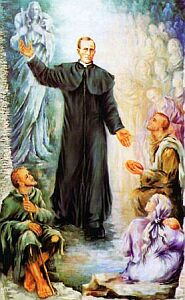
St. Jerome Emiliani

Saint Jerome Emiliani, Patron of the Orphans, by Flavia Ghelardi, photo by the Somascan Brothers in Brazil

Optional Memorial (1969 Calendar): February 8
Double (1955 Calendar): July 20

St. Jerome Emiliani was born in Venice in 1486 to Angelo and Eleanor Mauroceni Emiliani. After his father's death, Jerome ran away from his home. He became a soldier in Venice and was captured on August 27, 1511, by Venetian forces. While imprisoned in a dungeon, he prayed to Our Lady for help and was miraculously freed by her apparition. St. Jerome hung his chains on a church wall as an offering. He converted to Christianity after his dissolute youth.

St. Jerome Emiliani lived the rest of his life dedicated to serving the poor, the sick, and abandoned children. In 1518, he was ordained as a priest. In 1532 he founded a congregation (Somaschi) that was dedicated to educating children, especially orphans. St. Jerome Emiliani founded six orphanages, a shelter for penitent prostitutes, and a hospital. He died in 1537 of the plague while serving the afflicted. Later, in 1928 Pope Pius XI named him the universal patron of orphans and abandoned children.

Traditional Matins Reading:

Jerome was born at Venice, of the patrician family of the Æmiliani, and from his boyhood embraced a military life. At a time when the Republic was in great difficulty, he was placed in command of Castelnovo, in the territory of Quero, in the mountains of Treviso. The fortress was taken by the enemy, and Jerome was thrown, bound hand and foot, into a horrible dungeon. When he found himself thus destitute of all human aid, he prayed most earnestly to the Blessed Virgin, who mercifully came to his assistance. She loosed his bonds, and led him safely through the midst of his enemies, who had possession of every road, till he was within sight of Treviso. He entered the town; and, in testimony of the favour he had received, he hung up at the altar of our Lady, to whose service he had vowed himself, the manacles, shackles, and chains which he had brought with him. On his return to Venice he gave himself with the utmost zeal to exercises of piety. His charity towards the poor was wonderful; but he was particularly moved to pity for the orphan children who wandered poor and dirty about the town; he received them into houses which he hired, where he fed them at his own expense and trained them to lead Christian lives. 

At this time Blessed Cajetan and Peter Caraffa, who was afterwards Paul IV, disembarked at Venice. They commended Jerome’s spirit and his new institution for gathering orphans together. They also introduced him into the hospital for incurables, where he would be able to devote himself with equal charity to the education of orphans and to the service of the sick. Soon, at their suggestion, he crossed over to the continent and founded orphanages, first at Brescia, then at Bergamo and Como. At Bergamo his zeal was specially prolific, for there, besides two orphanages, one for boys and one for girls, he opened a house, an unprecedented thing in those parts, for the reception of fallen women who had been converted. Finally he took up his abode at Somascha, a small village in the territory of Bergamo, near to the Venetian border, and this he made his headquarters; here, too, he definitely established his congregation, which for this reason received the name of Somaschan. In course of time it spread and increased, and for the greater benefit of the Christian republic it undertook, besides the ruling and guiding of orphans and the taking care of sacred buildings, the education, both liberal and moral, of young men in colleges, academies, and seminaries. Pius V enrolled it among religious Orders, and other Roman Pontiffs have honoured it with privileges.

Entirely devoted to his work of rescuing orphans, Jerome journeyed to Milan and Pavia, and in both cities he collected numbers of children and provided them, through the assistance given him by noble personages, with a home, food, clothing, and education. He returned to Somascha, and, making himself all to all, he refused no labour which he saw might turn to the good of his neighbour. He associated himself with the peasants scattered over the fields, and while helping them with their work of harvesting, he would explain to them the mysteries of faith. He used to take care of children with the greatest patience, even going so far as to cleanse their heads, and he dressed the corrupt wounds of the village folk with such success that it was thought he had received the gift of healing. On the mountain which overhangs Somascha he found a cave in which he hid himself, and there scourging himself, spending whole days fasting, passing the greater part of the night in prayer, and snatching only a short sleep on the bare rock, he expiated his own sins and those of others. In the interior of this grotto, water trickles from the dry rock, obtained, as constant tradition says, by the prayers of the servant of God. It still flows, even to the present day, and being taken into different countries, it often gives health to the sick. At length, when a contagious distemper was spreading over the whole valley, and he was serving the sick and carrying the dead to the grave on his own shoulders, he caught the infection, and died at the age of fifty-six. His precious death, which he had foretold a short time before, occurred in the year 1537. He was illustrious both in life and death for many miracles. Benedict XIV enrolled him among the Blessed, and Clement XIII solemnly inscribed his name on the catalogue of the Saints.

Prayer:

O God, the Father of mercies, grant, that by the merits and intercession of blessed Jerome, whom Thou wast pleased to make a helper and father of orphans, we may faithfully keep the spirit of adoption whereby we are Thy sons both in name and in deed. Through our Lord.

Prayer Source: 1962 Roman Catholic Daily Missal
Read more >>
Monday, September 26, 2005
Saints


General Info:
Recommended Meditation on the Catholic Liturgical Year:
Those in the Process for Beatification:
Questions:
Blesseds (Not a complete list):
Saints (Not a complete list):
Read more >>
Wednesday, September 7, 2005
Catholic Feast Days


Introduction:

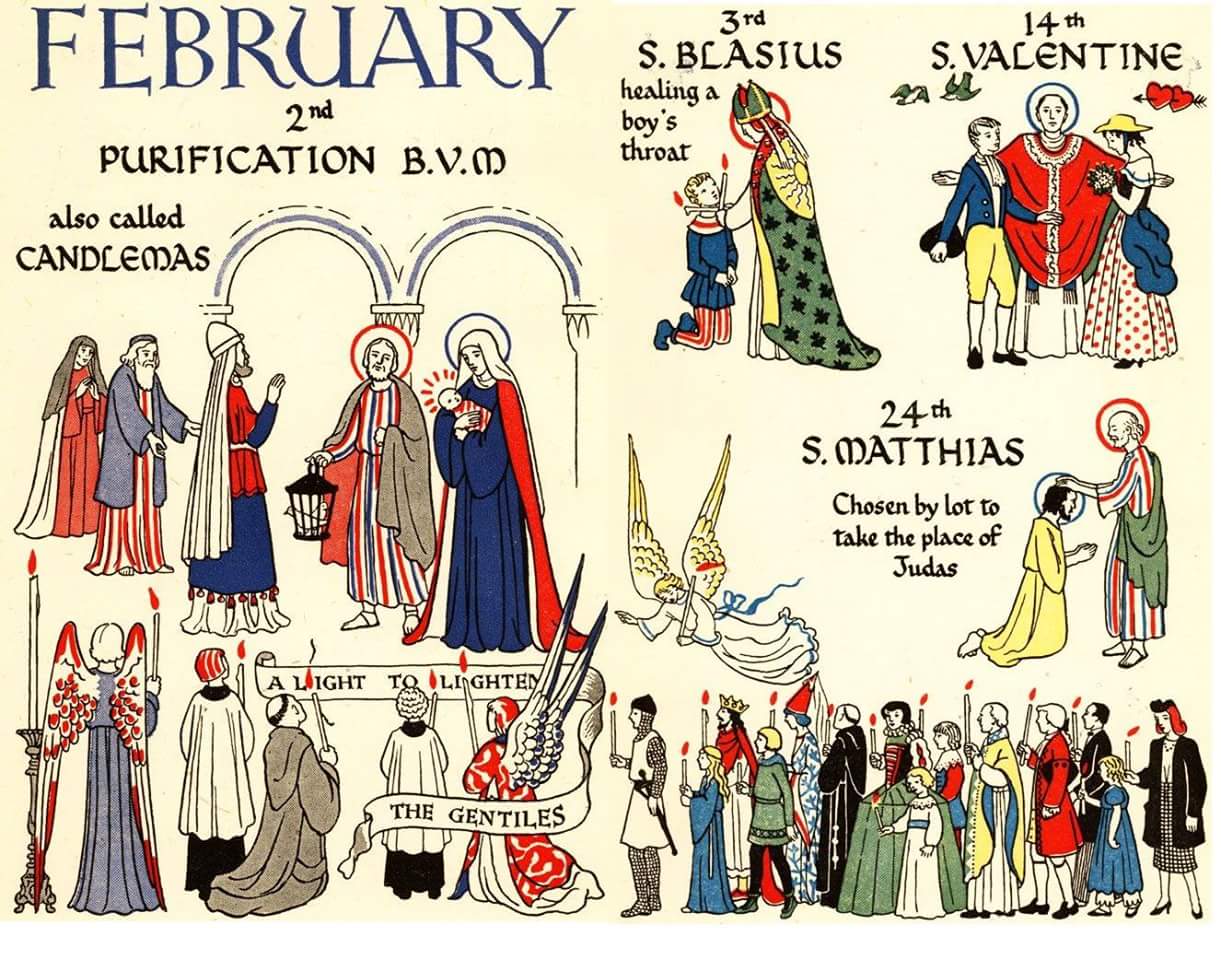
Catholic Feastdays are days set aside to remember important people and events through the course of the Faith from the time of Mary's birth all the way through today honoring the saints. The calendar of saints has been changed throughout Church history to remove some saints in order that others may be celebrated too. One of these changes occurred in 1969, which greatly altered (arguably in a very bad way), the calendar.

Today, some Traditional Catholics like to follow the pre-1955 Calendar, some prefer the 1955 Calendar, and some prefer the 1962 Calendar.  These three calendars are very similar. The exceptions are noted below

The following calendar lists the General Roman Catholic Calendar.  Many saints are not on the General Calendar and some are only on specific calendars of specific orders or for specific areas of the world.  Yet, all saints have a feast day in the year, even if it is not universally celebrated on the General Calendar.

Temporal vs. Sanctoral Cycle:

This page concerns the Proper of Saints, called the Sanctoral Cycle, which is the annual cycle of feasts not necessarily connected with the seasons. We commemorate and ask the intercession of those holy men and women who set a marvelous example that we should all strive to imitate. We also commemorate various events and mysteries of the faith in the Sanctoral Cycle.

There is also the Proper of Seasons, called the Temporal Cycle, traces the earthly life of Our Lord Jesus Christ. It consists mainly of Sundays related to the various liturgical seasons. This maps onto the 7 liturgical seasons contained in the two cycles we previously discussed: the Christmas Cycle and the Easter Cycle. It starts with Advent then goes through Christmas, Epiphany, Septuagesima, Lent, Easter, and Time after Pentecost. For that reason, when you go to Mass on Sundays you likely will not hear the readings for the saints mentioned here. You should refer to the Traditional Sunday Propers for the Sunday readings since in most cases, the temporal cycle takes precedence over the Sanctoral Cycle.

Recommended Volumes of Meditation on the Catholic Liturgical Year:

The Liturgical Year (15 Volume Set) by Father Dom Gueranger (A MUST READ!)

Pre-1954 vs 1962 Calendar:

The following list by month indicates the Liturgical Year according to the General Roman Catholic Calendar as of 1954.  In 1954, Pope Pius XII instituted the feast of the Blessed Virgin Mary, Queen on May 31, and to make room for it, he moved the feast of St. Angela Merici to June 1. That was the final change before significant changes occurred in 1955. Besides the drastic changes and alterations to the Holy Week Liturgies in 1955 as part of the temporal cycle, there were a few other noteworthy changes. With the advent of the 1955 Calendar, Pope Pius XII instituted the feast of "St. Joseph the Worker" on May 1 (moving the feast of "Saints Philip and James" from May 1, where it had been since the sixth century, to May 11th, and suppressing the Patronage of St. Joseph that, since Pope Pius IX's decree of September 10, 1847, had been celebrated on the second Wednesday after the Octave of Easter).  

Additional changes that occurred in 1960 under John XXIII include the removal of most saints who were on the calendar twice. For instance, the Feast of the Finding of the Holy Cross, the 2nd feast of St. Agnes commemorating her apparition to her parents, and the Feast of St. John before the Latin Gate were all removed. These changes were incorporated in the 1962 Missal, however, a priest may still choose to offer a votive Mass for those saints on those traditional feastdays.

Some of the Movable Feasts (Some are part of the Temporal Cycle but included here for easy reference):
Movable Masses in Some Places (Relating more to the temporal cycle but included here for easy reference):
Traditional Calendar (1954)

Differences related to different calendars are noted in italicsSome Masses that were only celebrated in certain places at this time and were not on the Universal Calendar are noted as "Mass in Some Places". In the Month of November, various locations or orders keep special feasts of their own saints. Those are noted as well.

 January:
** Feast of the Holy Name: Sunday between the Circumcision and Epiphany [or January 2, when no such Sunday occurs]

February
Note: In a leap year, the Vigil of St. Matthias is kept on February 24, and any Feasts usually occurring from February 24 through 28 are kept one day later.


March

April
Wednesday after the II Sunday after Easter: Solemnity of St. Joseph, C - Double of the I Class
Wednesday after the III Sunday after Easter: Octave Day of St. Joseph, C - Greater Double


May


June


July


August


September

October


November


December
Read more >>


Copyright Notice: Unless otherwise stated, all items are copyrighted under a Attribution-NonCommercial-NoDerivatives 4.0 International License. If you quote from this blog, cite a link to the post on this blog in your article.

Disclosure of Material Connection: Some of the links on this blog are “affiliate links.” This means if you click on the link and purchase the item, I will receive an affiliate commission. As an Amazon Associate, for instance, I earn a small commission from qualifying purchases made by those who click on the Amazon affiliate links included on this website. I am disclosing this in accordance with the Federal Trade Commission’s 16 CFR, Part 255: “Guides Concerning the Use of Endorsements and Testimonials in Advertising.”