Monday, March 12, 2012
1967 Letter from Father DePauw, President of the Catholic Traditionalist Movement, to Pope Paul VI on the Aftermath of the Crisis of Vatican II


Be Thou Peter!

Fr. Gommar A. DePauw, J.C.D,
President of the Catholic Traditionalist Movement

This letter was originally sent to Pope Paul VI as a private communication between a priest and the Supreme Pontiff who, two years earlier, had blessed and commissioned him as leader of the Catholic Traditionalist Movement (C.T.M.). ...

TIA reproduces here important excerpts of this letter, which was sent to Pope Paul VI on August 15, 1967, by Father Gommar A. DePauw, J.C.D, President of the Catholic Traditionalist Movement.  Father DePauw died on the morning of May 6, 2005.  His biography is available here.

The subtitles were added by TIA’s website desk

Your Holiness:

I still vividly remember that December 1, 1965 evening when Your Holiness personally blessed me and my work with the traditionalist Catholics who selected me to be their spokesman ….

I equally remember how Your Holiness literally begged me to urge the Catholics I was to lead in their fight for “TRUTH and TRADITION,” not to lose faith in the Church. And Your Holiness justified that request by stating: “Once the dust stirred up by the recent Ecumenical Council will have settled down, the Church will come out of all this with renewed strength and vigor.”

May I humbly submit that during this past year and a half I have labored as hard as any human individual could to do precisely what Your Holiness asked me to do: to keep the faith in our Church alive among those Catholics who had justifiedly become alarmed to the point of publicly asking themselves and others: “What, in the name of God, is happening to our Catholic Church?!” And may I add that one of the principal aspects of my efforts to keep that faith in our Church alive has consistently been the stressing of belief in the divine foundation of the Roman Papacy and respectful loyalty to its present incumbent, Your Holiness, Paul VI.

Already then, December 1, 1965, Your Holiness asked me to realize that our Church was going through “one of the gravest crises in her history.” If such a description of our Church’s condition was true then, how much more can the same be said of our Church today! To say that it has gone from bad to worse would be the understatement of the century.

Today's condition of the Catholic Church is beyond the point of doctrinal heresy, factual schism, and even apostasy. It is in a state of chaos and utter collapse resulting from the systematic destruction of first our liturgical and other traditions, and now our very beliefs and morals ….

In open violation of all past and present liturgical directives, the Roman Catholic Liturgy, once the envy of all other religions, has for all practical purposes been destroyed. And it gives us very little personal satisfaction to know that all those responsible for this destruction were in advance irrevocably anathematized by the still valid solemn decree of the Council of Trent: “If anyone says that the Mass ought to be celebrated in the vernacular only, let him be cursed.”(Canons of the Most Holy Sacrifice of the Mass, n. 9.)

Coercive changes have subrogated our traditional practices with the “litniks”of our Church Establishment daily intensifying their attempts to subjugate the “people of God” to becoming “Protestant” Catholics.

Our churches are no longer Catholic in appearance, atmosphere, or aim. Tables looking like butcher blocks or ironing boards have replaced our altars in perfect harmony with the 16th century Protestant Reformation directives bent on destroying the belief in the dogma of Transubstantiation and the sacrificial nature of the Mass and replacing it with a symbolical trans-signification-communal meal.

Our Holy Mass has disappeared an in its place our people are offered a holy mess of vernacularized vacuum stripped of the surety, serenity, uniformity, and dignity of our traditional Latin liturgy.

Hymns associated with the anti-Catholic rebellions of Luther, Calvin and Wesley have unceremoniously uprooted our cherished Catholic hymns to our God and the Blessed Mother, while our uniquely Catholic Gregorian and polyphonic music has been discarded for sounds and instruments sometimes borrowed from the decadent milieu of young human animals.

Communion rails are ripped out and Holy Communion is refused to the “people of God” unless they stand (not kneel) to receive Him at the mention of Whose name all knees should bend, if one is still to trust the text of the “unrevised” New Testament we were given at one time in our Catholic institutions.

The Most Blessed Sacrament, to be reserved in “the central place of honor” according to the legitimate liturgical directives, is relegated to an obscure shoe box-type niche, playing much less than second fiddle to the throne-type chair of the presiding clerical Buddha set up in dead center of a religious flavored discotheque-barn, from which the traditional statues and Stations of the Cross have been shipped to the nearest auction gallery or antiques shop.

A steadily increasing number of once unsuspecting Catholics are suddenly realizing that, as we predicted more than two years ago, they are gradually, first with subtle and then with increasing bold changes in the liturgy, being ushered into a humanistic rite of a universal brotherhood meal expressive of the existentialist pantheistic concepts of an illuminated “one-world-religion” preparing the way for a Communist controlled “one-world-government.”

The aggiornamento changed dogmatic and moral precepts

But, not only our liturgical traditions have been destroyed. The very beliefs and morals of our Catholic heritage are now up for grabs in our so-called “Church of the Aggiornamento.” Steadily, day in and day out since Vatican II, silt has subversively been shunted in to the minds of the Roman Catholics in America.

Our “Catholic” universities, seminaries, and colleges are bluntly rejecting the religious character that justifies their existence, and their teachers of the “new theology” are calling into question, if not outright rejecting, every tenet of our doctrinal heritage ….

Sunday after Sunday our traditional dogmas and moral precepts are denigrated with pseudo-modern preachments of Socialism or worse emanating from our pulpits occupied by “new breed” clergymen, whose pathological obsession with sex has brought them to the low point of not only advocating the end of clerical celibacy, but even of condoning Fornication, homosexuality, trial marriages, artificial birth control, divorce, and abortion.

Our Church Establishment's press and radio and television presentations are totally captured by the same heretical forces. And our once respected nuns not only have become nonentity “nones” with absurdity of demeanor and dress, but are sabotaging the religious instruction of our youngsters and children by replacing our traditional catechisms with brain-washing religion (?) books subtly poisoning the minds of our coming generations into gradual acceptance of first a unitarian, then a pantheistic, and finally an atheistic philosophy of life.

While some of our American Cardinals and Bishops are way in front of these apostatic hordes of religious rioters, the rest of our Hierarchy are burying their heads in the sand, rocking their consciences to sleep with the proverbial “Everything will be O.K.!” or trying to compensate for the trust and respect they no longer command among their own Catholic people by hob-nobbing with those outside-the-fold merely to produce nothing but a superficial inter-faith harmony built on the swift sand of doctrinal compromise and false hopes.

Your Holiness, we traditionalist Catholics see the evil visibly extant and reject any portion of that evil!

Rejection of the Conciliar Church

Your Holiness …. taking a closer look at the “Conciliar” church forced upon us in the name of Vatican II, and simply judging the tree by its fruits, we are tempted to agree with one of your own immediate collaborators in Rome who has been quoted as characterizing the recent Vatican Council as “a sinister farce acted out by a number of good-for-nothings, some of whom, despite the gold crosses on their chests, don't even believe in the Holy Trinity or the Virgin.”

Your Holiness, we were, we are, and we intend to remain members of the CATHOLIC Church, and we refuse to become absorbed into any new CONCILIAR church! WE CONDEMN AND REJECT THE CONCILIAR CHURCH!

In spite of all the gigantic and expensive promotional techniques used to “sell” it, the “Conciliar” church fails to fascinate the public, and refuses to spiritually refresh the individual. Instead it is repugnant to the point of rejection so tragically evident in the all-time low of our conversion rate and religious vocations, and the pathetic trek of our most loyal and devout Catholics transferring the almost snuffed out candle of traditional Catholic beliefs and practices from our desecrated churches to the underground sanctuary of their hearts and homes.

Responsibility of Paul VI

Your Holiness, if no IMMEDIATE ACTION is taken by YOU, the public reality of the Catholic religion will phase out very soon. Already the memory of a “real” Mass is fading away from the minds of our younger generation, while their elders are growing indifferent or bitter over a Church which, if all her former beliefs and practices were so irrelevant as to be replaced so quickly and drastically, they prefer to forget as the biggest hoax ever on record.

Your Holiness, take one last, hard look at the dying embers of your Church and ours! And decide, bluntly and honestly, whether you wish to be a POPE, Vicar of Jesus Christ, Supreme Pontiff of the one true Church, or to perpetuate your current image of the BISHOP of Rome, the first among equals, with a place of HONOR but without authority within the ranks of a so-called “college” of Bishops …..

We of the C.T.M. still refuse to join the increasing number of Catholics all over the world who accuse you of being part of the team out to destroy the Church we once knew, and of being less interested in remaining the Supreme Pontiff of Christ's one true Church than in becoming the Chief-Chaplain of a new one-world religion in the service of a one-world government.

We of the C.T.M. still have pent up in the reserve of our hearts the enthusiastic loyalty we, traditionalist Catholics, exclusively set apart for our Supreme Pontiff. And we would like nothing better than to forget the past four years and shower our loyalty on a Paul VI turned into a new Saint Pius X who had the courage to face the reality of enemies within our own ranks and the integrity to condemn them. The first four years of your pontificate, Your Holiness, have been disappointing to the most loyal of your sons and daughters. But, late as it is, you still have the opportunity to once more be capable instead of culpable.

Practical suggestions

May we, the traditionalist Catholics whose unworthy spokesman I am, help Your Holiness out of the impasse your enemies cornered you into, by humbly submitting to you the following requests:

Vatican II must be annulled.

Publicly announce via all available international public media that you are again exercising the prerogatives of the Supreme Pontiff of Christ's One True Church, and that the interregnum of Vatican II is over ….

[The Vatican II turned out to be a horrible mistake.] Maybe it was precisely the fear of this horrendous possibility that caused the Holy Ghost to have Pope John declare from the very start that Vatican II, unlike all previous Ecumenical Councils, was not a DOCTRINAL Council but simply a PASTORAL one, thus leaving the door open for any future Pope to eradicate it from the records.

Your Holiness, when honest people commit a blunder they admit it and try to undo it as quickly as possible. Vatican II has so far produced nothing but confusion and disunity among the people of God's Church. It takes humility and courage to admit that even a Pope, outside the realm of his infallible ex cathedra definitions, can commit a blunder. But it is this kind of humility that endears a truly great leader to his subjects. Even so, you know better than all of us together that to lose face is nothing compared to losing souls.

Rescind that falsely interpreted and abused “Collegiality” decree IMMEDIATELY and PERMANENTLY. The burden of the Papacy cannot be shared and was never intended to be. To Peter and to him alone were given the keys of the Kingdom. Peter and Peter ALONE was appointed to strengthen the faith of “his brethren,” the first bishops who governed the primitive Church not just WITH but UNDER Peter. Stop wearing that Bishop's mitre and place the papal tiara back on your anointed head where it was placed the day you accepted to serve as Christ's Vicar and Supreme Pontiff. You accepted the job; you have tasted the privileges – now, taste the responsibilities; they are the two sides of the same coin. Give us another opportunity to let the world know once again that: “HABEMUS PAPAM!” We have a Pope!

Stop accepting decisions made by your alleged “advisors.” Stand on your own two feet! These advisors have led you and the Church into the abyss of their anti-Christ activity. They have forced you into a world position of being apparently at ease in such impossible situations as your praying at the pantheistic monstrosity of the United Nations’ “meditation room,” your denying to the favorite visionary child of Fatima the favor granted to publicly known, unrepentant examples of degraded womanhood, your hobnobbing and exchanging symbols of religious authority with leaders of what still are heretical or schismatic sects, and above all, your lending respectability to the leaders of international Communism, which is still out to destroy our Church and all other religious bodies for that matter.

Stop listening to the politically attuned and diabolical-oriented “advisors” who have infiltrated the highest echelons of our Church, exactly as Our Lady foretold in her last message of Fatima which has been unjustifiedly withheld from our Catholic people for seven years now ….

Listen instead to the genuine Roman Catholic, the traditionalist “man and woman in the pew” who want their Pope to act like a Pope; the same Catholic who continues to kneel when receiving his living God in Holy Communion; who still prays the Rosary to his Mother in Heaven; who still genuflects at the words “And the Word was made flesh by the Holy Ghost of the Virgin Mary: and was made man”; who still reads the Last Gospel of St. John in his or her worn-out missal; who still says the Leonine prayers after Mass for the conversion of Russia; who still abstains from meat on Fridays; who still goes to church on Sundays instead of Saturdays; in one word, the traditionalist Catholics who refuse to turn their backs on the Son of God for any son of man, despite the red or purple he proudly preens ….

Your Holiness! In the name of Jesus Christ, your and our Lord and Saviour, have the courage to disperse the false shepherds and listen to your own conscience! Prove once again to friend and foe alike that the gates of Hell did indeed not prevail. Stir the embers of a dying Church and, with gallant despair, make her once more a House of Refuge in lieu of a house of refuse. Bind instead of grind the gnawing wounds of Christ's Mystical Body ….

Your Holiness! If we do not receive a satisfactory answer from Your Holiness or at least are given an opportunity to discuss our requests and proposals with Your Holiness personally - within the next month, we shall consider our requests denied and our proposals rejected, and draw the sad and tragic conclusion that Our Mother the Church has temporarily abandoned the best ones of her children.

I pray to God and to His blessed Mother whose Assumption we commemorate today – and millions all over the world are joining me in this prayer – that such a dark and tragic day will never come. But, if we have no other choice, we will jealously protect the small but still burning candle of our traditional Catholic Faith, and patiently carry on our spiritual “Resistance” movement without the hoped-for papal approval ….

Holy Father! Do no reject the best and most loyal ones of your sons and daughters! But, even if Paul VI would close his soul and heart to us – Quod Deus avertat! – we will not reject the Papacy!

Abandoned by you, we would sorrowfully pray and wait for the day a new successor of St. Peter would open his arms again to those of his children whose only crime it was to live up to the admonition of your patron saint: “Even if an angel from Heaven should preach a gospel to you other than that which we have preached to you, let him be cursed.” (Gal 1: 8), or of those other early Church leaders who taught us: “We ought to obey God rather than men.” (Acts 5: 29) ….

Prayerfully expecting Your Holiness' fatherly reply to this final anguished cry of today's “Suffering Church,” I beg to remain.

Your loyal and devoted son in Jesus Christ,

Fr. Gommar A. DePauw
Read more >>
The Ministry (Order) of the Lector

History of Lector


The Order of the Lector has been around since ancient times and this has served as an important function since the time of the Early Christians.  As explained in the Catholic Encyclopedia:
A lector (reader) in the West is a clerk having the second of the four minor orders. In all Eastern Churches also, readers are ordained to a minor order preparatory to the diaconate. The primary reason for a special class of readers was the need of some persons sufficiently educated to be able to read the books in church, for the Christians continued the Jewish practice of reading the Sacred Books publicly. The first mention of a Christian liturgical reader is by Justin Martyr (d. about 165) in I Apol., lxvii, 3, 4. 
For centuries the Order of Lector was a minor Order, an office to which a man on the path to ordination to the priesthood was ordained.  In the Traditional Roman Rite, it is the second minor order (Ostiarius, Lector, Exorcista, Acolythus).

In this image, we can see the dignity in which the Traditional Order of Lector is conferred.

The seminarian upon receiving the Order of Lector would hear: "May you believe with all you heart and accomplish in your actions that which your lips read... As you stand erect to read, you ought also to give good example and practice a height degree of virtue than those who listen to you."

The duty of the lector is (and was) to chant the Epistle when Mass is sung without a deacon and subdeacon.  This of course can only take place in the context of the Traditional Latin Mass.

Now enter the Novus Ordo and the unprecedented changes to the Sacraments.

In 1972, Pope Paul VI drastically altered the Minor Orders, essentially wiping them away and destroying much of the tradition of the Church.  Indeed, one may attribute to this action the very words from Paul VI, "...the smoke of satan has entered the Church."  Pope Paul VI’s motu proprio Ministeria Quaedam (1972) stated, "What up to now were called minor orders are henceforth to be called ministries."  He would also state that "their conferral will not be called ordination, but institution."

Why does this matter?

As explained in a scholarly article entitled Doubtfulness of New Catholic Ordination Rite, I wish to quote from one of the latter parts of the article: "The attack on the priesthood was also accomplished in ways that are practical and demonstrative. The conciliar revolution sought to make the priest a mere leader of the congregation, by bringing him down to the people’s level in various ways, including but not limited to:

A.) The use of lay Eucharistic ministers, to make this priestly role one that anyone can fulfill;  B.) The use of lay lectors for the same reason; C.) The practice of communion in the hand,to remove the distinction between the priest’s consecrated hands and the hands of laymen;  D.) The practice of general absolution, to eliminate the priest’s role as judge in the sacrament of  penance"

This does not even look like this belongs in a Catholic Church!

Women are now Lectors in the Novus Ordo!

Anyone that has attended a Novus Ordo Mass has likely seen women reading the readings for Mass, which is problematic enough for reasons above.  But now, in a direction violation of Sacred Teachings of the Church, the Synod of Bishops in 2008 went so far as to advise Pope Benedict XVI to allow women to receive the new "ministry" of Lector!  This is a stepping stone to having women-priests within the Novus Ordo Church. 

How long will Catholics continue to accept the Novus Ordo changes and regularly attend them, when in fact, they are subscribing to the Protestant practices of Luther, Kramer, and the other so-called Reformers.

My advice is relatively simple, find a Traditional Mass with priests ordained through a lineage of traditionally ordained bishops.  This is now the only way to be certain of a priest's proper and valid ordination.  What times we live in - how very troubling to the True Church and to our Lord.  Yet so many falsely follow along with neoprotestanism in the so-called name of "obedience" when in fact we must be obedient to the Commandments and teachings of God, as revealed throughout two millennia in His Church, rather than follow the whims and novelties of the New Church leaders.
Read more >>
Saturday, March 10, 2012
Whether St. Anselm’s Ontological Argument is Philosophically Sound?

This piece is written in the form of St. Thomas's Summa Theologica.  While I illustrate the problem with the Ontological Argument by St. Anselm, I do not disagree with his conclusion, namely the existence of Almighty God.  This is merely a philosophical exercise to illustrate that in the Catholic Life a Catholic must commit himself to philosophical study and discourse.

Whether St. Anselm’s Ontological Argument is Philosophically Sound?

Objection 1: It would seem that Anselm’s ontological argument is sound. Anselm was canonized in 1494 and given the distinction of Doctor of the Church in the 18th century. Therefore, since the Church only honors those individuals who promote orthodoxy and do not adhere to heresy, St. Anselm’s ontological argument must be considered by all Catholics as not only philosophically valid but also sound.

Objection 2: Unlike other substances, the Necessary Existent (i.e. God) has existence as its very essence. And, as such, existence must always be applied to God; it is impossible to imagine the Necessary Existent in a state of not existing. Therefore, Kant’s objection that existence is not a predicate is incorrect.


On the Contrary, Immanuel Kant states, “Time and labour therefore are lost on the famous ontological (Cartestian) proof of the existence of a Supreme Being from mere concepts; and a man might as well imagine that he could become richer in knowledge by mere ideas, as a merchant in capital, if, in order to improve his position, he were to add a few noughts to his cash account" (Beck 291).

I answer that, Anselm’s ontological argument for the existence of God is unsound in the first and third premises, which render the entirety of the argument unsound. Anselm’s argument utilizes a reduction-ad-absurdum approach, whereby Anselm affirms the fool’s claim that there is no God (cf. Psalms xiv. I). Assuming that the fool was correct, then God, that which nothing greater can be conceived, exists in understanding but not in reality. But, it is greater to exist in reality than to exist only in understanding. Therefore, God exists in reality. Anselm’s argument in a more enumerated form states the following:

1. God is that which nothing greater can be conceived
2. God exists in understanding (established in the Psalms)
3. It is greater to exist in reality than in understanding alone
4. If God does not exist in reality, then that which nothing greater can be conceived does not equal that which nothing greater can be conceived
5. Therefore, God exists in reality and not only in understanding

First, one must examine the notion that God is that which nothing greater can be conceived. While such a definition can be theologically orthodox, such a definition is not truly sufficient for the sake of Anselm’s argument. When a person attempts to conceive of this definition, it is impossible to deposit any sort of perceivable reality in his or her mind. No observable color, condition, or state is able to be deposited and as such, the one following the argument does not deposit any real substance in his or her mind.

Thomas Aquinas provides a sufficient objection to Anselm when he observes the distinction between the condition of being self-evident in itself and not to us and self-evident in itself and to us. Since Anselm argues that the existence of God can be known through reason alone and without any observation of the world, it seems that Anselm claims that the existence of God is self-evident in itself and to us. After all, he believes that through reason alone mankind can assent to God, and the existence of God is consequently self evident to all. Thomas argues, “If, therefore the essence of the predicate and subject be known to all, the proposition will be self-evident to all,” (I Q. 2, art. 1 responsio) yet, he further clarifies that if the predicate and subject are unknown to some then the proposition is not self-evident in itself and to us.

Furthermore, Aquinas observes the following observation in the proposition ‘God exists’: “Now because we do not know the essence of God, the proposition is not self-evident to us; but needs to be demonstrated by things that are more known to us…” (I Q. 2, art. 1 responsio).

Therefore, by Aquinas’ logic, Anselm’s argument is insufficient because the initial premise is above the ability of a human being to adequately consider and thereby actually deposit a reality in one’s mind. God’s existence is not self-evident to us, and Anselm’s argument based in large part on definition alone is not sufficient to convert a non-believer. However, in his most blatant rebuttal to Anselm’s definition of God, Thomas states, “Perhaps not everyone who hears this word ‘God’ understands it to signify something than which nothing greater can be thought, seeing that some have believed God to be a body” (I Q. 2, art. Ad 2) And, consequently, the soundness of Anselm’s first premise in the ontological argument is questionable.

Secondly, Anselm’s usage of a priori demonstration to arrive at the conclusion of God’s existence is lacking in comparison to a posteriori demonstration, thereby discrediting his argument. Similarly, according to Thomas, a thing may be demonstrated in one of two ways: through the causes (i.e. a priori) or through the effects (i.e. a posteriori). In particular, Thomas states, “When an effect is better known to us than its cause, from the effect we proceed to the knowledge of the cause” (I Q. 2, art. 2 responsio). And, as generally accepted among Christian philosophers, God’s ways transcend the ways of average human beings, making not only God but His ways beyond our reasoning.

Consequently, in respect to God, we understand the effects of God far better than the causes, and through the effects one is still able to comprehend the thing in question. Therefore, Anselm’s method of a priori demonstration is unbefitting since the effects of God are better known, which means that a posteriori demonstration of God’s existence is the superior form of demonstration in this matter. Thomas not only discusses the two ways of demonstration but also utilizes them in order to create several arguments from a posteriori demonstration (e.g. First Mover, First Cause, et cetera).

Anselm’s argument with its a priori approach, forces the observer to posit knowledge of the Christian God to arrive at the conclusion sought by Anselm. Because the argument does not take into account the effects of God’s actions, one is unable to ascertain – through the argument alone – the traits of God such as His generosity, humility, et cetera. Yet, through an examination of God’s observable presence in the world, one may better understand God while at the same time observing the effects of humility, generosity, et cetera, which must be reciprocally applied to God.

Anselm’s argument as a purely a priori approach does not allow observers to conclude anything about God or even to conclude of the Christian God’s existence. Thomas further states that more than “philosophical science built up by human reason” is necessary for mankind’s salvation; namely sacred doctrine is necessary (I Q. 1, art. 1 responsio). Yet, Anselm’s ontological argument does not profess doctrinal matters but seeks to use only a philosophical approach. Boethius later affirms that God alone has true intelligence while humans only possess reason (Boethius 198). And because of man’s limitations, he is unable to understand theological truths and even arrive at the conclusion of God’s actual existence through a priori demonstration alone.

Thirdly, the third premise of Anselm’s ontological argument is called into question by the advent of Immanuel Kant, who stated that existence is not a property. One is unable to talk about something without presupposing its existence. In this way, existence is not like a color, shape, or characteristic, which can be applied to existing things. Simply put, without presupposing a substance’s existence, one is unable to discuss the substance at all. In this way, Kant’s argument that existence is not a property is supported. And, if existence is not a property, it is no greater to exist in reality than to exist in understanding alone. Therefore, assuming the truth of Kant’s initial claim, existing in reality is not greater than existing in understanding alone. And, if Kant’s argument is proven sound, the third premise of Anselm’s argument will be undoubtedly unsound. If Anselm is unable to prove that existing in reality is greater than existing in understanding, then his argument is ultimately unable to reach the conclusion that God exists in reality.

In summation, due to the questionability of Anselm’s definition of God, the less-than-adequate usage of a priori demonstration, and the notion that existence is not a property, Anselm’s ontological argument is revealed to be unsound.

Reply to Objection 1: While the Church confers the distinction of sainthood and Doctor of the Church only on non-heretics, the reception of these distinctions does not imply that the Church endorses the soundness of each of the philosopher’s premises. Unsound premises neither bar an individual from honors bestowed by the Church nor establish the individual as a heretic.

Reply to Objection 2: Objectors need to revise their arguments to consider theories such as the Atomist Theory. According to the theory, everything necessary consists of atoms, which can be neither created nor destroyed. As a result, atoms are by definition eternal, since they possess “…the simultaneous and complete possession of infinite life” (Boethius 199). Atoms necessarily exist. Therefore, something other than God can be considered as necessarily existing. And, if all physical things are composed of atoms, all physical things are in some sense eternal. Therefore, the Necessary Existent is not a special exception to the general rule, as Objection 2 would advocate.

Works Cited
Read more >>
Friday, March 9, 2012
Confirmations by Bishop Fellay in Phoenix (February 2012)

The website of the Society recently posted these photos from Confirmations on the weekend of Septuagesima (February 5th).  I happened to arrive at Our Lady of Sorrows in Phoenix that evening and did see Bishop Fellay the next morning.

These photos are from the SSPX.  God bless those who have been confirmed and keep them in His grace!


Read more >>
Thursday, March 8, 2012
Happy Birthday, Your Excellency!

His Lordship Bishop Williamson is 72 years of age today.  May God grant him continued protection and grace in preaching the True Faith and conferring the life giving Sacraments.
Read more >>
Holy Week at the Shrine of Christ the King 2012

header


Holy Week April 1st-8th
Read more >>
St. Patrick Novena

Say once a day for 9 days, especially beginning on 8 March and ending on 16 March, the eve of the Feast of St. Patrick. Especially appropriate for those of Irish descent.

Blessed saint Patrick, glorious Apostle of Ireland, who didst become a friend and father to me for ages before my birth, hear my prayer and accept, for God, the sentiments of gratitude and veneration with which my heart is filled. Through thee I have inherited that faith which is dearer than life. I now make thee the representative of my thanks, and the mediator of my homage to Almighty God. 


Most holy Father and patron of my country, despise not my weakness; remember that the cries of little children were the sounds that rose, like a mysterious voice from heaven, and invited thee to come amongst us. Listen, then, to my humble supplication; may my prayer ascend to the throne of God, with the praises and blessings which shall ever sanctify thy name and thy memory. 

May my hope be animated by the patronage and intercession of our forefathers, who now enjoy eternal bliss and owe their salvation, under God, to thy courage and charity. Obtain for me grace to love God with my whole heart, to serve him with my whole strength, and to persevere in good purposes to the end, o faithful shepherd of the Irish flock, who wouldst have laid down a thousand lives to save one soul, take my soul, and the souls of my countrymen, under thy special care. 

Be a father to the Church of Ireland and her faithful people. Grant that all hearts may share the blessed fruits of that Gospel thou didst plant and water. Grant that, as our ancestors of old had learned, under thy guidance, to unite science with virtue, we too, may learn, under thy patronage, to consecrate all Christian duty to the glory of God. I commend to thee my native land, which was so dear to thee while on earth. Protect it still, and, above all, direct its chief pastors, particularly those who teach us. 

Give them grace to walk in thy footsteps, to nurture the flock with the word of life and the bread of salvation, and to lead the heirs of the Saints thou hast formed to the possession of that glory which they, with Thee, enjoy in the kingdom of the Blessed: through Christ Jesus, our Lord. Amen.

V. Pray for us, O glorious saint Patrick.
R. And obtain for us the intention of this Novena.
Read more >>
Wednesday, March 7, 2012
Audio Sermon on St. Thomas Aquinas


Today is the Feast of St. Thomas Aquinas, who is my Confirmation Patron as well as the patron of the University from which I earned my undergraduate degree.


Read more >>
Sunday, March 4, 2012
Marcel Lefebvre: An Example of Holiness


Archbishop Marcel Lefebvre, the one who would not offer "fruits of the earth and work of human hands" An outcast because he offered what Our Lord instructed. He would not co operate with the condemned doctrine of ecumenism, he wanted to preserve the priesthood, and hold fast to tradition, as Our Lord God demanded.

Perhaps no one else in the modern Church has been more calumniated and despised than His Excellency, for the reason that he "delivered that which [he] also received" (cf 1 Cor 15:3).  Michael Davies' "Apologia Pro Marcel" (available online) and "The Horn of the Unicorn" by Professor David Allen White each help illustrate an unbiased life of this man, who should be declared a saint of God.

I encourage all of you to read these two texts if you have been led to believe that Marcel Lefebvre was a "rebel", "excommunicated", or "disobedient." 
Read more >>
Saturday, March 3, 2012
Sale in Honor of Fulton J Sheen's Cause of Canonization Anniversary

This year marks the 10th anniversary of the opening of Archbishop Fulton J. Sheen's Cause of Canonization.  CatechismClass.com proudly include excerpts from Sheen's many literary masterpieces, including his Life of Christ, throughout its lessons.

We are all very pleased to celebrate this year the 10th Anniversary of the Opening of his cause.  Please join with us in praying for his canonization.
Heavenly Father, source of all holiness, You raise up within the Church in every age men and women who serve with heroic love and dedication.  You have blessed your Church through the life and ministry of Your faithful servant, Archbishop Fulton J. Sheen.  He has written and spoken well of Your Divine Son, Jesus Christ, and was a true instrument of the Holy Spirit in touching the hearts of countless people.
If it be according to Your Will, for the honor and glory of the Most Holy Trinity and for the salvation of souls, we ask You to move the Church to proclaim him a saint.  We ask this prayer through Jesus Christ, our Lord.  Amen
Imprimatur:
+Most Rev. Daniel R. Jenky, C.S.C.
Bishop of Peoria
In honor of the life of the Servant of God Fulton J. Sheen, CatechismClass.com is offering 30% off on its summary of Sheen's Life is Worth Living and their series on The Life of Christ 

Simply enter discount code SheenCause10 and receive 30% off either of these items.

This discount is available only in March!  Please act now. 
Read more >>
Friday, March 2, 2012
The Top Traditional Catholic Charities: Almsgiving for Traditional Catholics

"Let the charity of the brotherhood abide in you. And hospitality do not forget; for by this some, being not aware of it, have entertained angels" (Heb 13:1-2)

Our Lord Jesus commands us to give alms to the poor, but how are we in the current day able to give alms?  And while we should do so always, there is no better time than during Lent.

As one person writes to me, "In my city, dozens of people daily sit along the sidebar begging for money.  Yet, they likely are not poor.  Some of them are average people that don't want to work and would rather sit outside all day to collect others' pocket change.  Others are drug addicts and alcoholics who seek money to support their addictions.  Surely our Lord is not calling us to support these."

Then how can we give alms when even Catholic Charities and other organizations are no longer truly Catholic? After some investigation, I'm pleased to publish the following 13 Traditional Catholic Charities:

1. The Fatima Center

Dedicated to spreading the Traditional Catholic Faith and the message of Fatima, The Fatima Center was founded by Fr. Gruner and continues his mission of spreading the Faith through its website, social media presence, conferences, and missions. They are a tax-deductible organization worth supporting. Make an online donation.

2. SSPX Asian Missions and Orphanage

In 2009 the Society began the creation of an orphanage in Palayamkottai, India.  All donations to this project and any others for the Asian Missions are tax-deductible on US returns.  In addition to the orphanage, there are several other very worthwhile projects to donate to. Addresses on where to send donations are available here.

3. FSSP Columbian Foundation

The FSSP has a foundation in Colombia with the goal of building a school (and, if possible, eventually a seminary), that needs support. Situated in the municipality of Anolaima in the department of Cundinamarca, 44 miles northwest from the capital of Colombia, Bogotá, the house of Saint Martin de Porres was approved by the bishop of Girardot on 13th May 2006 and canonically erected by Father Devillers on June 29th, 2006 as a house of vocational discernment for candidates to the priesthood in Latin America and constitute therefore the first house of the Fraternity on this continent.

In addition to the vocational discernment, so important for the development and the life of the Church and the Fraternity, this one develops an apostolic activity (celebration of blessings, preaching, catechism, visiting the sick and the old, scoutism) but also educational and social with a project of creating a center for further education for the young people of the village who do not have the possibility to study further than high school, the offer of various courses at technical school level, and finally the creation of an arts school (music, dance, theater and painting) and the organization of a monthly cultural event. You can donate to their Mission work online.

4. Friends of Campos

Friends of Campos, Inc. is a US-based not-for-profit (501c3) that supports the social and educational projects of the Personal Apostolic Administration of Saint John Mary Vianney, most of which are located around the diocese of Campos dos Goytacazes in the state of Rio de Janeiro, Brazil.

The Personal Apostolic Administration of Saint John Mary Vianney also operates fifteen primary and secondary schools in eleven towns; eight monasteries and convents; three homes for the elderly; as well as centers for the care of needy young children and the mentally handicapped. It also regularly distributes baskets of staple foods to impoverished residents.

5. Traditional Catholic Schools

Let us not forget the many traditional Catholic schools operated by good Catholic priests and orders around the country.  All of these schools would certainly appreciate donations of any size. Besides donating dollars, some of these schools accept Box Tops for Education.  One school, in particular, is Queen of the Holy Rosary Academy in Missouri which accepts the box tops.

Look up traditional Catholic schools and if there is one in your area, see if they accept Box Tops. Box Tops in 2020 switched to an online app where you only need to scan your receipt. No clipping box tops anymore. It's never been easier to raise funds for Catholic schools now.

6. Institute of Christ the King African Missions

For some time now, the priests of the Institute have been present in Gabon and have worked with success under Bishop Obamba, and upon his retirement, under the apostolic administrator and current Archbishop of Libreville, the Most Reverend Mve Engone, as well as under the present bishop of the Diocese of Mouila, Bishop Dominique Bonnet.

Some of the Institute's missions are located in the middle of the jungle. They have, by Divine Providence, restored and constructed several churches, chapels, schools, kindergartens, and medical dispensaries. The native population is very attached to the missionaries, and they are deeply rooted in the beautiful tradition of the Classical Latin Mass.  You can make an online donation here to the African missions or any other apostolates.

7. Traditional Catholic Monasteries & Convents & Orders

If you have read "How the Catholic Church Built Western Civilization" by Thomas Woods, you will recall in chapter 3 how Dr. Woods relates the varied, countless achievements from monasticism.  Among them, we have not only the preservation of literacy and the priceless books of Antiquity but countless works of charity, the creation of champagne, the first wide-scale use of water power, the cultivation of agriculture, the clearing of immense areas of previously uninhabitable land, the creation of complex astronomical clocks, and dozens of other significant accomplishments.  We owe a deep debt to the monks for their work in building our society.

In our modern world, many orders have fallen into oblivion as they have abandoned Traditional Catholicism for heretical practices.  Thankfully, there are a number of orders that still observe the Traditional Practices of the Church.  They certainly need our prayers and could use any support that we could send them. You may find some of these orders by clicking here.


8. SSPX Medical Mission in the Philippines

The Medical Mission of the SSPX in the Philippines is certainly a worthy traditional Catholic charity.  It has done great work by reaching out to the poor who have no money to pay for basic medical treatment and who often possess little more than the rudiments of the faith. Everything from catechism to scapular distribution to dental care and minor operations takes place during each mission over the course of two weeks. Visit the website of Rosa Mystica Medical Mission to learn more and make a donation online.

9. SSPX African Missions

A personal favorite charity of mine is the SSPX's African Missions.  There is much that could be said about this mission. Donation information is available on the SSPX African Mission page, along with relevant articles from the missions.

10. Traditional Catholic Radio Stations

While there are very few traditional Catholic media sources, there are a few that provide traditional Catholic programming, chants, and prayers. And they all need your donations to help stay on the air.

11. Give Mass Stipends

Have Mass offered for reparation for your sins or those of your family or friends or have Mass said for the conversion of non-Catholics. You can also have a Mass offered in reparation for all sins and insults against the Blessed Sacrament; having Mass said for this intention gains one a plenary indulgence. To find Traditional Catholic priests or orders that accept online Mass requests, please click here.

12. Catholic Coffee Companies

Shop for your next coffee purchase from a Catholic organization, some of which are run by traditional Catholic monks, and help support them with your purchase. It's a very easy way to help them out. See 10 Catholic Coffee Alternatives to Starbucks.

13. Pro-life Catholic Causes

See my separate list of 12 Pro-life Catholic causes so that you help the work to defend life by Catholic organizations and not ones that are protestant and opposed to the Catholic Faith.

CONCLUSION

It is my hope that this compilation will aid you during this Lent and thereafter, in making donations to organizations that are truly Catholic and faithful to the enduring Traditions of the Church.  If you know of any more organizations, please leave them in the comments section.

Please share this post via Facebook and social media to help other Catholics this Lent in finding traditional organizations for almsgiving. Almsgiving is vitally important for Lent but it should be practiced all year.

Updated: August 17, 2024
Read more >>
Thursday, March 1, 2012
Catholic Cuisine: Babette's Feast (Movie Recommendation)


I'd like to give a shout-out to a newly discovered blog, Catholic Cuisine.  Naturally as someone concerned with living a Catholic life in tune with the Liturgical Year, I quickly found this blog to be a true gem worthy of bookmarking.  With recipes for everything from First Class feasts to Lenten ferias (and everything in between), I can see the great value in this blog.

This blog helps us create a Catholic ethos in our daily lives.  Meals are meant to be times of celebration and community while linked to the Catholic Liturgical Year.  Unlike the protestant view of meals of "having it your way," (which is personified in fast food), Catholic meals are concerned with order, balance, nutrition, and enriching of the spirit.  The order in table etiquette and manners and the symmetrical order in table setting all tend to the greater order and glory in the created world.

I'd like to recommend, on this same subject, the movie "Babette's Feast."  As Fisheaters explains in regards to the movie, "A sumptuous, visually rich movie that is, on the surface, about a French Catholic woman who flees to Denmark after her husband and son were killed. There, she works as a domestic for two aging Protestant sisters and ends up winning the lottery. Then, after fourteen years of cooking Danish foods in a Puritan style as the sisters instructed, she uses her winnings and skills to prepares a French feast for twelve (undoubtedly not a coincidental number) -- a meal that changes their lives.

"On a deeper level, the movie is about everything from sacrifice, the roads not taken, the mind-body connection, unrequited and uncosummated love, the contrast between the Protestant and Catholic views of the temporal world [especially on food]..."
Read more >>
Wednesday, February 29, 2012
Hold Fast to Strict Lenten Discipline

"The observance of Lent is the very badge of the Christian warfare. By it we prove ourselves not to be enemies of the cross of Christ. By it we avert the scourges of divine justice. By it we gain strength against the princes of darkness, for it shields us with heavenly help. Should mankind grow remiss in their observance of Lent, it would be a detriment to God's glory, a disgrace to the Catholic religion, and a danger to Christian souls. Neither can it be doubted that such negligence would become the source of misery to the world, of public calamity, and of private woe." - Pope Benedict XIV, 1741
Read more >>
Tuesday, February 28, 2012
Lenten Embertide Fast

Although Ember Days are no longer considered required in mainstream Roman Catholicism following Vatican II, they can - and should - still be observed by the Faithful. In fact, many Traditional priests encourage the Faithful to observe the days. Ember Days are set aside to pray and/or offer thanksgiving for a good harvest and God's blessings. If you are in good health, please at least fast during these three days and pray the additional prayers. Remember the words from the Gospel: "Unless you do penance, you shall likewise perish" (Luke 13:5)

Ember Days this Lent: February 29, March 2, March 3

From New Advent:

Ember days (corruption from Lat. Quatuor Tempora, four times) are the days at the beginning of the seasons ordered by the Church as days of fast and abstinence. They were definitely arranged and prescribed for the entire Church by Pope Gregory VII (1073-1085) for the Wednesday, Friday, and Saturday after 13 December (S. Lucia), after Ash Wednesday, after Whitsunday, and after 14 September (Exaltation of the Cross). The purpose of their introduction, besides the general one intended by all prayer and fasting, was to thank God for the gifts of nature, to teach men to make use of them in moderation, and to assist the needy. The immediate occasion was the practice of the heathens of Rome. The Romans were originally given to agriculture, and their native gods belonged to the same class.

At the beginning of the time for seeding and harvesting religious ceremonies were performed to implore the help of their deities: in June for a bountiful harvest, in September for a rich vintage, and in December for the seeding; hence their feriae sementivae, feriae messis, and feri vindimiales. The Church, when converting heathen nations, has always tried to sanctify any practices which could be utilized for a good purpose. At first the Church in Rome had fasts in June, September, and December; the exact days were not fixed but were announced by the priests. The "Liber Pontificalis" ascribes to Pope Callistus (217-222) a law ordering: the fast, but probably it is older. Leo the Great (440-461) considers it an Apostolic institution. When the fourth season was added cannot be ascertained, but Gelasius (492-496) speaks of all four. This pope also permitted the conferring of priesthood and deaconship on the Saturdays of ember week--these were formerly given only at Easter.

Before Gelasius the ember days were known only in Rome, but after his time their observance spread. They were brought into England by St. Augustine; into Gaul and Germany by the Carlovingians. Spain adopted them with the Roman Liturgy in the eleventh century. They were introduced by St. Charles Borromeo into Milan. The Eastern Church does not know them. The present Roman Missal, in the formulary for the Ember days, retains in part the old practice of lessons from Scripture in addition to the ordinary two: for the Wednesdays three, for the Saturdays six, and seven for the Saturday in December. Some of these lessons contain promises of a bountiful harvest for those that serve God.

From Catholic Culture:

Since man is both a spiritual and physical being, the Church provides for the needs of man in his everyday life. The Church's liturgy and feasts in many areas reflect the four seasons of the year (spring, summer, fall and winter). The months of August, September, October and November are part of the harvest season, and as Christians we recall God's constant protection over his people and give thanksgiving for the year's harvest.

The September Ember Days were particularly focused on the end of the harvest season and thanksgiving to God for the season. Ember Days were three days (Wednesday, Friday and Saturday) set aside by the Church for prayer, fasting and almsgiving at the beginning of each of the four seasons of the year. The ember days fell after December 13, the feast of St. Lucy (winter), after the First Sunday of Lent (spring), after Pentecost Sunday (summer), and after September 14 , the feast of the Exaltation of the Holy Cross (fall). These weeks are known as the quattor tempora, the "four seasons."

Since the late 5th century, the Ember Days were also the preferred dates for ordination of priests. So during these times the Church had a threefold focus: (1) sanctifying each new season by turning to God through prayer, fasting and almsgiving; (2) giving thanks to God for the various harvests of each season; and (3) praying for the newly ordained and for future vocations to the priesthood and religious life.
Read more >>
Monday, February 27, 2012
Each Feria of Lent has a Proper Mass


For those of you with Roman Catholic Daily Missals, you may have been surprised to see that each day of Lent has its own Mass propers - Introit, Collect, Scripture readings, Offertory, Communion, Post Communion, etc. Dom Guéranger explains.

From
The Liturgical Year
by Dom Guéranger, O.S.B.

Each feria of Lent has a proper Mass; whereas, in Advent, the Mass of the preceding Sunday is repeated during the week. This richness of the lenten liturgy is a powerful means for our entering into the Church's spirit, since she hereby brings before us, under so many forms, the sentiments suited to this holy time... All this will provide us with most solid instruction; and as the selections from the Bible, which are each day brought before us, are not only some of the finest of the sacred volume, but are, moreover, singularly appropriate to Lent, their attentive perusal will be productive of a twofold advantage.
Read more >>
HHS Mandate NOT About Religious Liberty

This was written in response to an article in the Chicago Tribune.  Since this op-ed piece was not published, I'm publishing it here.


In response to Mr. Rex Huppke’s Article, “Contraception Debate Neglects Catholics at odds with Doctrine,” (published February 19, 2012) I have to object to several points of the article. As a traditional Roman Catholic, I must first point out the error in Mr. Fogarty’s words when he says, “Jesus gets in trouble for…breaking a lot of the rules of the Jewish church.”

As one familiar with the Scriptures should recall, Christ did not violate the laws of the Jewish religion. However, for some Jewish leaders concerned with only the letter of the law – instead of the spirit of the law – the Lord appeared to be in violation. In truth, since Christ is God, one can know that it is philosophically impossible for God to violate His own laws. And secondly, for Catholics familiar with the Scriptures, Christ showed how His actions were not in violation of the Law but instead a reflection of the true meaning of the law.

On to the more serious issue at hand, Mr. Huppke writes, “At the heart of this argument are issues of religious liberty…” This is again not quite right. While many are making this an argument for religious liberty, the actual argument is far more important for Catholics. Those Catholics who observe the Traditional Catholic Faith simply reject the notion of religious liberty all together.

The Church teaches that Jesus Christ, the 2nd Person of the Blessed Trinity, is the King of all peoples, all places, and all time. For many people, this doctrine stops there. Yet, if Christ is indeed king of all, then all peoples and nations should act in conformity with His divine law, even if they are not Catholics. One need only see how the moral code of many societies (e.g. forbidding killing, stealing, prostitution, etc) is a reflection of the Divine Law which also forbids such practices. To say that any nation has the right to violate Divine Law is a violation of the doctrine of Christ’s Kingship.

If Christ is King (which all Catholics are bound as a matter of dogma to believe), then all Catholics must respond to the HHS controversy by not seeking to stand up for religious liberty. Rather, these same Catholics should be fighting against the HHS mandate for the reason that it offends God, who is our Supreme King, Redeemer, and our ultimate Judge.

In the words of Archbishop Marcel Lefebvre, "How many of these missionaries sent by the Church during the course of centuries have been massacred, massacred because they said that Our Lord Jesus Christ should be the King of people, King of society?"
Read more >>
Sunday, February 26, 2012
Stational Churches of Lent

Our modern observance of the stational liturgy traces its roots back to the practice of the Bishop of Rome celebrating the liturgies of the church year at various churches throughout the city, a tradition dating back as far as the late second or early third century. One reason for this was practical: with the church in Rome being composed of diverse groups from many cultures, regular visits by the bishop served to unify the various groups into a more cohesive whole. Another reason, particularly following the legalization of Christianity in A.D. 313 which permitted public worship, was to commemorate certain feast days at churches with a special link to that celebration. Therefore, Good Friday came to be celebrated at the Basilica of the Holy Cross in Jerusalem and Christmas at St. Mary Major, where a relic of the manger was venerated. In time, the original churches in the city, known as tituli (sing. titulus) because they often bore the name of the donor, took on an additional significance as the places that held the relics of the martyrs and the memory of the early history of the church in this city.1

As time passed the schedule of these visits, which had earlier followed an informal order, took on a more formalized structure. By the last half of the fifth century, a fairly fixed calendar was developed, having the order of the places at which the pope would say Mass with the church community on certain days throughout the year. In the weeks before the beginning of Lent, the three large basilicas outside the walls were visited, forming a ring of prayer around the city before the season of Lent began. During Lent, the various stations were originally organized so that the Masses were held in different areas of the city each day. During the octave of Easter the stations form a litany of the saints, beginning with St. Mary Major on Easter Sunday and continuing with St. Peter, St. Paul, St. Lawrence, the Apostles, and the martyrs.2

The liturgy of these Masses had several elements, many of which developed over time. According to the structure of the late first millennium, the people would gather in mid-afternoon with the pope at one church, known as the collectum. There, after some prayers, the group would move in procession to the statio, at which Mass would be said. The use of the term statio for this ending point has a connection with the practice of fasting on these days. The Christians of this time made a comparison of their fasting and prayer during Lent with the guard duty of soldiers, seeing their actions as something to be approached with a similar seriousness of purpose. The term statio came to be applied to the Eucharistic celebrations that took place on fast days. Later the term came to be used for all churches at which the major liturgical celebration in the city was to be held on a certain day.3

The order of the stations, originally organized in the fifth century, would undergo several changes over the following three centuries. The current order was essentially fixed by the time of the Council of Trent. Over the last several centuries, two of the original stations have been lost, although most older liturgical books still list their name as the station for their original day. The church of St. Augustine has taken the place of St. Tryphon, an older church which once stood on a nearby site. The second lost church is that of St. Cyriacus, which originally stood near the Baths of Diocletian. Having fallen into ruin, its stational day was transferred to Santa Maria in Via Lata, possibly because a monastery, also dedicated to St. Cyriacus, once stood behind this church. The other churches have not passed the centuries without their difficulties either: many have been destroyed and rebuilt; some fell into ruins, being saved only when on the verge of final collapse; all have been modified in various ways throughout the ages. Yet what remains through all the changes is the memory of those past Christians who worshiped at these places. While other cities, such as Jerusalem, Constantinople, and Milan once had similar stational liturgies, Rome is the only city in which these continue in some regular form. Therefore, just like the writings of the Fathers of the Church and the art of the early Christian era, the stational cycle comes down to us as a monument of the early church, a living connection to those days when the witness of the martyrs was still fresh and the echo of the apostles’ voices could still be heard in the city’s streets.
___________________
1Pp. 147-153
2 Pp. 153-158
3 Pp. 143-144; 161-162

Source: Pontifical North American College


Stational Churches:

Please join me in spiritually journeying to each of the Stational Churches this Lent.  Please bookmark this post and refer back to it.

Ash Wednesday
Thursday after Ash Wednesday
Friday after Ash Wednesday
Saturday after Ash Wednesday

First Sunday of Lent
Monday in the First Week of Lent
Tuesday in the First Week of Lent
Wednesday in the First Week of Lent
Thursday in the First Week of Lent
Friday in the First Week of Lent
Saturday in the First Week of Lent

Second Sunday of Lent
Monday in the Second Week of Lent
Tuesday in the Second Week of Lent
Wednesday in the Second Week of Lent
Thursday in the Second Week of Lent
Friday in the Second Week of Lent
Saturday in the Second Week of Lent

Third Sunday of Lent
Monday in the Third Week of Lent
Tuesday in the Third Week of Lent
Wednesday in the Third Week of Lent
Thursday in the Third Week of Lent
Friday in the Third Week of Lent
Saturday in the Third Week of Lent

Laetare Sunday
Monday in the Fourth Week of Lent
Tuesday in the Fourth Week of Lent
Wednesday in the Fourth Week of Lent
Thursday in the Fourth Week of Lent
Friday in the Fourth Week of Lent
Saturday in the Fourth Week of Lent

Passion Sunday
Monday in the Fifth Week of Lent
Tuesday in the Fifth Week of Lent
Wednesday in the Fifth Week of Lent
Thursday in the Fifth Week of Lent
Friday in the Fifth Week of Lent
Saturday in the Fifth Week of Lent

Palm Sunday
Monday in Holy Week
Tuesday in Holy Week
Wednesday in Holy Week
Read more >>
Saturday, February 25, 2012
Video: Interview with former Lutheran Pastor turned Catholic Priest


Some of you may have seen this inspiring interview with Fr. Sandmark. For those of you who have not seen it, it is of great consolation.

On July 30, 2006, Sten Sandmark, a Swedish Lutheran pastor, abjured Protestantism in the church of St. Nicolas in Parish. In the summer of 2010, he was ordained a Catholic priest and offered, for the first time, valid Sacraments. He is a priest of the Society of St. Pius X. He reflects in this video on his conversion, on how the Novus Ordo Church did not want converts, on traditional Catholicism, and on Lutherans.
Read more >>
Friday, February 24, 2012
Holy Communion in Lent: The Most Pleasing to God


From
The Liturgical Year
by Dom Guéranger, O.S.B.

Of all the works whereby a Christian can sanctify the time of Lent, there is none so pleasing to God as to assist at the holy sacrifice of the Mass, in which is offered the Victim of man’s salvation. But now that his own unworthiness is more than ever evident to him, ought he to abstain from partaking, by Holy Communion, of this life-giving and purifying Host? Such is not our Saviour’s will. He came down from heaven, not to judge, but to save us. He knows how long and rugged is the road we have to traverse, before we reach that happy day, on which we shall rest with Him, in the joy of His Resurrection. He has compassion on us; He fears lest we faint in the way; and He, therefore, offers us the divine food, which gives light and strength to our souls, and refreshes them in their toil. We feel that our hearts are not yet pure enough; let us then, with a humble and contrite heart, go to Him, who has come that He may restore to our souls their original beauty. Let us, at all times, remember the solemn injunction which this Saviour so graciously deigned to give us: “Except ye eat the Flesh of the Son of Man, ye shall not have life in you.”

If, therefore, sin has no longer dominion over us; if we have destroyed it by true sorrow and sincere confession, made efficacious by the absolution of God’s priest: let us not deprive ourselves of the Bread of life, no matter how great soever our infirmities may seem; for it is for us that our Jesus has prepared the feast. If we feel that the chains of sin are still upon us; if by self-examination made with the light of the truth that is now granted to us, we discover in our souls certain stains, which the false principles of the world and too easy a conscience have hitherto made us overlook; let us lose no time, let us make a good confession: and when we have made our peace with the God mercy, let us approach the holy Table, and receive the pledge of our reconciliation.

Yes, let us go to Holy Communion, during this season of Lent, with the most heart-felt conviction of our unworthiness. It may be that hitherto we have sometimes gone with too much familiarity, on account of our not sufficiently understanding our nothing ness, our misery, and the infinite holiness of the God who thus unites Himself with His sinful creatures. Henceforth, our heart shall be more truthful; blending together the two sentiments of humility and confidence, we will say, with an honest conviction, those words of the centurion of the Gospel, which the Church puts upon our lips, when she is distributing to us the Bread of life: “Lord, I am not worthy that Thou shouldest enter under my roof; say but the word, and my soul shall be healed.”
Read more >>
Thursday, February 23, 2012
St. Thomas Aquinas on Fasting

The Temptation of St. Thomas Aquinas

From the Summa Theologica (II, 2, Q 147, Art 1) of St. Thomas Aquinas writes the following words on Fasting.  Yesterday was Ash Wednesday and the start of the Great Fast.  Please join me in fasting for 40 days in observance of the traditional Lenten fast that took place for over a thousand years up until the Vatican Council in 1969.
Fasting is practiced for a threefold purpose:

First, in order to bridle the lusts of the flesh, wherefore the Apostle says (2 Corinthians 6:5-6): "In fasting, in chastity," since fasting is the guardian of chastity. For, according to Jerome, "Venus is cold when Ceres and Bacchus are not there," that is to say, lust is cooled by abstinence in meat and drink.

Secondly, we have recourse to fasting in order that the mind may arise more freely to the contemplation of heavenly things: hence it is related (Daniel 10) of Daniel that he received a revelation from God after fasting for three weeks.

Thirdly, in order to satisfy for sins: wherefore it is written (Joel 2:12): "Be converted to Me with all your heart, in fasting and in weeping and in mourning." The same is declared by Augustine in a sermon: "Fasting cleanses the soul, raises the mind, subjects one's flesh to the spirit, renders the heart contrite and humble, scatters the clouds of concupiscence, quenches the fire of lust, kindles the true light of chastity.

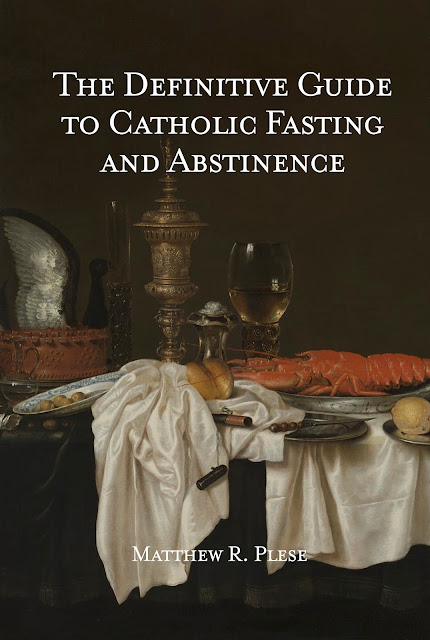
Want to learn more about the history of fasting and abstinence? Check out the Definitive Guide to Catholic Fasting and Abstinence. 

Read more >>
Wednesday, February 22, 2012
Everything Lent

Please bookmark this post and/or share it via email, Facebook, Twitter, etc using the links at the bottom of this post.  This post is a collection of all of my past posts for Lent.  This is meant to be a guide for you to find prayers, devotions, and liturgical information for this holy season.


Q: Why are the forty days called Lent?

A: They are called Lent because that is the Old English word for spring, the season of the year during which they fall. This is something unique to English. In almost all other languages, its name is a derivative of the Latin term, or 'the forty days.' Lent is a time in the Church year lasting forty days (excluding Sundays) from Ash Wednesday to Holy Thursday. It is a period of penance leading up to the joy of Easter.

Words to contemplate throughout Lent: "All things, even humiliation and death, help to save us."

General Lenten Information:

The Origin of Lent
The Purpose of Lent according to Monsignor Massimo Camisasca
Isaiah 53:4-6

Fasting & Abstinence:

Fasting and Abstinence Rules
History of Lenten Fasting: How to Observe the Traditional Lenten Fast
Abstinence from Meat and Animal Products on Sundays in Lent

Prayers:

Fat Tuesday Prayer
Ash Wednesday Prayer
General Lent Prayer
Prayer to Our Lord Jesus Crucified
Stational Churches for Each Day of Lent
Lenten Prayer I
Lenten Prayer II
Prayer before a Crucifix
Stations of the Cross
Prayer for the Grace of the Passion
Prayer in the Steps of the Passion
Lenten Prayer of St. Ephraim
Litany of the Passion

Traditional Mass Propers:

Good Friday

Ash Wednesday:

What is Ash Wednesday, and what are the rules of this day?
Ash Wednesday Prayer
Ash Wednesday Traditional Mass Propers

Holy Week General Information:

Top Ten Suggestions for Holy Week
Palm Sunday
Spy Wednesday - Wednesday before Holy Thursday
Why Do We Celebrate Holy Thursday?
Holy Thursday Plenary Indulgence
Good Friday
Good Friday Indulged Prayer to the Cross
Good Friday Reproaches (Popule Meus) 
The passion of Our Lord Jesus Christ According to St. John (in Gregorian Chant)
Holy Saturday Sermon

Quotations/Letters/Documents:

The Dolorous Passion of Our Lord Jesus Christ
St. Benedict's Words on Lent
St. Leo the Great's Words on Lent
St. Leo the Great's Words on Charity
Advice from the St. Andrew Daily Missal
Pope Benedict XIV (1714) on the Strictness of Lent
Homily For Passion Sunday by Bishop Antoine Godeau

Scripture:

Isaiah 53:11b-12
Read more >>
Ash Wednesday Traditional Mass Propers

Today's Mass embodies the spirit of Lent. All are reminded to be sorry for sin and to do penance, but not in a spirit of showy sadness or of inward despair. Rather, let the sincere and humble prepare with inner joy to celebrate their baptism in Christ. By living their baptismal promises, they enter more deeply into Christ's suffering. Knowing God's desire to forgive, to heal, and to share with all men His own divine life, we discipline our passions gladly and with confidence in victory. God gives the grace for every Lenten restraint. Therefore everyone should receive the blessed ashes, both as a means of grace and as a reminder to do penance unobtrusively, for personal sins and for the sins of all mankind.

Remember that today is a day of required fast and abstinence from meat.

Before the Mass, the celebrant vested in alb, purple stole, and cope, goes up to the altar for the blessing of the ashes.


THE DISTRIBUTION OF THE ASHES

The celebrant stands and receives ashes on his head; he then distributes them to the clergy and the congregation, who kneel before him. He admonishes each one as he places ashes on his head:

Remember, man, that you are dust, and into dust you shall return.

THE MASS

INTROIT
Sap. 11:24, 25, 27

You are merciful to all, O Lord, and hate none of the things that You have made. When men repent, You overlook their sins and pardon them; for You are the Lord our God. Ps. 56:2. Have pity on me, O God, have pity on me, for my soul trusts in You. V. Glory be . . .

COLLECT

O Lord, may the faithful begin the solemn season of fast with fitting piety, and may they continue through to its end with unwavering devotion. Through our Lord . . .

LESSON
Joel 2:12-19

Now, therefore, saith the Lord. Be converted to me with all your heart, in fasting, and in weeping, and mourning. And rend your hearts, and not your garments and turn to the Lord your God: for he is gracious and merciful, patient and rich in mercy, and ready to repent of the evil. Who knoweth but he will return, and forgive, and leave a blessing behind him, sacrifice and libation to the Lord your God? Blow the trumpet in Sion, sanctify a fast, call a solemn assembly, Gather together the people, sanctify the church, assemble the ancients, gather together the little ones, and them that suck at the breasts: let the bridegroom go forth from his bed, and the bride out of her bridal chamber. Between the porch and the altar the priests, the Lord's ministers, shall weep, and shall say: Spare, O Lord, spare thy people: and give not thy inheritance to reproach, that the heathens should rule over them. Why should they say among the nations: Where is their God? The Lord hath been zealous for his land, and hath spared his people. And the Lord answered, and said to his people: Behold I will send you corn, and wine, and oil, and you shall be filled with them: and I will no more make you a reproach among the nations.

GRADUAL
Ps. 56:2, 4

Have pity on me, O God, have pity on me, for my soul trusts in You. V. He has sent from heaven, and saved me; He has made them a reproach who trample upon me.

TRACT
Ps. 102:10; 78:8-9

O Lord, repay us not according to the sins we have committed, nor according to our iniquities. V. O Lord, remember not our iniquities of the past; let Your mercy come quickly to us, for we are being brought very low. (All Kneel.) V. Help us, O God our Savior, and for the glory of Your name, O Lord, deliver us; and pardon us our sins for Your name's sake.

GOSPEL
Matthew 6:16-21

At that time, Jesus said to His disciples, "And when you fast, be not as the hypocrites, sad. For they disfigure their faces, that they may appear unto men to fast. Amen I say to you, they have received their reward. But thou, when thou fastest anoint thy head, and wash thy face; That thou appear not to men to fast, but to thy Father who is in secret: and thy Father who seeth in secret, will repay thee.
"Lay not up to yourselves treasures on earth: where the rust, and moth consume, and where thieves break through, and steal. But lay up to yourselves treasures in heaven: where neither the rust nor moth doth consume, and where thieves do not break through, nor steal. For where thy treasure is, there is thy heart also."

OFFERTORY ANTIPHON
Ps. 29:2-3

I will extol You, O Lord, for You have upheld me, and have not let my enemies rejoice over me. O Lord, I cried out to You and You have healed me.

SECRET

O Lord, make us truly fit to offer these gifts with which we commemorate the institution of this blessed Sacrament. Through our Lord . . .

COMMUNION ANTIPHON
Ps. 1:2-3

He who meditates on the law of the Lord day and night shall bring forth his fruit in due season.

POSTCOMMUNION

O Lord, may this Sacrament which we have received make our fasting an acceptable offering to You and a healthful remedy to our souls. Through our Lord . . .

PRAYER OVER THE PEOPLE

O Lord, look with mercy upon those who worship before Your majesty. May Your heavenly aid always strengthen those who have feasted upon Your divine Sacrament. Through our Lord Jesus Christ, Your Son, who lives and rules with You in the unity of the Holy Spirit, one God forever and ever.
Read more >>


Copyright Notice: Unless otherwise stated, all items are copyrighted under a Attribution-NonCommercial-NoDerivatives 4.0 International License. If you quote from this blog, cite a link to the post on this blog in your article.

Disclosure of Material Connection: Some of the links on this blog are “affiliate links.” This means if you click on the link and purchase the item, I will receive an affiliate commission. As an Amazon Associate, for instance, I earn a small commission from qualifying purchases made by those who click on the Amazon affiliate links included on this website. I am disclosing this in accordance with the Federal Trade Commission’s 16 CFR, Part 255: “Guides Concerning the Use of Endorsements and Testimonials in Advertising.”